Opening
The rack and the till
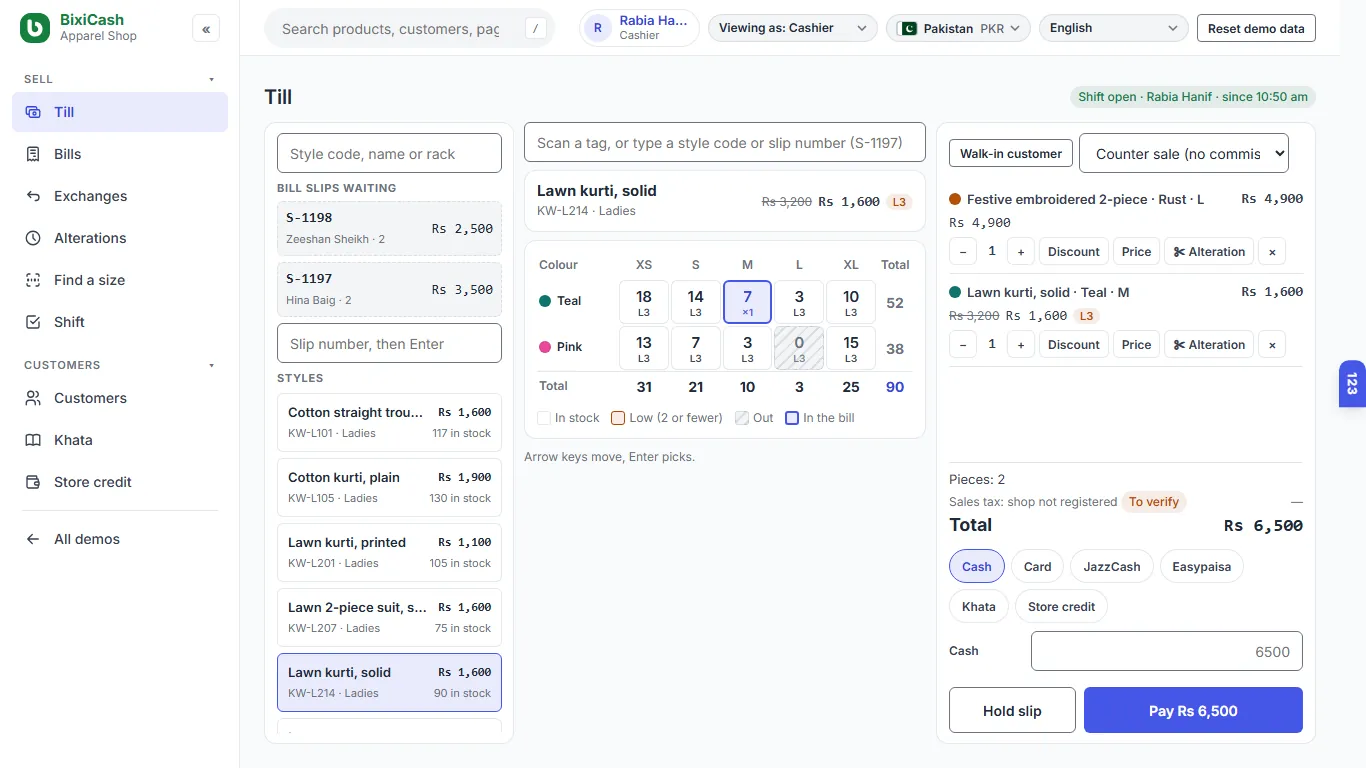
The cashier scans a tag or picks a style, and the size-and-colour grid shows what is left in every cell, with sold-out cells hatched. A struck-through tag price shows the markdown level.

Live demo Retail & Specialty
Built around a clothing boutique selling ladies', men's and kids' ready-to-wear. The till shows each style as a size-and-colour grid; an exchange is one document that nets to the paisa; a markdown pass never sells below cost; a reorder is worked out from the sizes that actually sold; and consigned pieces sell at the same till with the consignor's share held apart. Shown in our clothing boutique demo.
A working day
Opening
The cashier scans a tag or picks a style, and the size-and-colour grid shows what is left in every cell, with sold-out cells hatched. A struck-through tag price shows the markdown level.
A size swap
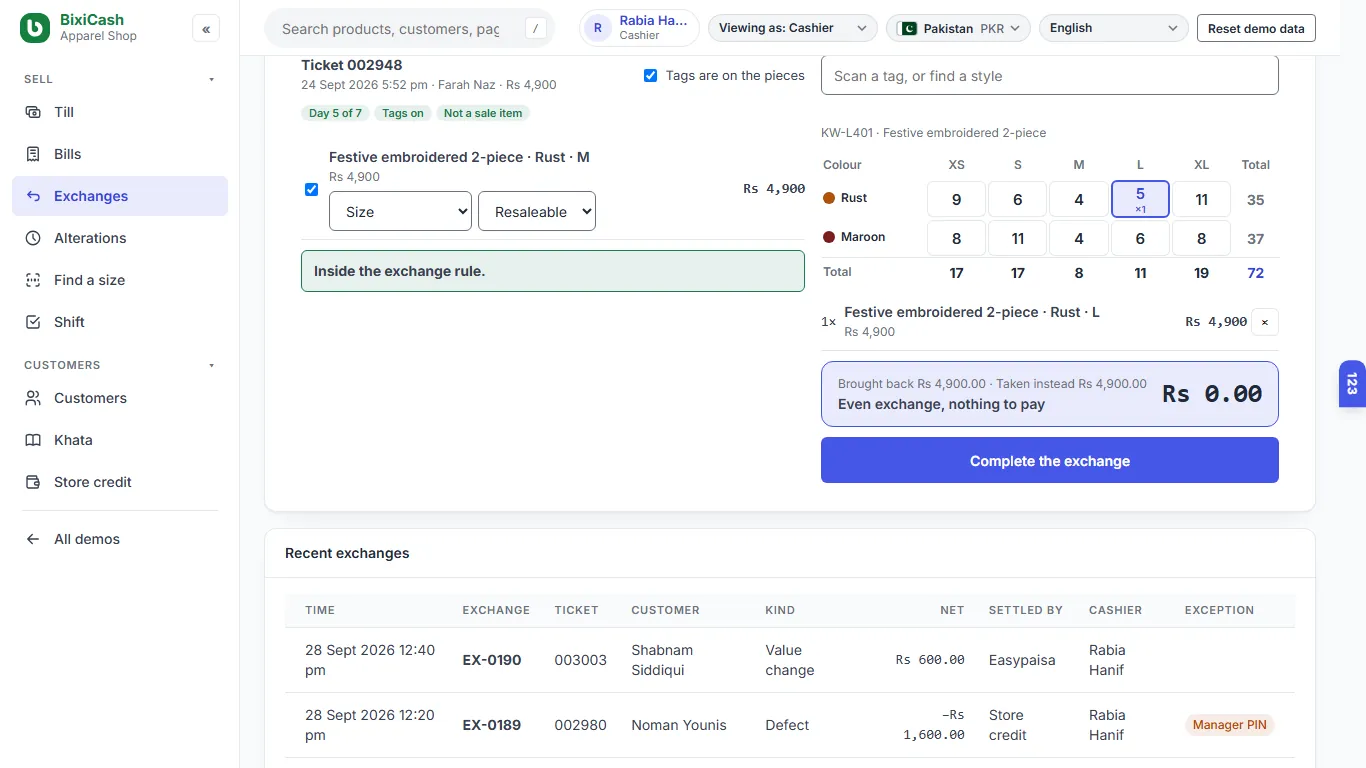
A customer brings back a piece on day 5 of 7. The receipt is scanned, the window and the sale status are checked and the cashier confirms the tags, and the swap nets to Rs 0.00 as one exchange document.
Outside the rule
A sale item or a late return is refused at the counter. A manager's PIN with a reason lets the exchange go ahead, for example as store credit, and the audit names both people.
A delivery arrives
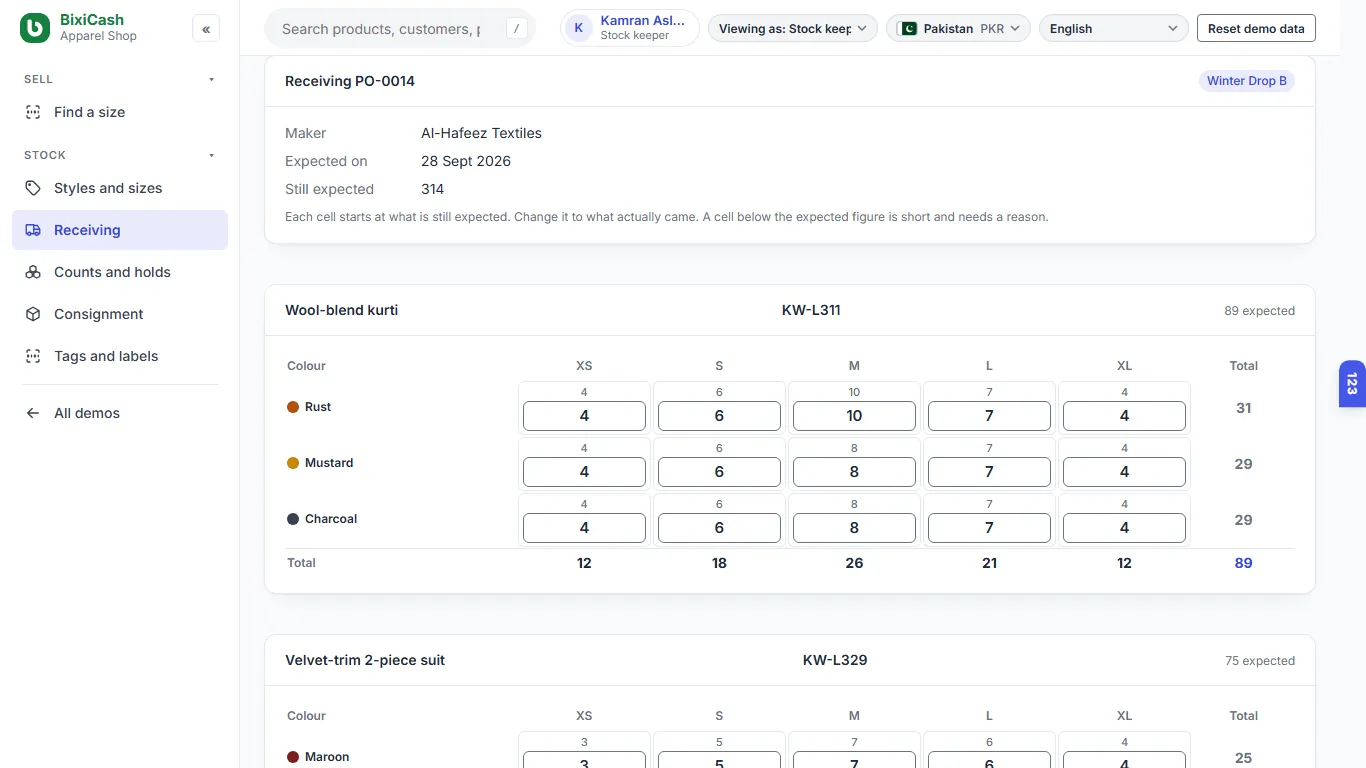
The stock keeper receives the order grid by grid, gives a reason for every short, and the freight is spread over the pieces into their cost.
Mid-season
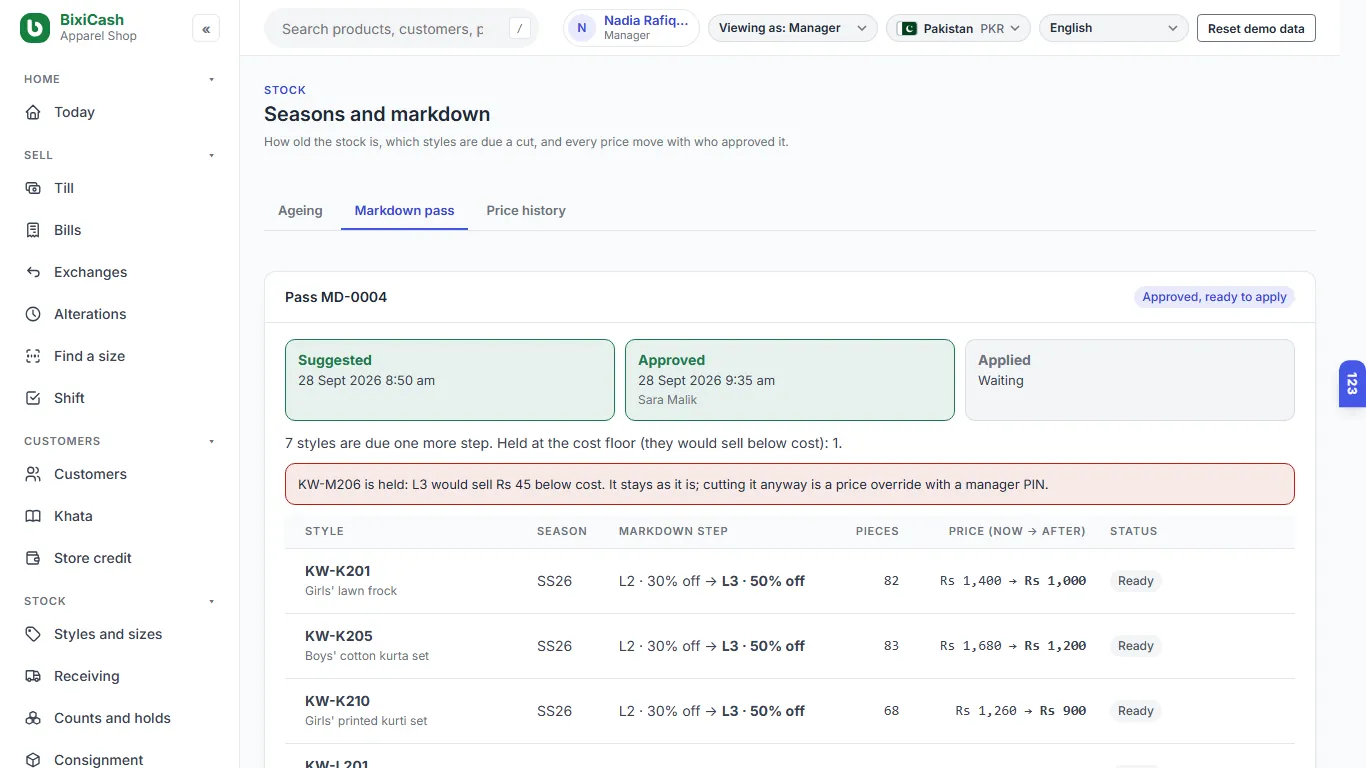
The owner approves a pass and the manager applies it. A style that would sell below cost is held back, and every price move records who approved it.
Evening
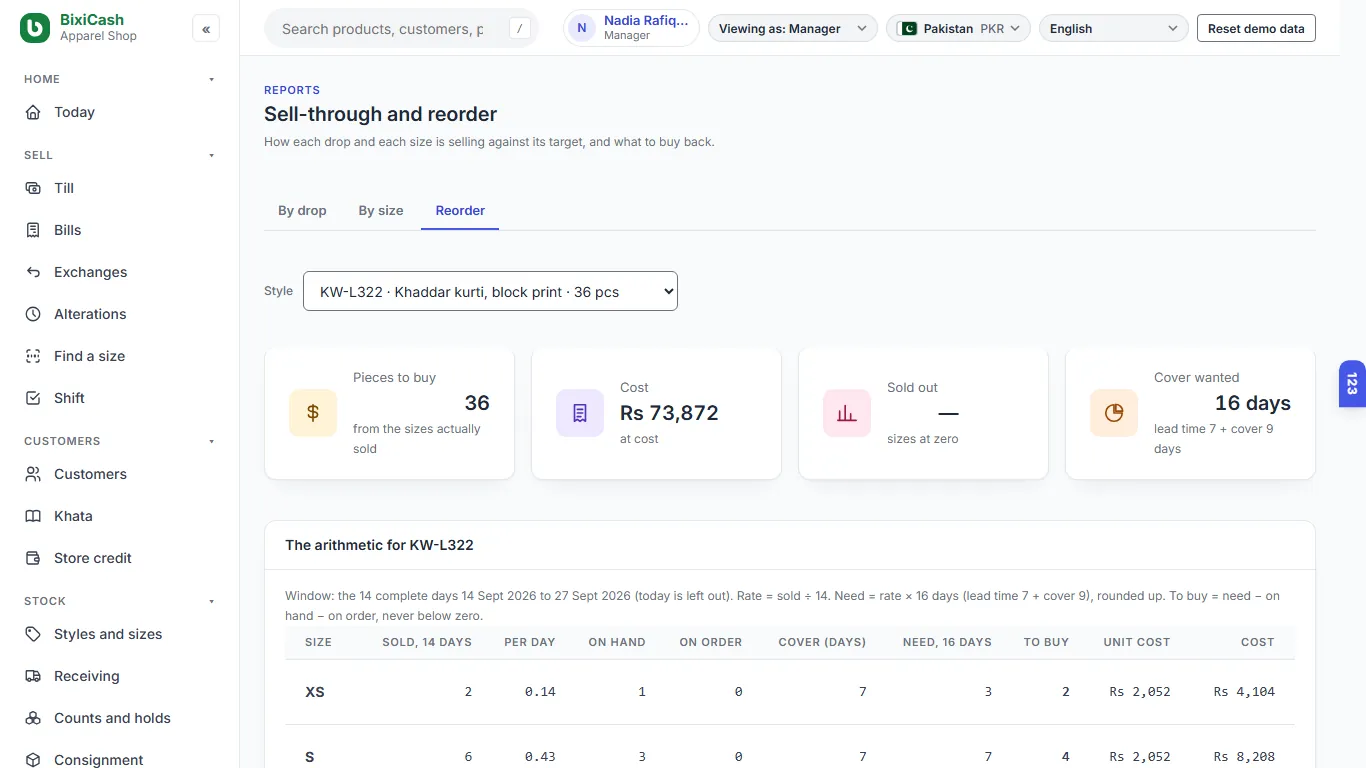
A reorder for a selling-out style is worked out from 14 days of sales by size, a 7-day lead time and the cover wanted, and drafted as an order for a person to send.
What goes wrong today
A popular style's middle sizes sell out while the extremes sit on the shelf.
A size swap handled as two disconnected transactions instead of one.
No easy way to see a style's colour nearly gone before a customer asks for it.
An end-of-season markdown that quietly drops a price below what the item cost.
What it does
Parts marked Coming soon are on the way; founding shops get them first, at no extra charge.
Shown in our clothing boutique demo: sizes across, colours down and a count in every cell. Sold-out cells are hatched and can't be picked, low cells are marked, and a scanned tag lands on the exact size and colour.
Shown in our demo: the receipt is scanned, the screen checks the day count and the sale status and the cashier confirms the tags are on, each piece gets a reason and a condition, the return is at the price paid and the replacement at today's price, and the swap is one exchange document.
Shown in our demo: outside the exchange rule the cashier is refused, and a manager's PIN with a reason lets the exchange go ahead, for example as store credit. Cash goes back only for a defect within 3 days, with a reason and a manager's PIN.
Shown in our demo: a salesman's discount is capped at 20%, a sale below cost is refused, and changing a price needs a manager's PIN. The cashier and the salesman never see the cost.
Shown in our demo: cash, card, JazzCash, Easypaisa, khata and store credit on one bill. A salesman builds a slip and sends it to the cashier, who recalls it by number, and the commission stays with the salesman. Card and wallet payments are recorded, not processed.
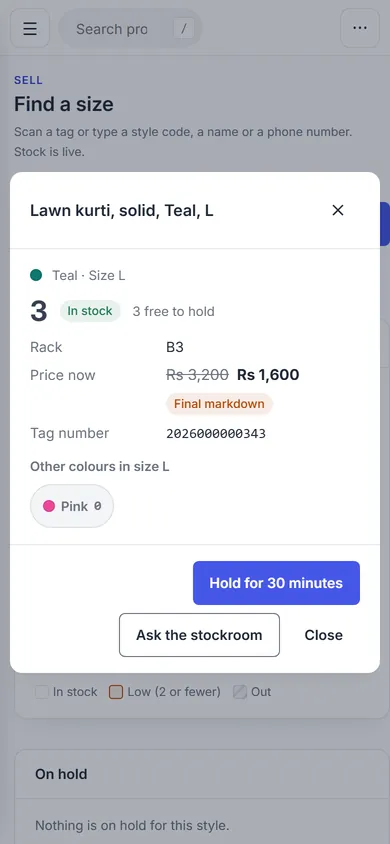
Shown in our demo: search by style, name, phone or tag; see the stock, the rack, the price and the other colours; hold a piece for 30 minutes; or ask the stockroom on WhatsApp.
Shown in our demo: a delivery is received cell by cell against its order, a short needs a reason, the freight is spread into each piece's cost, and the maker's bill is raised.
Shown in our demo: the owner approves a pass, the manager applies it, and a style that would sell below cost is held. Every price move is in the price history with who approved it.
Shown in our demo: sell-through by delivery against its target, the size curve, and a reorder with its arithmetic shown that drafts the order and a WhatsApp message; nothing is sent by itself.
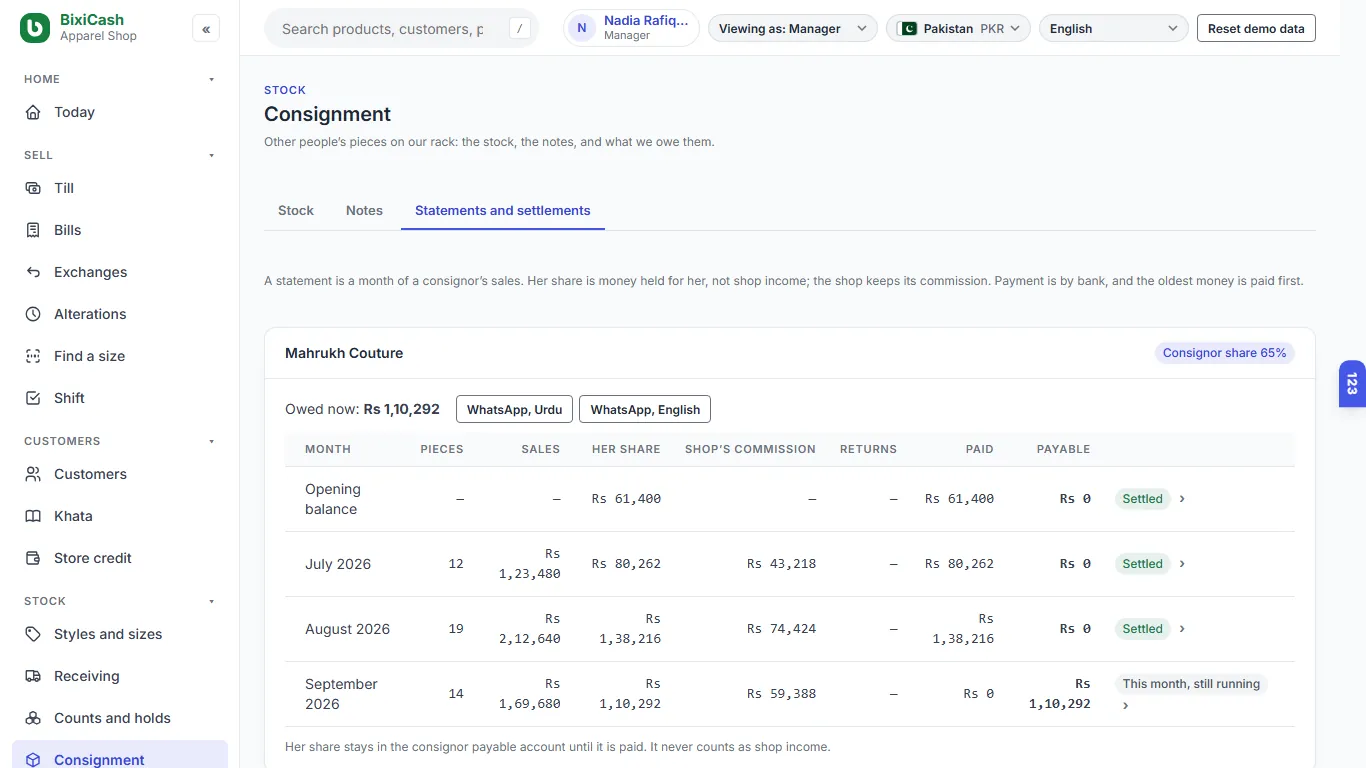
Shown in our demo: consigned pieces sell at the till with the consignor's 65% held apart from the shop's income, monthly statements, and settlement by bank.
Shown in our demo: a board from received to delivered with each step time-stamped, list prices, a free first hem on a bill of Rs 8,000 or more, an optional deposit, and a ready note on WhatsApp. The tailor's screen shows no prices.
Shown in our demo: customers with their own and their family's sizes, khata within a limit and with no late fee, and store credit and gift vouchers spent like a tender.
A receipt, an alteration-ready note or a khata statement opens WhatsApp with the message written out, for customers who agreed to it; a person presses Send. The app itself sends nothing.
The accounts already post each pay period as one balanced entry; a pay sheet with a salesman's commission is shown in the demo and still being built in the product.
Inside the product
Who uses it
Owner
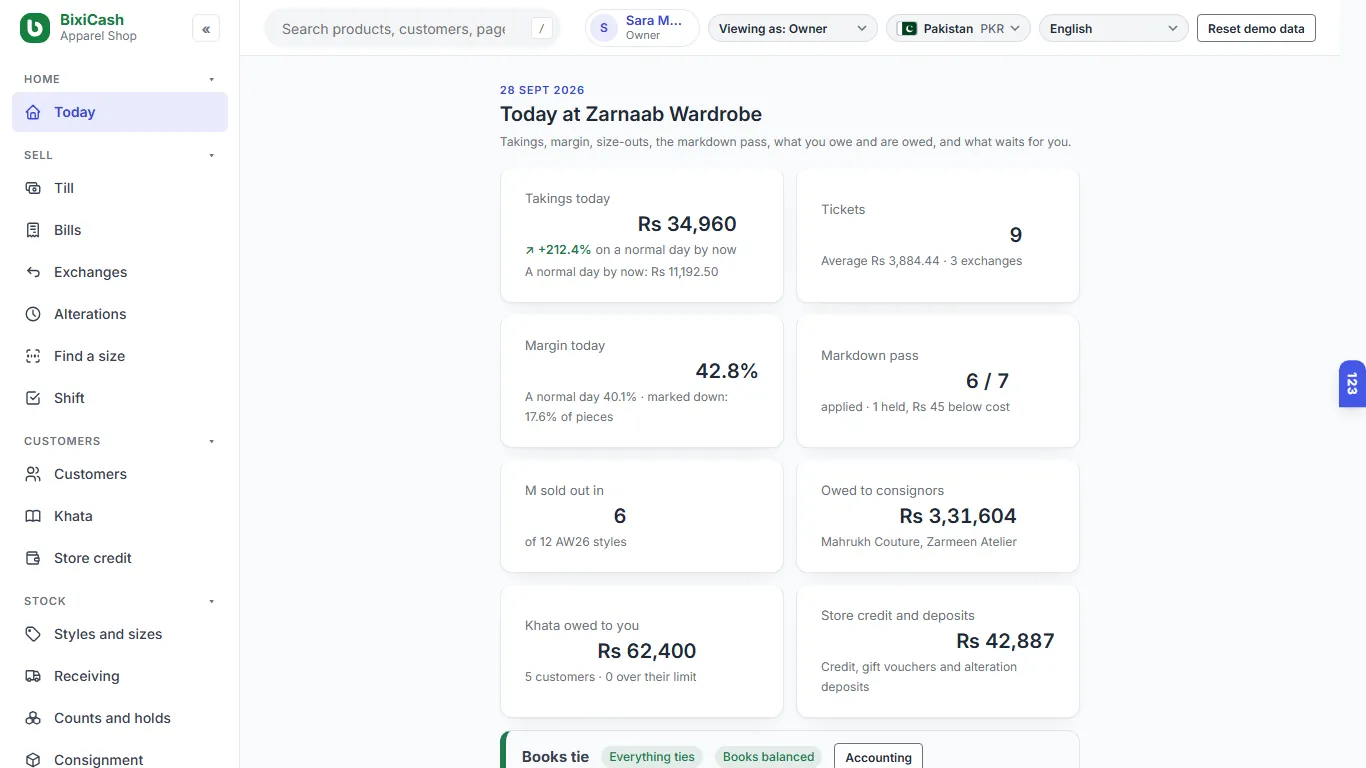
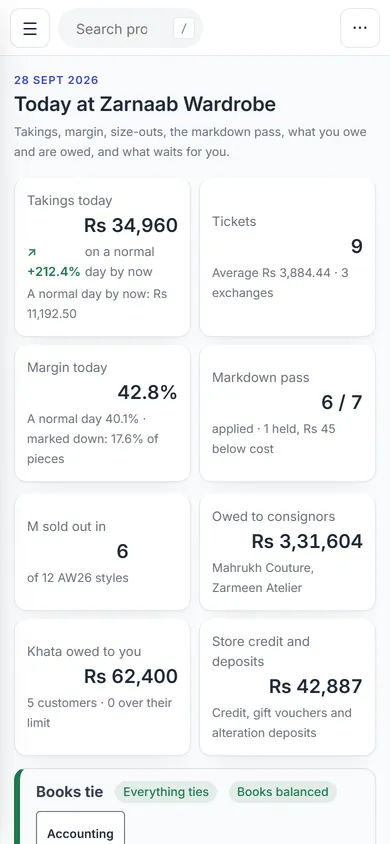
Takings, margin, size-outs, the markdown pass and what is owed to consignors, with a check that the books tie.
Cashier
Every bill, split tender and exchange at one till, without seeing what a piece cost.
Salesman
Find a size on a phone, hold a piece for a customer, and see their own sales and commission.
Stock keeper
A delivery received against its order grid, with every short explained.
Behind the counter
The screens for your trade sit on a full set of books. These parts come with it.
Double-entry books, statements, period close.
Cash, bank, cheques and reconciliation.
Orders, supplier bills and what you owe.
What you hold, where, and what it cost.
One staff register, attendance, pay runs.
The numbers an owner asks for each morning.
More than one shop, one set of books.
On the counter
Bought together with the software: one delivery, one bill, set up to work.
The price
Introductory price. VAT is added where it applies. A second shop costs the same as the first. Prices for United Kingdom, in GBP, as of 28 Sep 2026.
The first 50 shops in United Kingdom get free setup and data import with a yearly plan, and today's price locked for two years.
Claim a placeStraight answers
Yes. Our clothing boutique demo is one shop with ladies', men's and kids' ready-to-wear: 38 styles in 302 size-and-colour variants, ninety days of sample history, six staff roles, and English and Urdu. It runs on sample data in your own browser. Book a demo and we send you a private link.
Yes, in the demo. The swap is one exchange document: the piece comes back at the price paid, the new one goes out at today's price, and the difference, often Rs 0.00, is all that changes hands.
Yes, in the demo. A salesman holds a size and colour for 30 minutes from a phone; the piece stays on the rack, the hold is listed on the Find a size screen, and it does not take the piece out of stock.
Not for real. The demo has a switch that simulates it: the bill carries the small POS fee, and the receipt gets an invoice number and a QR marked as a simulation. Nothing is sent to the tax authority, and a real link is not built.
No. Card, JazzCash and Easypaisa are recorded as tenders on the bill; the payment itself goes through your machine or wallet as it does today.
The demo runs one shop. Moving stock between branches is not in the demo; ask us what is ready for your branches.
Every tax point in the demo's settings and at the till is marked To verify, including whether your shop counts as a Tier-1 retailer. Check the rules with your accountant before relying on them.
We are building it to keep working when the internet drops, with the books kept safe online. It isn't finished yet. Ask us what is ready for your shop.
Same aisle
Twenty minutes on a call. We show your day on the screen, with your words and your stock.