Order
Measurements and selection
The counter clerk recalls a saved measurement profile, or takes new ones, and selects the garment, fabric and style.

Coming soon Beauty, Fitness, Personal & Pet
Recalls a returning customer's saved measurements instead of asking again, takes an advance at order with the balance due on delivery, and shows an order's stage — cut, stitched, finishing, ready — so nothing is promised past what the karigars can deliver.
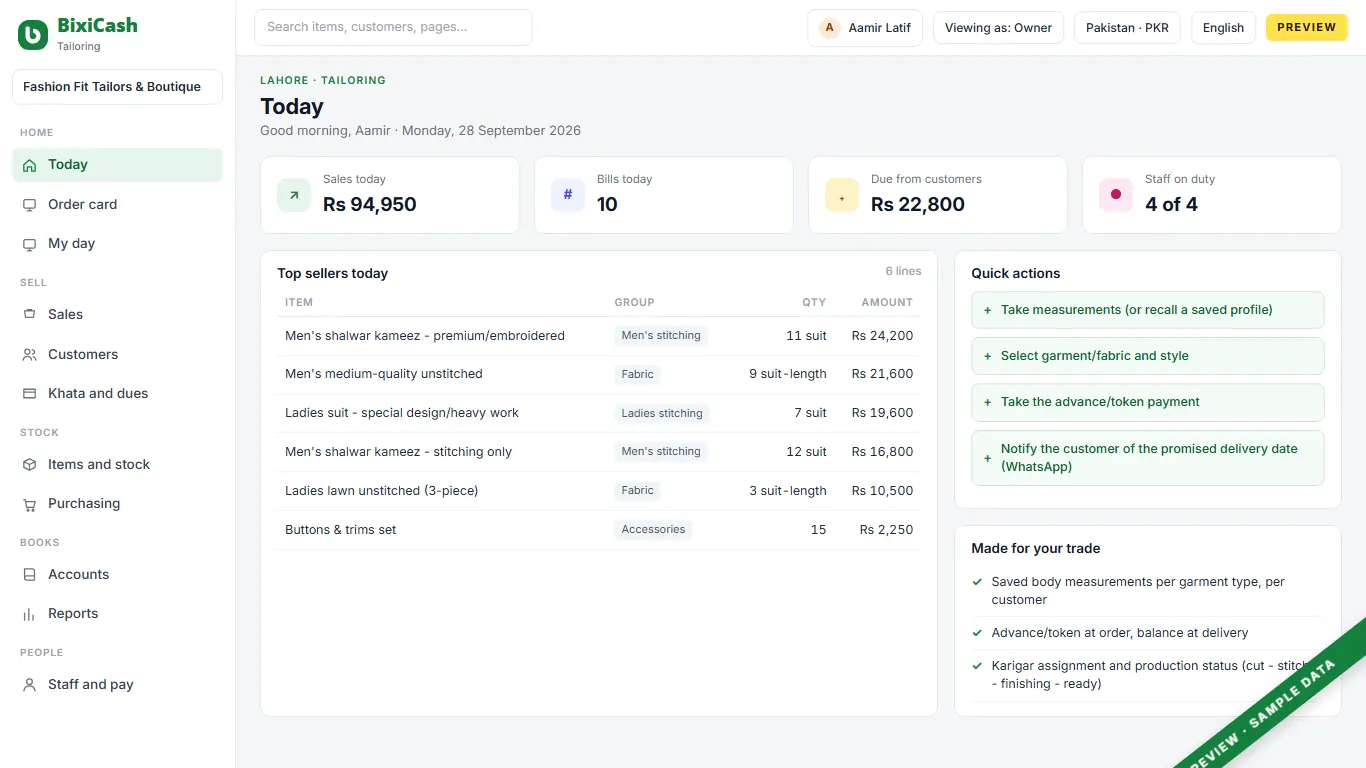
A working day
Order
The counter clerk recalls a saved measurement profile, or takes new ones, and selects the garment, fabric and style.
Advance
An advance is taken at order, with the promised delivery date sent by WhatsApp.
Production
A karigar works the order through its stages, each one visible and never skipped.
Delivery
The customer collects the order and pays the balance.
Closing
The owner checks orders due today or overdue, especially in the run-up to Eid.
What goes wrong today
A regular customer's measurements re-taken on every visit.
A delivery date given without checking the karigars' workload.
No visibility into an order until it's already overdue.
No clear record of whose fabric is whose in the workshop.
What it does
Parts marked Coming soon are on the way; founding shops get them first, at no extra charge.
A saved body-measurement profile per garment type, per customer, recalled instead of retaken, is planned.
An order's advance is kept as an open balance on the customer's account, applied against the final invoice on delivery — the same khata mechanism behind a bridal package or a boarding deposit.
An order card with a visible stage ladder that can't be skipped is planned, the same shape as a laundry ticket.
Checking a promised delivery date against a karigar's current workload before it's promised is planned.
The promised delivery date, and the ready-for-collection message, are pre-filled as WhatsApp messages for the counter clerk to send.
Shown in our demos: a discount can never take an order below its cost, or past the owner's maximum.
Planned: an on-site relay hub that keeps order-taking and the till working through an outage.
Who uses it
Counter / measurement clerk
to recall a saved measurement profile, take the advance, and promise a realistic delivery date
Karigar
to see today's cutting/sewing queue by promised date, and move each order to its next stage
Owner
to see orders due or overdue, and how much is outstanding in advances
Behind the counter
The screens for your trade sit on a full set of books. These parts come with it.
Double-entry books, statements, period close.
Cash, bank, cheques and reconciliation.
Orders, supplier bills and what you owe.
What you hold, where, and what it cost.
Tax on every line, by your country's rules.
One staff register, attendance, pay runs.
Machines and vehicles, and their wear.
The numbers an owner asks for each morning.
On the counter
Bought together with the software: one delivery, one bill, set up to work.
The price
Introductory price. Local taxes are added where they apply. A second shop costs the same as the first. Prices for countries without their own page, in USD, as of 28 Sep 2026.
The first 50 shops in each country get free setup and data import with a yearly plan, and today's price locked for two years.
Claim a placeThis trade does not have its own price line yet. The price shown is our retail line, and we confirm it when we quote.
Straight answers
No — the plan is to save a measurement profile per garment type and recall it, not retake it.
An advance is taken at order and kept as an open balance, applied against the final bill when the order is delivered.
An order card with a visible stage — cut, stitched, finishing, ready — that can't be skipped, is planned.
That check, before a date is promised, is planned — especially useful in the Eid rush.
Customer-supplied fabric is meant to be tracked as held-not-owned, separately from fabric the shop sells, so it's never confused with stock.
Same aisle
Twenty minutes on a call. We show your day on the screen, with your words and your stock.