Morning
The shop opens
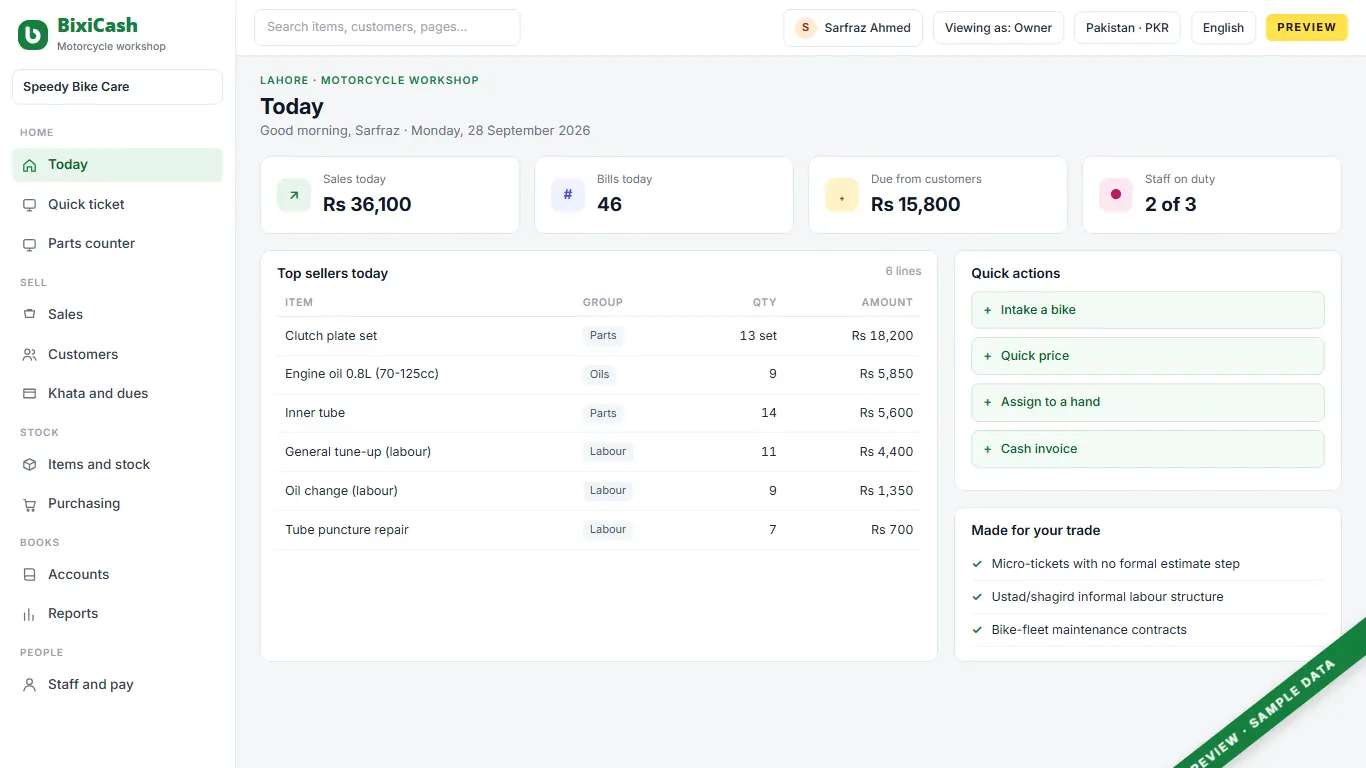
The head mechanic takes in the first bikes, gives a quick price and assigns each one to a hand.

Coming soon Automotive & Mobility
A walk-in ticket completes in under a minute, next to a full fleet-contract invoice on the same screen. Parts issued always reduce real stock, and labour and parts stay as separate lines even at this small scale.
A working day
Morning
The head mechanic takes in the first bikes, gives a quick price and assigns each one to a hand.
Mid-morning
A courier or delivery-fleet bike goes through a lightweight job card instead of a cash ticket, so the monthly invoice has a paper trail.
Midday
The parts boy issues oil, chains or a battery against a ticket by a scan, so the shelf count stays real.
Afternoon
Most jobs finish with a cash invoice on the spot, labour and parts shown as separate lines.
Evening
The owner checks today's tickets, which fleet contracts are due, and what needs reordering.
What goes wrong today
A five-minute oil change does not need the paperwork of a full car job; a slow ticket loses the small-margin, high-volume business its speed depends on.
A courier fleet's bikes need a service record by frame number, not a memory of which bike came in last.
Oil, chains and batteries handed to a mechanic without a scan leave the shelf count wrong by the end of the day.
A monthly fleet bill that isn't built from the actual tickets raised is hard to defend if the customer questions it.
What it does
Parts marked Coming soon are on the way; founding shops get them first, at no extra charge.
Planned: a walk-in ticket that completes in under a minute, without the car workshop's estimate-and-approval step.
Planned: a monthly contract for a fleet of delivery or courier bikes, invoiced against the tickets actually raised.
A fleet contract can be billed monthly on account, with open invoices and ageing behind the balance.
Orders to parts and lubricant suppliers flow through to goods receipt and then a bill.
Every ticket prints a real receipt with labour and parts as separate lines.
Shown in our demo: issuing a part to a ticket by scanning its barcode.
Planned: the counter keeps taking cash tickets through an internet outage, through a small on-site relay hub.
Who uses it
Head mechanic (ustad)
to intake, price and assign a bike in seconds, without a formal estimate step
Parts boy
to issue a part to a ticket by a scan, never from memory
Owner
today's tickets, fleet contracts and the reorder point, on one screen
Behind the counter
The screens for your trade sit on a full set of books. These parts come with it.
Double-entry books, statements, period close.
Orders, supplier bills and what you owe.
What you hold, where, and what it cost.
Quotations, orders, invoices, delivery notes.
Tax on every line, by your country's rules.
One staff register, attendance, pay runs.
The numbers an owner asks for each morning.
On the counter
Bought together with the software: one delivery, one bill, set up to work.
The price
Introductory price. Local taxes are added where they apply. A second shop costs the same as the first. Prices for countries without their own page, in USD, as of 28 Sep 2026.
The first 50 shops in each country get free setup and data import with a yearly plan, and today's price locked for two years.
Claim a placeThis trade does not have its own price line yet. The price shown is our retail line, and we confirm it when we quote.
Straight answers
No. Small tickets are designed to move straight from intake to a cash invoice; a fleet bike gets a lightweight job card instead.
Planned: a fleet contract invoiced against the tickets actually raised that month.
That is a genuine informal-economy practice; we have not forced an apprentice's stipend into the same wage record as registered staff.
Shown in our demo: scanning a part onto a ticket.
Not yet. It is planned: a small on-site relay hub that keeps the counter selling through an outage.
Same aisle
Twenty minutes on a call. We show your day on the screen, with your words and your stock.