Through the day
Fit and sell by size
A customer tries sizes until one fits; the sale rings up against the style's size and colour grid.

Coming soon Retail & Specialty
Fit a customer by size, width and colour, net an exchange against the receipt, and see exactly which sizes in a size curve are about to run out.
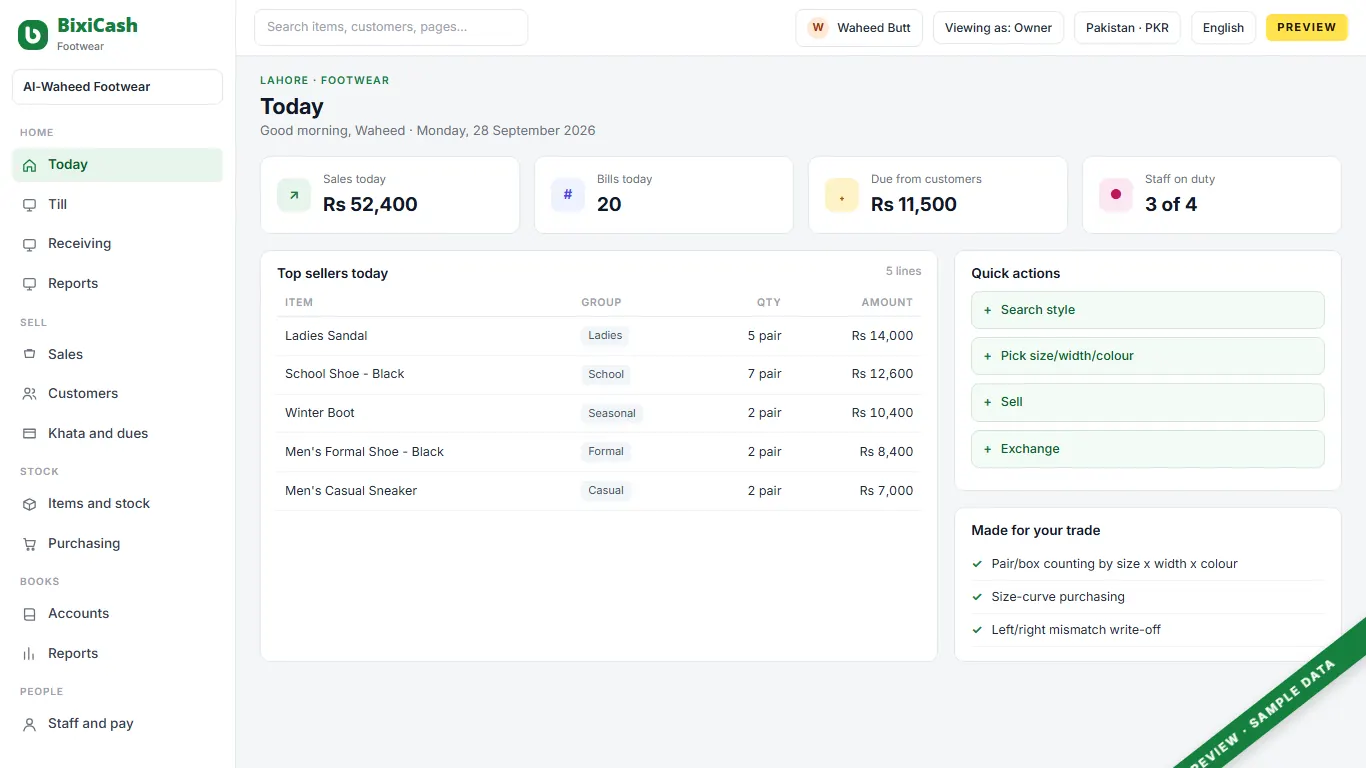
A working day
Through the day
A customer tries sizes until one fits; the sale rings up against the style's size and colour grid.
Through the day
A customer exchanges a size against their receipt; the original pair is returned and the new one sold, the difference tendered.
Receiving
The stock keeper breaks a new carton down into pairs by size, giving each its own barcode.
Weekly
A size that has sold out in a popular colour is flagged for reorder.
Stock count
A mismatched left/right pair turns up at a stock count and is written off with its own reason.
Closing
The owner checks sell-through by size curve and the shrinkage/damage report.
What goes wrong today
Extreme sizes sit on the shelf while the middle sizes of a style sell out first.
A size exchange handled as two disconnected transactions instead of one.
A mismatched left/right pair only discovered at a stock count, long after the sale.
No easy way to see whether another branch still has a customer's size.
What it does
Parts marked Coming soon are on the way; founding shops get them first, at no extra charge.
The same size, width and colour grid apparel retail needs will let a style sell from one grid instead of separate stock lines.
A sell-through-by-size-curve report will flag a size running low before it fully sells out.
A return posts as a proper credit note against the original invoice, so a size exchange nets the difference in one transaction.
Shown in our demos: a discount can never take a line below cost, even on a clearance rack.
Stock is tracked by branch, so a missing size can be checked against another branch.
A stock-adjustment reason code will cover just a mismatched left/right pair found at a count, kept separate from ordinary shrinkage.
A receipt pre-fills on WhatsApp with one tap; a person still presses send.
A small on-site hub will keep the till selling through an outage.
Who uses it
Owner
Sell-through by size curve and the shrinkage/damage numbers.
Manager
To supervise the floor and approve an exchange or a write-off.
Sales staff
To fit customers fast and check another branch for a missing size.
Stock keeper
To break cartons into pairs, barcode each, and flag reorders.
Behind the counter
The screens for your trade sit on a full set of books. These parts come with it.
Double-entry books, statements, period close.
Orders, supplier bills and what you owe.
What you hold, where, and what it cost.
One staff register, attendance, pay runs.
More than one shop, one set of books.
On the counter
Bought together with the software: one delivery, one bill, set up to work.
The price
Introductory price. Local taxes are added where they apply. A second shop costs the same as the first. Prices for countries without their own page, in USD, as of 28 Sep 2026.
The first 50 shops in each country get free setup and data import with a yearly plan, and today's price locked for two years.
Claim a placeStraight answers
Not yet. That grid is planned, built for what apparel retail needs.
Yes. A return posts as a credit note against the original sale.
No. That is decided and shown in our demos.
Yes. Stock is tracked by branch and warehouse in the product.
Not yet. A dedicated reason code for a mismatched pair is planned.
Same aisle
Twenty minutes on a call. We show your day on the screen, with your words and your stock.