A shipment arrives
A client's container is notified
An importer or exporter client notifies the agent that a shipment is arriving or ready to ship.

Coming soon Trade & Distribution
A customs clearing and forwarding agent moves a client's shipment through customs, pays port charges and duty on the client's behalf, and bills every disbursement back alongside its own service fee, so nothing paid for a client is ever forgotten.
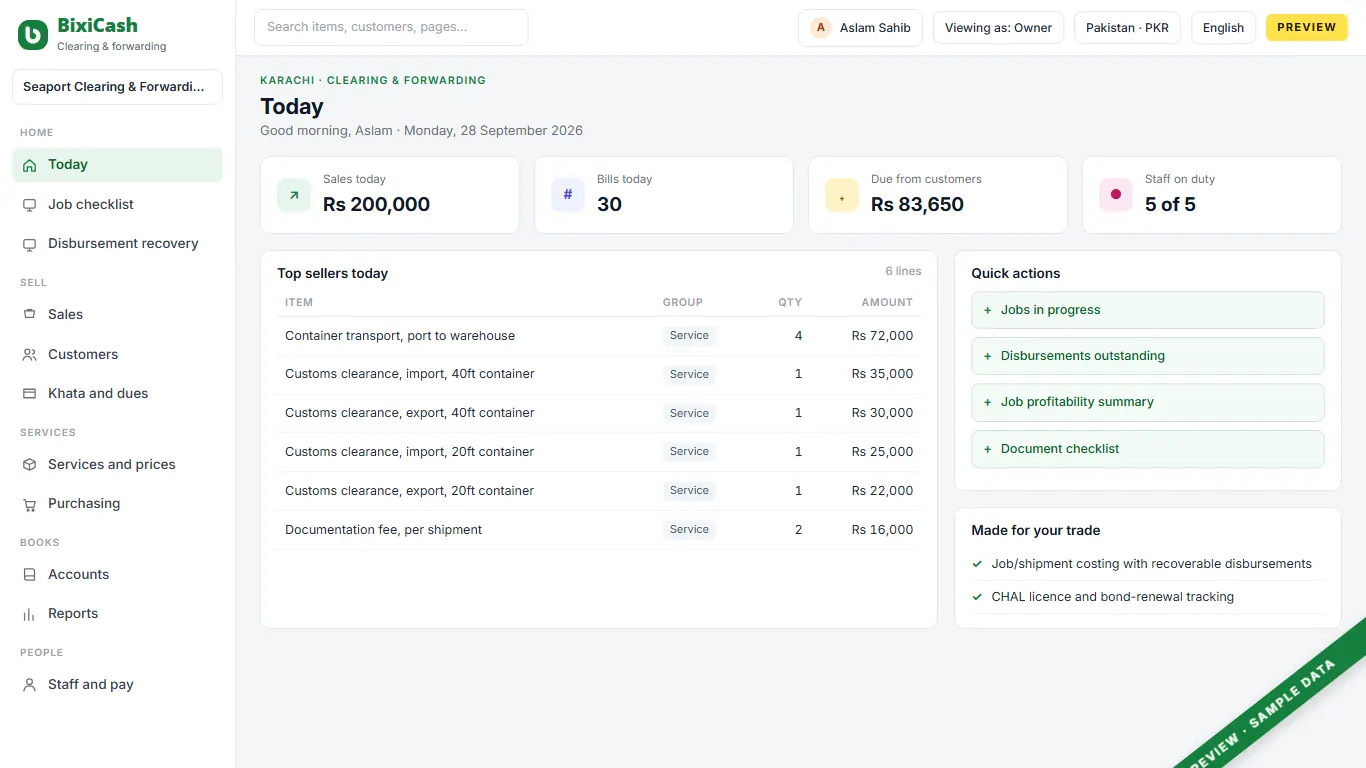
A working day
A shipment arrives
An importer or exporter client notifies the agent that a shipment is arriving or ready to ship.
Filing
The documentation clerk collects the shipping documents and files the bill of entry through WeBOC.
Paying on the client's behalf
Port and terminal charges, and customs duty, are paid on the client's behalf before the container can move.
Examination
The operations coordinator liaises with the examiner if the shipment is selected for physical examination.
Release
The container is released and moved to the client's warehouse.
Billing
The client is billed for the service fee plus every disbursement paid on their behalf, and the job's own profitability is closed out.
What goes wrong today
Port charges or duty paid on a client's behalf that never makes it onto their bill.
A shipment cleared and billed with no clear picture of what it actually earned after disbursements.
The CHAL licence or its bond lapsing without warning.
A client's bill that doesn't make clear what's the agent's fee and what's a cost paid on their behalf.
What it does
Parts marked Coming soon are on the way; founding shops get them first, at no extra charge.
Planned: port charges, duty and other costs paid on a client's behalf tracked as their own pass-through item until they're billed back, so nothing paid for a client is forgotten.
Planned: each shipment costed as its own job, freight, duty and fees on one side against the service fee and disbursement recovery on the other, so its real margin is visible.
Planned: the CHAL licence and its bond renewal date tracked and flagged before it lapses.
A client's job billing is tracked the same way as any account: open invoices, receipts and ageing behind the balance.
Every disbursement paid, and every fee billed, is a full double-entry journal entry, not a side note.
Who uses it
Owner / CHAL holder
Which jobs are in progress, what's still owed in disbursements, and each job's real profitability.
Documentation clerk
A document checklist and bill-of-entry status for every job, so nothing is filed late.
Accountant
Every disbursement paid on a client's behalf tracked until it's billed back, none forgotten.
Client-relations coordinator
To update a client on their shipment without chasing three other people first.
Behind the counter
The screens for your trade sit on a full set of books. These parts come with it.
Double-entry books, statements, period close.
Cash, bank, cheques and reconciliation.
Orders, supplier bills and what you owe.
Quotations, orders, invoices, delivery notes.
The price
Introductory price. Local taxes are added where they apply. A second shop costs the same as the first. Prices for countries without their own page, in USD, as of 28 Sep 2026.
The first 50 shops in each country get free setup and data import with a yearly plan, and today's price locked for two years.
Claim a placeStraight answers
Planned: disbursements like port charges and duty tracked as their own pass-through item until they're billed back to the client, so none are forgotten.
Planned: each shipment costed as its own job, so its real profit after disbursements and fees is visible, not just the total across every job.
Planned: the licence and bond renewal date tracked and flagged before it lapses.
Yes. A client's job billing is tracked as an open-item account with ageing, the same as any customer account.
No. This business owns no resale inventory. It tracks documents, disbursements and container jobs, not stock.
Twenty minutes on a call. We show your day on the screen, with your words and your stock.