Booking
A shipper books a consignment
A shipper brings or calls in cargo; the booking clerk writes a bilty with the consignor, consignee, goods, weight and freight terms.

Coming soon Trade & Distribution
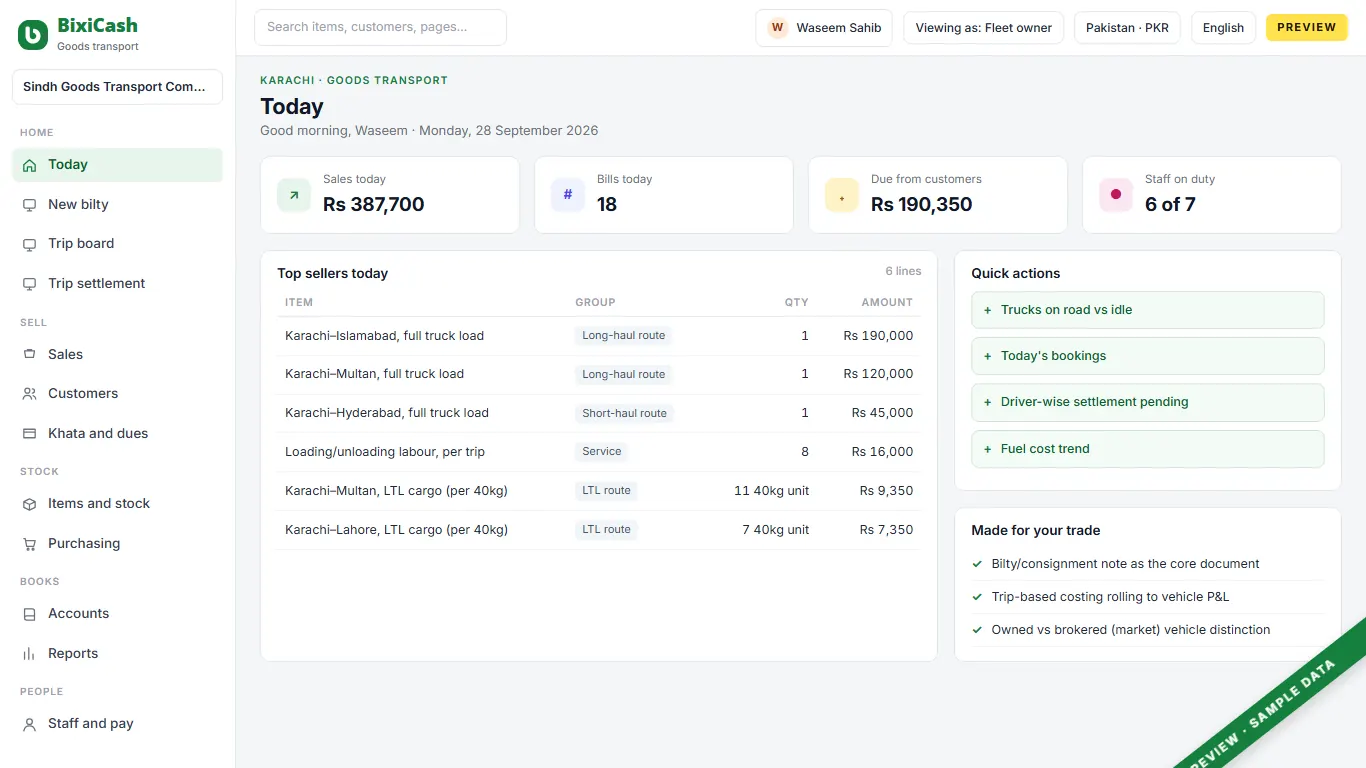
A goods-transport company writes a bilty for every consignment, puts a truck (owned or brokered) on the road against it, and rolls fuel, tolls and driver settlement up to a real profit and loss for each trip and each vehicle.
A working day
Booking
A shipper brings or calls in cargo; the booking clerk writes a bilty with the consignor, consignee, goods, weight and freight terms.
Dispatch
The dispatcher assigns an owned or a brokered truck and driver to the trip, and the truck loads.
On the road
The truck departs, stops for fuel and tolls, and the trip board shows its status as it moves.
Delivery
The truck delivers, a proof of delivery is taken, and freight is collected: from the consignor if paid up front, from the consignee if it's to-collect.
Settlement
The driver settles fuel, toll and loading expenses against their standing advance.
Closing
The owner checks which trucks are on the road, which are idle, and how each vehicle's trips are adding up.
What goes wrong today
A consignment booked at the counter, and the trip board finding out about it late.
A "to-collect" delivery where nobody actually confirms the money came in.
Fuel, tolls and loading paid from an advance that nobody adds up until it's a problem.
Fuel, tolls and driver pay never rolled up against what a truck actually earned.
What it does
Parts marked Coming soon are on the way; founding shops get them first, at no extra charge.
A bilty written at the booking counter will appear on the dispatcher's trip board immediately, with consignor, consignee, goods, weight and freight terms all in one place.
A bilty pre-fills on WhatsApp with one tap; a person still presses send.
Freight earned will roll up against fuel, tolls and driver pay, trip by trip, to a real profit and loss for each truck.
An owned truck will track as a fixed asset. A brokered "market" truck will track instead as a commission paid per trip, not an asset the company owns.
A regular shipper's monthly account is tracked the same way as any customer account: open invoices, receipts and ageing.
Fuel, toll and loading expenses will settle against a driver's standing advance, so the running balance is always visible, never just assumed.
Who uses it
Fleet owner / proprietor
Which trucks are on the road, which are idle, and each vehicle's real profit after fuel, tolls and driver pay.
Booking clerk (munshi)
To write a clean bilty (consignor, consignee, goods, weight, freight terms) and get it to the dispatcher instantly.
Dispatcher
One trip board showing every truck's status, owned or brokered, at a glance.
Accountant
Freight due (paid, to-pay or to-collect) and each driver's advance and settlement, never left untracked.
Behind the counter
The screens for your trade sit on a full set of books. These parts come with it.
Double-entry books, statements, period close.
Cash, bank, cheques and reconciliation.
Orders, supplier bills and what you owe.
Quotations, orders, invoices, delivery notes.
Machines and vehicles, and their wear.
One staff register, attendance, pay runs.
On the counter
Bought together with the software: one delivery, one bill, set up to work.
The price
Introductory price. Local taxes are added where they apply. A second shop costs the same as the first. Prices for countries without their own page, in USD, as of 28 Sep 2026.
The first 50 shops in each country get free setup and data import with a yearly plan, and today's price locked for two years.
Claim a placeStraight answers
A bilty pre-fills on WhatsApp with one tap; a person still presses send. It also prints, the same as any BixiCash document.
Not yet. A trip board will show every truck's status, owned or brokered, in one place, updating the moment a bilty is written.
Not yet. Freight earned will roll up against fuel, tolls and driver pay, trip by trip, to a real profit and loss per vehicle.
Not yet. A brokered ("market") truck will be kept apart from an owned truck: not tracked as a company asset, its owner paid a commission per trip instead.
Yes. A regular shipper's account is tracked as an open-item khata with ageing, the same as any customer account.
Twenty minutes on a call. We show your day on the screen, with your words and your stock.