Placing the order
A foreign-currency purchase order
The purchasing coordinator places a foreign-currency order with a supplier in China or the Gulf and applies for a letter of credit at the bank.

Coming soon Trade & Distribution
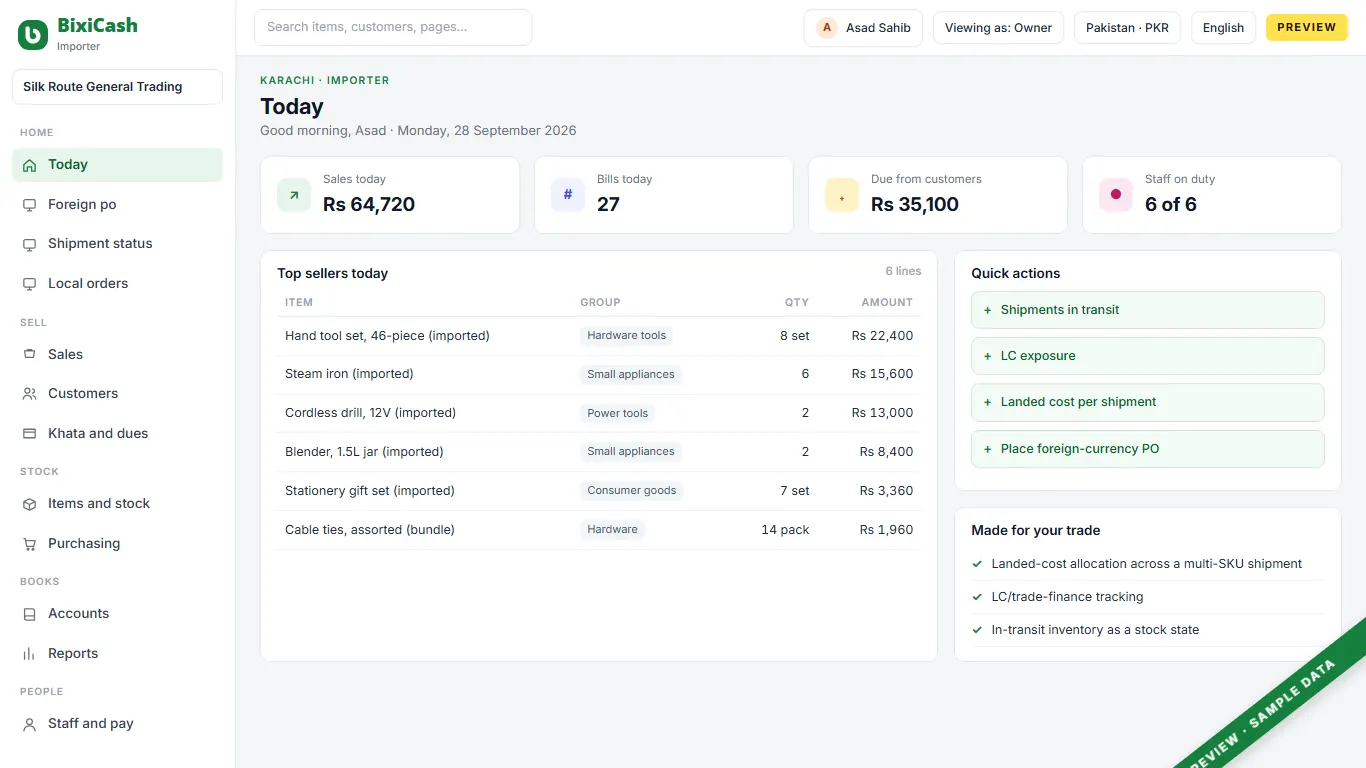
A general trading company imports multi-category goods on a foreign-currency order and a letter of credit, then allocates freight, duty and clearing charges across every SKU on the shipment, so the true cost and margin are known before anything is priced for local sale.
A working day
Placing the order
The purchasing coordinator places a foreign-currency order with a supplier in China or the Gulf and applies for a letter of credit at the bank.
In transit
The shipment is at sea or in customs; freight, duty and clearing charges are still accumulating, and the stock is tracked separately as in-transit, not yet warehouse stock.
Customs clearing
A separate clearing and forwarding business files the paperwork and moves the container through customs examination.
Receiving
The warehouse manager receives the shipment; the freight, duty and clearing charges entered once are allocated proportionally across every SKU in the container.
Selling
The sales manager books a local wholesale order priced from each item's actual landed cost, not the supplier's invoice price alone.
Monthly
The accountant reviews foreign-exchange exposure on open orders and how much of the letter-of-credit limit is already committed.
What goes wrong today
Freight, duty and clearing charges for one shipment, divided across dozens of SKUs on a spreadsheet, every time.
Goods still on the water counted the same as goods already on the shelf, so stock reports are wrong until the container clears.
A new purchase order placed without knowing how much letter-of-credit exposure is already committed.
A price quoted before landed cost is known, so the real margin on the sale is only found out afterwards.
What it does
Parts marked Coming soon are on the way; founding shops get them first, at no extra charge.
Entering a shipment's freight, duty and clearing charges once will allocate them proportionally across every SKU it contains, so each item's true cost is known before it's priced.
Goods still at sea or in customs will track as their own stock state, separate from what's actually on the warehouse shelf.
A lightweight register of LC exposure and limit use will show before a new purchase order is placed, so you're never buying blind.
Local wholesale customers buy on account. The product tracks open invoices, receipts and ageing behind every balance.
The product keeps stock by warehouse and location, useful once goods are re-exported or held across more than one port.
Our demos sell in nested packs — carton, box, unit — with a price per level. The product today handles one pack level per sale line, with pack support on purchases coming next.
Who uses it
Owner / trading principal
Which shipments are in transit, how much of the LC limit is used, and the landed cost on each shipment.
Purchasing / LC coordinator
To place a foreign-currency order and open a letter of credit against it.
Warehouse manager
To receive a shipment and see landed cost allocated across every SKU, without working it out by hand.
Accountant
Foreign-exchange gain or loss and local receivable ageing in one set of books, not two.
Behind the counter
The screens for your trade sit on a full set of books. These parts come with it.
Double-entry books, statements, period close.
Cash, bank, cheques and reconciliation.
Orders, supplier bills and what you owe.
What you hold, where, and what it cost.
Quotations, orders, invoices, delivery notes.
More than one shop, one set of books.
On the counter
Bought together with the software: one delivery, one bill, set up to work.
The price
Introductory price. Local taxes are added where they apply. A second shop costs the same as the first. Prices for countries without their own page, in USD, as of 28 Sep 2026.
The first 50 shops in each country get free setup and data import with a yearly plan, and today's price locked for two years.
Claim a placeStraight answers
That's planned: entering one shipment's freight, duty and clearing charges once and spreading them proportionally across every SKU it contains, so each item's landed cost is known before it's priced.
The product has a multi-currency foundation today; the fuller foreign-currency purchasing and letter-of-credit tracking this business needs is still being built.
Planned: in-transit stock kept separate from warehouse stock, so reports aren't wrong while a shipment is still moving.
Yes. A local customer's account is tracked as an open-item khata with ageing, the same as any customer account.
No. Clearing a shipment through customs is its own segment, the clearing and forwarding agent. This profile covers the importer's own buying, landed cost and local resale.
Twenty minutes on a call. We show your day on the screen, with your words and your stock.