Through the day
An order lands from the marketplace
An order arrives from the marketplace or the web store and joins one pick-pack queue, whichever channel it came from.

Coming soon Trade & Distribution
A marketplace and web-store seller pools stock across every channel so nothing is oversold, and reconciles each payout against exactly which orders it covers: commission, payment fee and courier remittance, all matched to the order.
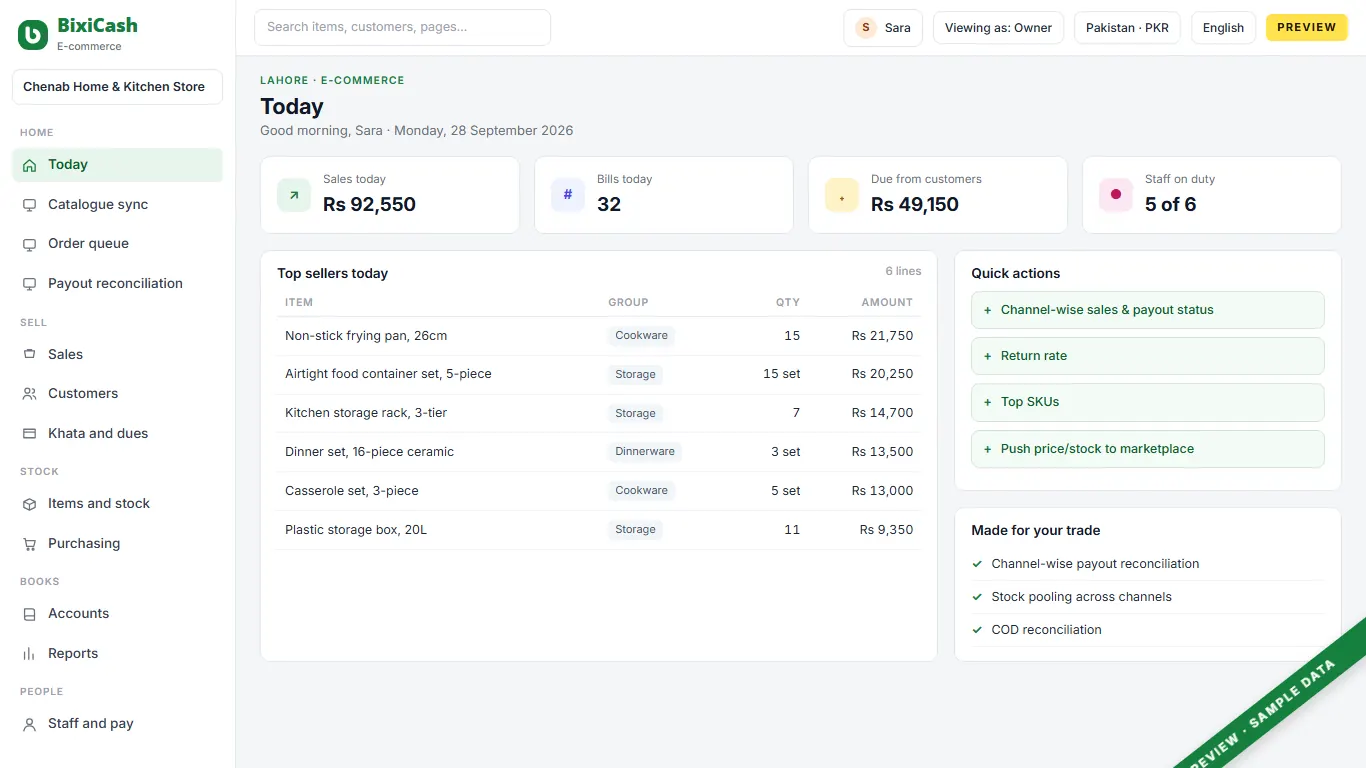
A working day
Through the day
An order arrives from the marketplace or the web store and joins one pick-pack queue, whichever channel it came from.
Through the day
The warehouse packer picks the order, packs it, and hands it to the courier for delivery.
Through the day
Payment is collect-on-delivery or already taken online; either way the order's status updates as the courier moves it.
When it goes wrong
A customer refuses the parcel at the door, or returns it; customer service handles the exception and the stock is restocked or written off.
Weekly
The listing manager pushes updated prices and stock levels to the marketplace so nothing is sold that isn't actually on the shelf.
When the payout lands
The accountant checks the marketplace's payout against exactly which orders it covers, after commission, payment fee and returns.
What goes wrong today
A sale on the web store and a sale on the marketplace both promise the same last unit.
Money lands from the marketplace with no order-by-order breakdown of commission, fees and returns.
A parcel refused at the door, and the stock it contained never makes it back into a countable state.
Cash collected by the courier on delivery, remitted days later, with no clear match to which orders it covers.
What it does
Parts marked Coming soon are on the way; founding shops get them first, at no extra charge.
Planned: stock shared across the marketplace and the web store from one pool, so a sale on one channel is felt on the other instantly and nothing is oversold.
Planned: a marketplace payout reconciled order by order against commission, payment fee and returns, not left as one lump number.
Planned: cash collected by the courier tracked as its own in-transit balance until the courier actually remits it.
Planned: a cash-on-delivery refusal traced back to restocked or written-off inventory, so a refusal doesn't just disappear from the count.
Returns post as credit notes against the original invoice, the same as any other sale.
Every marketplace or web-store sale, whatever the channel, is a full double-entry journal entry.
Who uses it
Owner / account manager
Channel-wise sales and payout status, and the return rate, without logging into each channel separately.
Listing / catalogue manager
One place to push price and stock to the marketplace, so it never oversells what's actually on the shelf.
Warehouse / packer
One pick-pack queue for every channel's orders, not a separate screen per marketplace.
Accountant
A payout that reconciles to the order, not just a lump sum from the marketplace.
Behind the counter
The screens for your trade sit on a full set of books. These parts come with it.
Double-entry books, statements, period close.
Cash, bank, cheques and reconciliation.
Orders, supplier bills and what you owe.
What you hold, where, and what it cost.
Quotations, orders, invoices, delivery notes.
On the counter
Bought together with the software: one delivery, one bill, set up to work.
The price
Introductory price. Local taxes are added where they apply. A second shop costs the same as the first. Prices for countries without their own page, in USD, as of 28 Sep 2026.
The first 50 shops in each country get free setup and data import with a yearly plan, and today's price locked for two years.
Claim a placeStraight answers
Planned: one stock pool shared across every channel, so a sale on one channel is felt everywhere else instantly.
Planned: a payout matched order by order against commission, payment fee and returns, instead of arriving as one lump number to puzzle over.
Planned: a refusal traced back to restocked or written-off inventory, so it doesn't just disappear from the count.
Yes. A return posts as a credit note against the original invoice, the same as any other sale.
Planned: cash collected on delivery tracked as its own in-transit balance until the courier actually remits it.
Twenty minutes on a call. We show your day on the screen, with your words and your stock.