Morning
A lot arrives
A customer's lot is weighed and gate-passed in, then allocated to a chamber or rack against that customer's holding.

Coming soon Agriculture & Livestock
For a potato, fruit or vegetable cold store: every bag's rent is worked out from exactly how many days it sat in the chamber, and a customer's remaining holding is always provably correct, gate pass by gate pass.
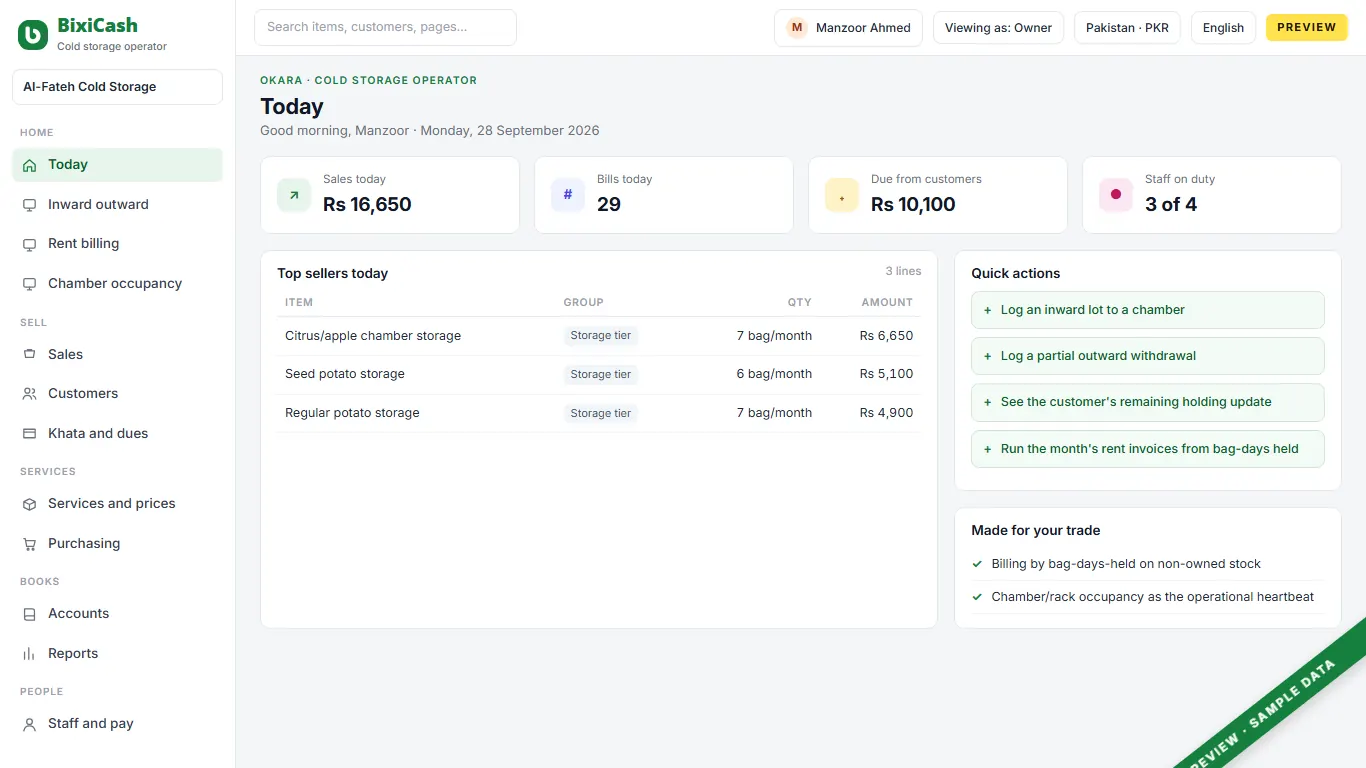
A working day
Morning
A customer's lot is weighed and gate-passed in, then allocated to a chamber or rack against that customer's holding.
Through the day
A customer withdraws part of their holding; the withdrawal is weighed and gate-passed out, reducing what they still have stored.
Through the day
The chamber technician logs temperature and any fault; a power outage triggers a generator failover, logged the same way.
End of day
The owner sees which chambers are full, near-empty, or overdue for rent, at a glance.
Month end
The accountant runs the month's rent invoices from bag-days held, and applies any deposit.
What goes wrong today
A season-long flat rate can be far from what a bag actually cost to store, especially in a bad year for prices.
With paper gate passes, proving exactly how much of a customer's produce is left in a chamber takes digging through a register.
A weight difference at withdrawal is easy to argue about when there is no separate, agreed shrinkage figure.
Knowing which chambers are full, near-empty or overdue for rent usually means walking the yard.
What it does
Parts marked Coming soon are on the way; founding shops get them first, at no extra charge.
Planned: rent will be worked out from exactly how many days each lot sat in its chamber, not a flat season guess.
Planned: a dashboard will show which chambers are full, near-empty or overdue for rent at a glance, the way a hotel shows room occupancy.
Planned: every bag will be held as a customer's memo quantity by chamber and lot; the cold store's own books will never carry it as stock.
Planned: a customer's deposit will sit as a liability until it is released against their first rent invoice.
A customer's rent balance keeps a running account with ageing, the same open-item ledger used for any credit sale.
Bills for electricity and chamber maintenance are tracked as open items until paid.
A click-to-chat message can carry a deposit or rent-due alert; a person still presses send.
Who uses it
Owner / manager
to see chamber occupancy and overdue rent at a glance, and set rent rates
Gate / weighbridge clerk
to log an inward or outward lot and see a customer's holding update immediately
Chamber technician
to log chamber temperature and any fault without needing ledger access
Accountant
to run the month's rent invoices from bag-days actually held, and reconcile deposits
Behind the counter
The screens for your trade sit on a full set of books. These parts come with it.
Double-entry books, statements, period close.
Cash, bank, cheques and reconciliation.
What you hold, where, and what it cost.
The numbers an owner asks for each morning.
More than one shop, one set of books.
On the counter
Bought together with the software: one delivery, one bill, set up to work.
The price
Introductory price. Local taxes are added where they apply. A second shop costs the same as the first. Prices for countries without their own page, in USD, as of 28 Sep 2026.
The first 50 shops in each country get free setup and data import with a yearly plan, and today's price locked for two years.
Claim a placeThis trade does not have its own price line yet. The price shown is our retail line, and we confirm it when we quote.
Straight answers
Planned: the design bills exactly the bag-days a lot actually held, not a flat guess. It is not built yet.
That is the plan: every inward and outward gate pass is meant to update the customer's holding immediately.
Yes, that is the design: a shrinkage figure is meant to be kept apart from the billing figure, never blended.
Planned, the same way a hotel shows room occupancy; not built yet.
No, and the product is designed around that: every bag is meant to be tracked as the customer's own stock, never the operator's.
Twenty minutes on a call. We show your day on the screen, with your words and your stock.