Daily
Eggs received and graded
Hatching eggs, from the hatchery's own breeder flock or bought in, are graded and candled.

Coming soon Agriculture & Livestock
For a hatchery: a batch of eggs set three weeks ago closes with an exact hatchability rate and a saleable day-old-chick count, next to every open-shed farm and EC shed's booking and advance waiting against it.
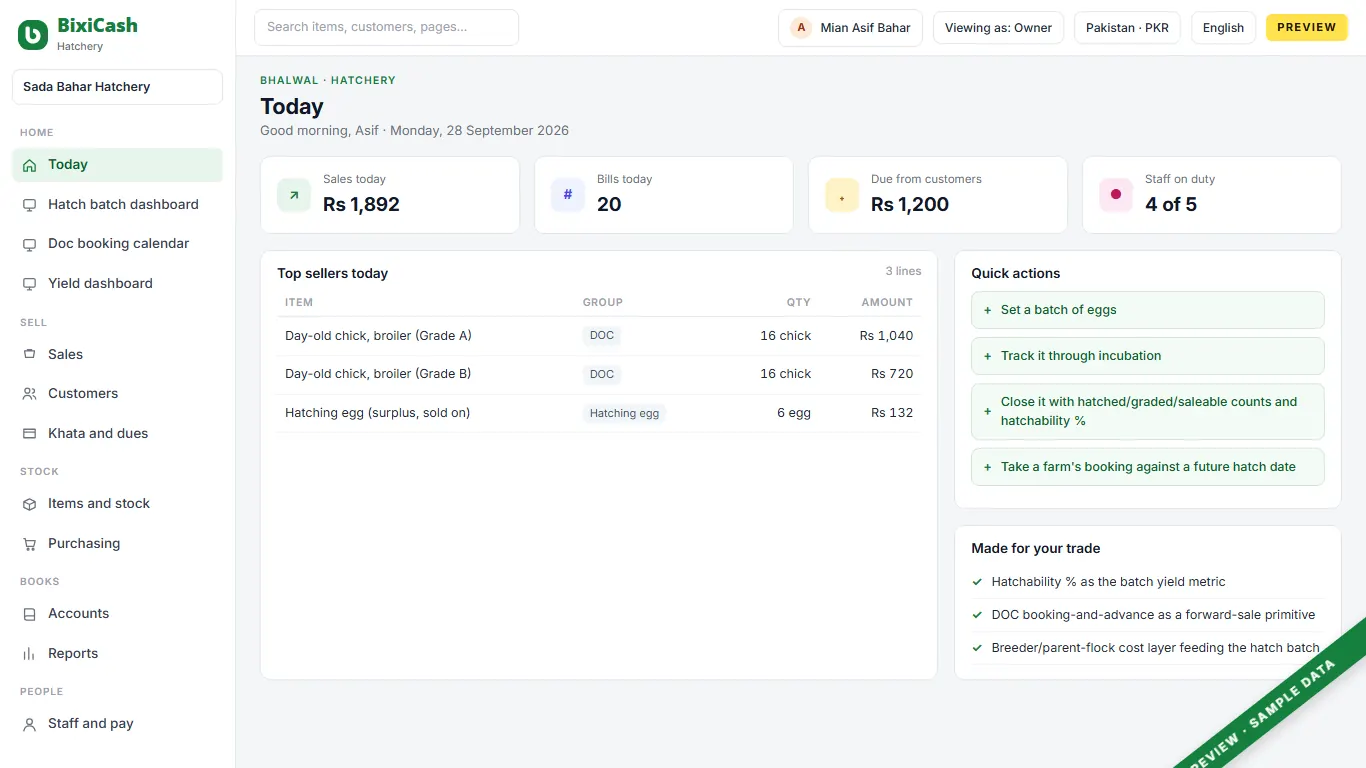
A working day
Daily
Hatching eggs, from the hatchery's own breeder flock or bought in, are graded and candled.
Daily
Graded eggs are set into incubators, starting a new hatch batch, while earlier batches are monitored through their cycle.
Through the day
The booking clerk takes a farm's order against a future hatch date and records the advance.
On hatch day
Chicks are candled, graded and vaccinated, and the batch closes with hatched, graded and saleable counts.
On collection
A booked farm's order is matched to the batch, sold on to an open-shed farm or an EC shed, and the balance is collected.
What goes wrong today
Eggs set three weeks ago are hard to track through incubation to a clear, comparable hatchability figure.
A cull or reject count is noted but rarely written off against the batch's own cost.
A farm's booking against a future hatch date, and the advance paid, are easy to lose track of until collection day.
Incubators need continuous power, and a batch already weeks in has the most to lose.
What it does
Parts marked Coming soon are on the way; founding shops get them first, at no extra charge.
A hatch batch will close with an automatic hatchability rate: hatched divided by set.
A cull or reject count will write off its own share of the batch's accumulated cost.
A farm's booking and advance will match automatically to the batch at collection.
An already-booked order will keep its agreed price, even as the day-old-chick price moves daily for new bookings.
A farm's booking advance will sit as a liability until the chicks are collected, not counted as revenue on the day it's taken.
Bills from an egg or breeder-feed supplier are tracked as open items until paid.
A click-to-chat message can confirm a booking or a price change; a person still presses send.
Who uses it
Owner
to see hatchability trend, day-old-chick price and booking-to-delivery reliability
Hatchery manager
to schedule hatch batches and review hatchability
Egg grader / candler
to grade and candle eggs for fertility without needing ledger access
Sales / booking clerk
to take a farm's booking and advance against a future hatch date
Behind the counter
The screens for your trade sit on a full set of books. These parts come with it.
Double-entry books, statements, period close.
Orders, supplier bills and what you owe.
What you hold, where, and what it cost.
One staff register, attendance, pay runs.
The numbers an owner asks for each morning.
On the counter
Bought together with the software: one delivery, one bill, set up to work.
The price
Introductory price. Local taxes are added where they apply. A second shop costs the same as the first. Prices for countries without their own page, in USD, as of 28 Sep 2026.
The first 50 shops in each country get free setup and data import with a yearly plan, and today's price locked for two years.
Claim a placeThis trade does not have its own price line yet. The price shown is our retail line, and we confirm it when we quote.
Straight answers
Not yet. A batch will close with an automatic hatchability rate: hatched divided by set.
That's the plan: a cull or reject count will write off its own share of the batch's cost. Not built yet.
Not yet. A booking and advance today will match automatically to the batch at collection.
The plan is to keep a booked order's agreed price fixed, even as the day's price moves for new bookings.
Generator failover is a real operating necessity here; the product itself does not yet log or alert on it for this segment.
Twenty minutes on a call. We show your day on the screen, with your words and your stock.