Morning
Field work logged
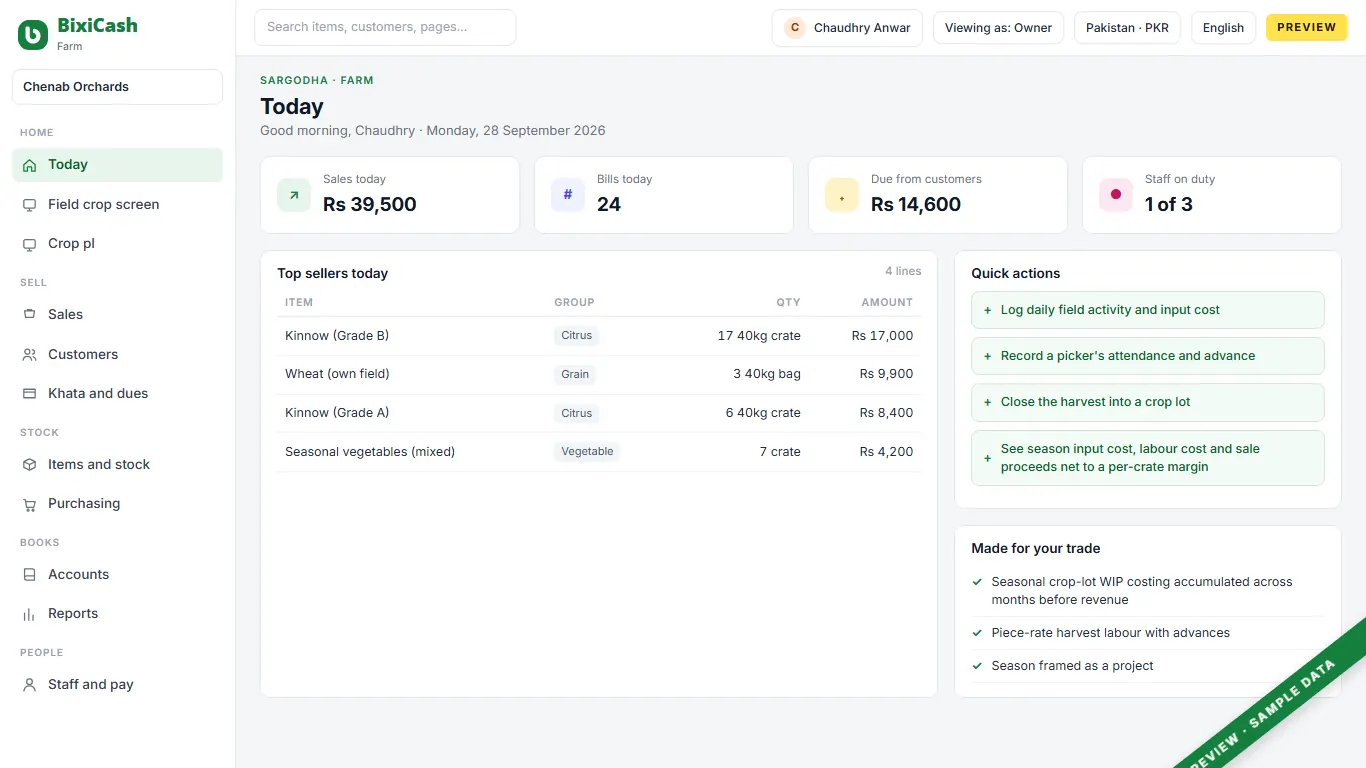
The farm manager records the day's field activity, irrigation and input cost against the season's crop.

Coming soon Agriculture & Livestock
For a family farm or orchard: every input cost from the season tags to the crop it grew, a piece-rate picker's advance is recovered from what they earn, and the harvest keeps its accumulated cost all the way to sale.
A working day
Morning
The farm manager records the day's field activity, irrigation and input cost against the season's crop.
Through the day
Permanent labourers and, at harvest, piece-rate pickers are marked present, with a picker's advance tracked against what they will earn.
At harvest
Picked produce is graded and closed into a crop lot carrying the season's accumulated cost.
At sale
The lot is sold direct, sent to an agent on consignment, or moved into cold storage, keeping its cost as it goes.
Season end
The owner checks the season's input cost, labour cost and sale proceeds against a real per-crate margin.
What goes wrong today
Fertiliser bought in one month and a labour advance given in another rarely land back on the harvest that actually earned them.
A picker's advance against future earnings is easy to lose track of once the season gets busy.
Once produce moves to an agent or cold storage, its accumulated cost is often reset to zero instead of carried forward.
Last season and this season on the same crop are hard to compare side by side.
What it does
Parts marked Coming soon are on the way; founding shops get them first, at no extra charge.
Input cost from across the season will tag to the crop it grew, instead of sitting in a generic expense bucket.
A picker paid by quantity will have their advance recovered automatically from what they go on to earn.
Each season will have a start and an end, with cost accumulating until the harvest sells.
A harvested lot will keep its accumulated cost as it moves to an agent or into cold storage.
Seed, fertiliser, pesticide and diesel bills are tracked as open items until paid.
An agent selling on consignment, or a direct buyer, keeps a running account.
A click-to-chat message can reach the agent or labour contractor; a person still presses send.
Who uses it
Owner / farmer
to see the season's real per-crate margin, and to approve labour advances
Farm manager / mistri
to log daily field activity and record a picker's attendance and advance
Seasonal / piece-rate picker
no system access, only to be paid correctly against quantity picked
Behind the counter
The screens for your trade sit on a full set of books. These parts come with it.
Double-entry books, statements, period close.
Orders, supplier bills and what you owe.
What you hold, where, and what it cost.
One staff register, attendance, pay runs.
The numbers an owner asks for each morning.
On the counter
Bought together with the software: one delivery, one bill, set up to work.
The price
Introductory price. Local taxes are added where they apply. A second shop costs the same as the first. Prices for countries without their own page, in USD, as of 28 Sep 2026.
The first 50 shops in each country get free setup and data import with a yearly plan, and today's price locked for two years.
Claim a placeThis trade does not have its own price line yet. The price shown is our retail line, and we confirm it when we quote.
Straight answers
Not yet. Fertiliser, irrigation and labour cost will tag to the season's crop lot instead of a generic expense bucket.
Not yet. It matches a gap already flagged in the product: a generic staff-advance feature, recovered from wages or piece-rate earnings, still being built.
That's the plan: the lot will carry its accumulated cost forward rather than reset to zero. Not built yet.
Planned, not built yet.
Agricultural income tax is a provincial matter in Pakistan, and current thresholds and rates need checking for your province.
Twenty minutes on a call. We show your day on the screen, with your words and your stock.