Daily
Stock received from the integrator
Chicks, feed and medicine arrive already owned by the integrator and are logged as consignment stock, never a purchase.

Coming soon Agriculture & Livestock
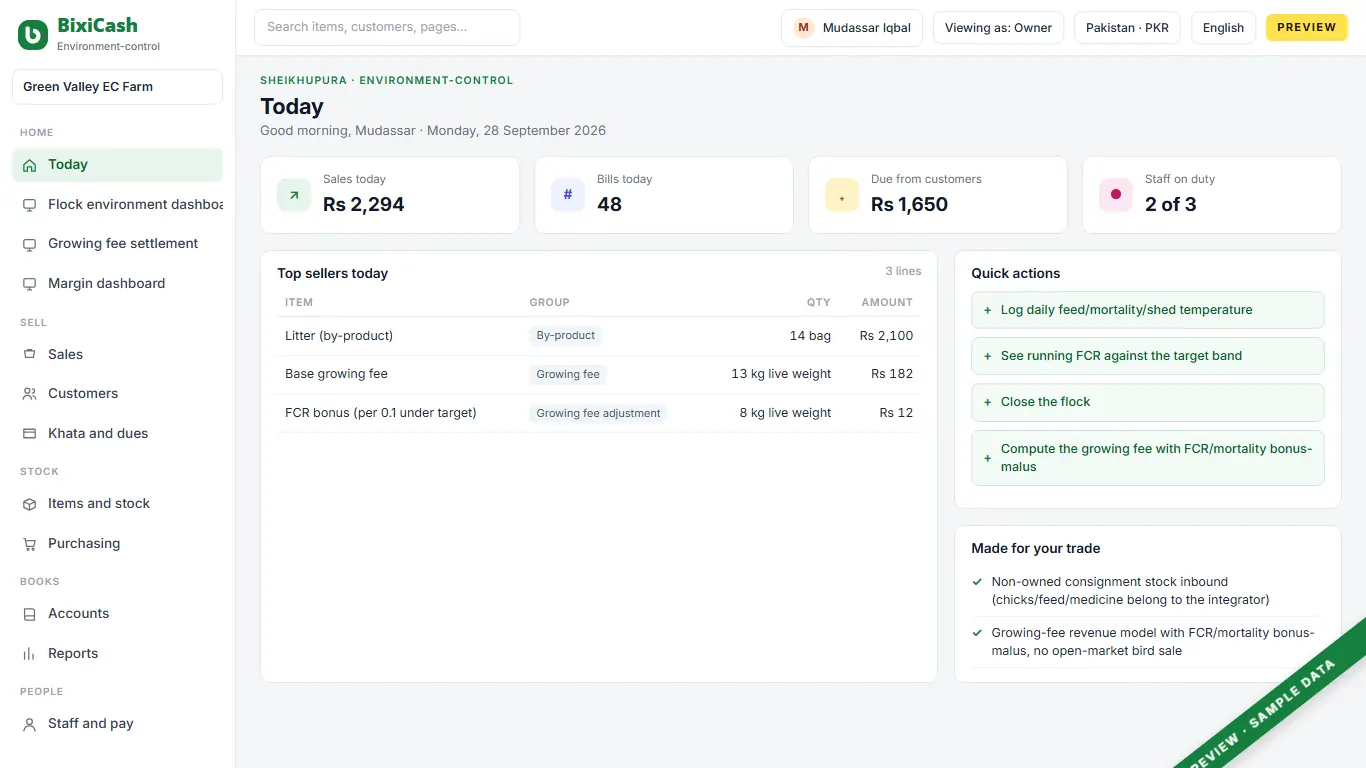
For an environment-control (EC) broiler shed growing under contract: chicks, feed and medicine belong to the integrator's own hatchery and feed mill, and the shed earns a growing fee per kilogram, adjusted by its flock's own feed-conversion ratio and mortality.
A working day
Daily
Chicks, feed and medicine arrive already owned by the integrator and are logged as consignment stock, never a purchase.
Through the day
The shed operator monitors ventilation and cooling and logs feed, mortality and shed temperature.
Ongoing
A running feed-conversion ratio is compared to the integrator's own target band.
At the end of a flock cycle
Birds are weighed out at market weight and handed to the integrator's own transport, on their way to the same market as an open-shed farm's birds or a live-bird trader.
At settlement
The accountant closes the flock and raises the integrator invoice, with any FCR or mortality bonus or penalty applied.
What goes wrong today
Stock that belongs to the integrator is easy to record as an ordinary purchase by mistake.
Electricity, diesel and labour cost are the grower's real profit lever, but they are easy to lose inside a bigger flock-cost picture that is mostly the integrator's.
Heat stress during an outage can raise mortality sharply, and a dispute over that mortality at settlement needs the outage on record.
An FCR or mortality bonus-malus against a contract's target band is easy to get wrong without the day's log behind it.
What it does
Parts marked Coming soon are on the way; founding shops get them first, at no extra charge.
Chicks, feed and medicine belong to the integrator throughout and are tracked as a memo quantity, never a purchase.
The fee is worked out from live weight delivered, adjusted by the flock's own FCR and mortality against the integrator's target bands.
Electricity, diesel and labour cost are meant to show against the fee earned, separate from bird economics that were never the grower's.
The flock costing engine built for the open-shed poultry farm prices this shed's very different revenue model without a special-cased screen.
Bills for the shed's own running costs are tracked as open items until paid.
A click-to-chat message can reach the team on a mortality spike or an outage; a person still presses send.
Who uses it
Owner / grower
to see the growing fee earned against the shed's own electricity and labour cost, separate from the integrator's bird economics
Shed operator / technician
to log feed, mortality and shed temperature and watch FCR against the integrator's target
Generator operator
to log fuel use and run backup power during an outage
Accountant
to bill the integrator per flock and track the shed's own utility cost
Behind the counter
The screens for your trade sit on a full set of books. These parts come with it.
Double-entry books, statements, period close.
Orders, supplier bills and what you owe.
Machines and vehicles, and their wear.
The numbers an owner asks for each morning.
On the counter
Bought together with the software: one delivery, one bill, set up to work.
The price
Introductory price. Local taxes are added where they apply. A second shop costs the same as the first. Prices for countries without their own page, in USD, as of 28 Sep 2026.
The first 50 shops in each country get free setup and data import with a yearly plan, and today's price locked for two years.
Claim a placeThis trade does not have its own price line yet. The price shown is our retail line, and we confirm it when we quote.
Straight answers
No. The design keeps them as a memo consignment quantity, never a purchase and never part of the shed's own cost of sales.
That is the plan; it is not built yet.
Yes, that is the design: the shed's electricity, diesel and labour cost are meant to be shown apart from stock that was never the grower's.
Planned: an outage is meant to sit on the same screen as any mortality spike it caused, for the settlement conversation that follows.
The flock-batch engine is the same one used for an open-shed poultry farm; only the revenue side changes, from a bird sale to a growing fee.
Same aisle
Twenty minutes on a call. We show your day on the screen, with your words and your stock.