Before dawn
Farm-gate purchase
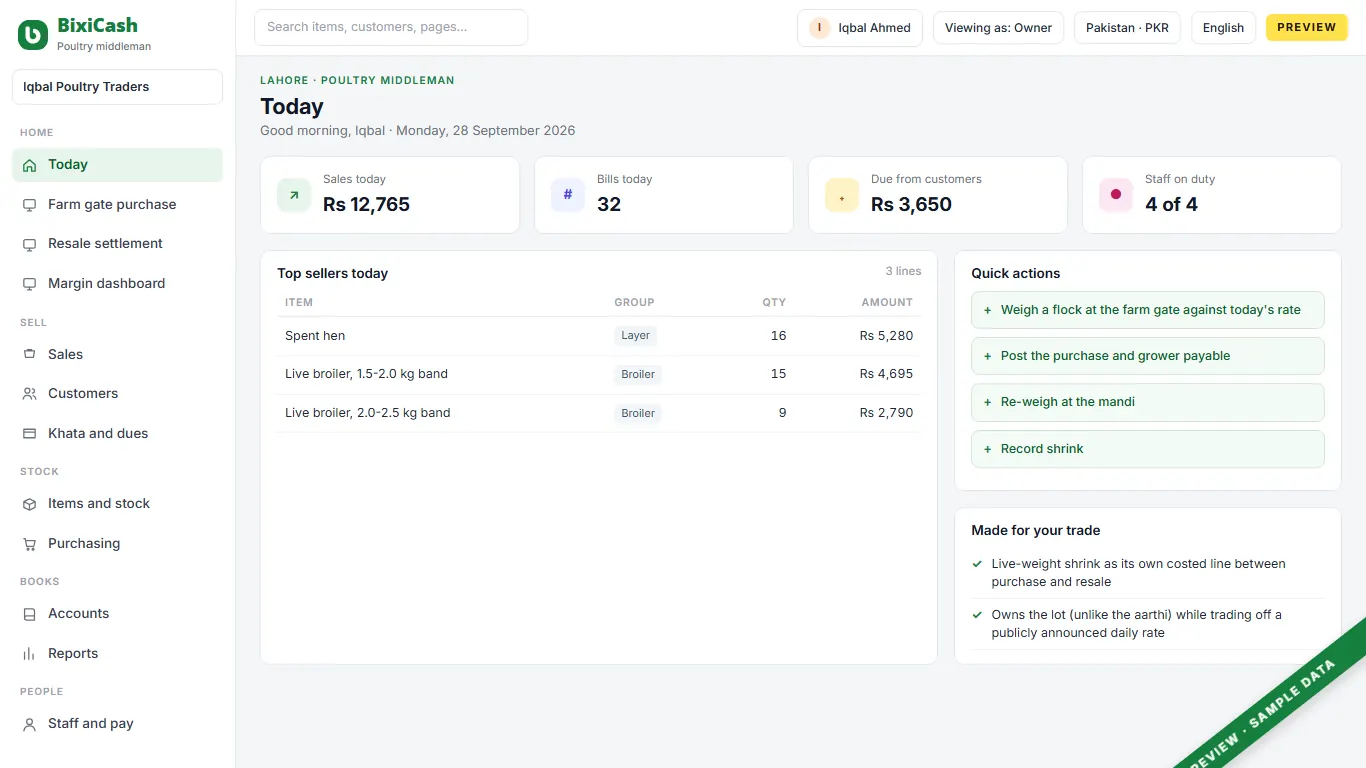
The weighman weighs a flock at the farm gate against today's announced rate, and the purchase posts as owned stock with a grower payable.

Coming soon Agriculture & Livestock
For a poultry middleman buying at the farm gate of an open-shed farm or a contract shed, and reselling into the mandi and poultry shops: today's announced rate prices both ends, with the live-weight shrink in between shown as its own honest number.
A working day
Before dawn
The weighman weighs a flock at the farm gate against today's announced rate, and the purchase posts as owned stock with a grower payable.
Early morning
The driver moves birds from farm to mandi, logging any death in transit along the way.
Morning
Birds are re-weighed at the mandi. The difference from the farm-gate weight posts as shrink, kept apart from margin.
Through the morning
Mandi buyers and poultry shops buy on cash or short credit, and the sale posts revenue and releases stock at cost.
Midday
The owner checks today's buy rate, sell rate, shrink and net margin per lot, the way a currency trader would.
What goes wrong today
Weight lost between farm-gate and mandi resale is a real cost, but it is easy to fold invisibly into a smaller, unexplained margin.
A bird that dies in the truck is a different cost from ordinary weight loss, but the two rarely get told apart on paper.
A grower paid within a few days, not on the spot, is easy to lose track of without a proper payable ageing.
Buy rate, sell rate and shrink usually only come together into a clear margin well after the birds are sold.
What it does
Parts marked Coming soon are on the way; founding shops get them first, at no extra charge.
A farm-gate purchase posts as owned stock at today's announced rate, not a consignment lot like the mandi aarthi's.
The weight lost between farm-gate and mandi resale weighing shows as its own honest number, never blended into margin.
A death in transit is meant to write off distinctly from ordinary shrink.
Buy rate, sell rate and shrink are meant to come together into a margin the owner can see the same day, not after the fact.
What is owed to a grower ages like any other payable, days rather than weeks.
A mandi buyer or shop on short credit gets a running account with ageing.
A click-to-chat message can reach a grower or buyer; a person still presses send.
Who uses it
Owner / trader
to see today's buy rate, sell rate, shrink and net margin at a glance
Weighman
to weigh a flock at the farm gate and again at resale, against today's rate
Driver / transporter
to move birds from farm to mandi and log any death in transit
Accountant
to post the grower payable, the buyer receivable and the shrink report
Behind the counter
The screens for your trade sit on a full set of books. These parts come with it.
Double-entry books, statements, period close.
Orders, supplier bills and what you owe.
What you hold, where, and what it cost.
The numbers an owner asks for each morning.
On the counter
Bought together with the software: one delivery, one bill, set up to work.
The price
Introductory price. Local taxes are added where they apply. A second shop costs the same as the first. Prices for countries without their own page, in USD, as of 28 Sep 2026.
The first 50 shops in each country get free setup and data import with a yearly plan, and today's price locked for two years.
Claim a placeThis trade does not have its own price line yet. The price shown is our retail line, and we confirm it when we quote.
Straight answers
Planned: unlike a mandi commission agent, a live-bird trader owns the lot, and the design records it as owned stock from the purchase itself. Not built yet.
That is the design: shrink between farm-gate and resale weighing is meant to be its own line, never blended into margin.
Planned, yes: a transit death is meant to write off on its own, distinct from ordinary weight loss.
That is the design goal, the way a currency trader would want to see a rate move; it has not been built yet.
Yes, a grower payable ages like any other payable until it is settled.
Same aisle
Twenty minutes on a call. We show your day on the screen, with your words and your stock.