Morning
Feed and water given
Shed attendants feed and water the flock and record any mortality from the tablet in the shed.

Coming soon Agriculture & Livestock
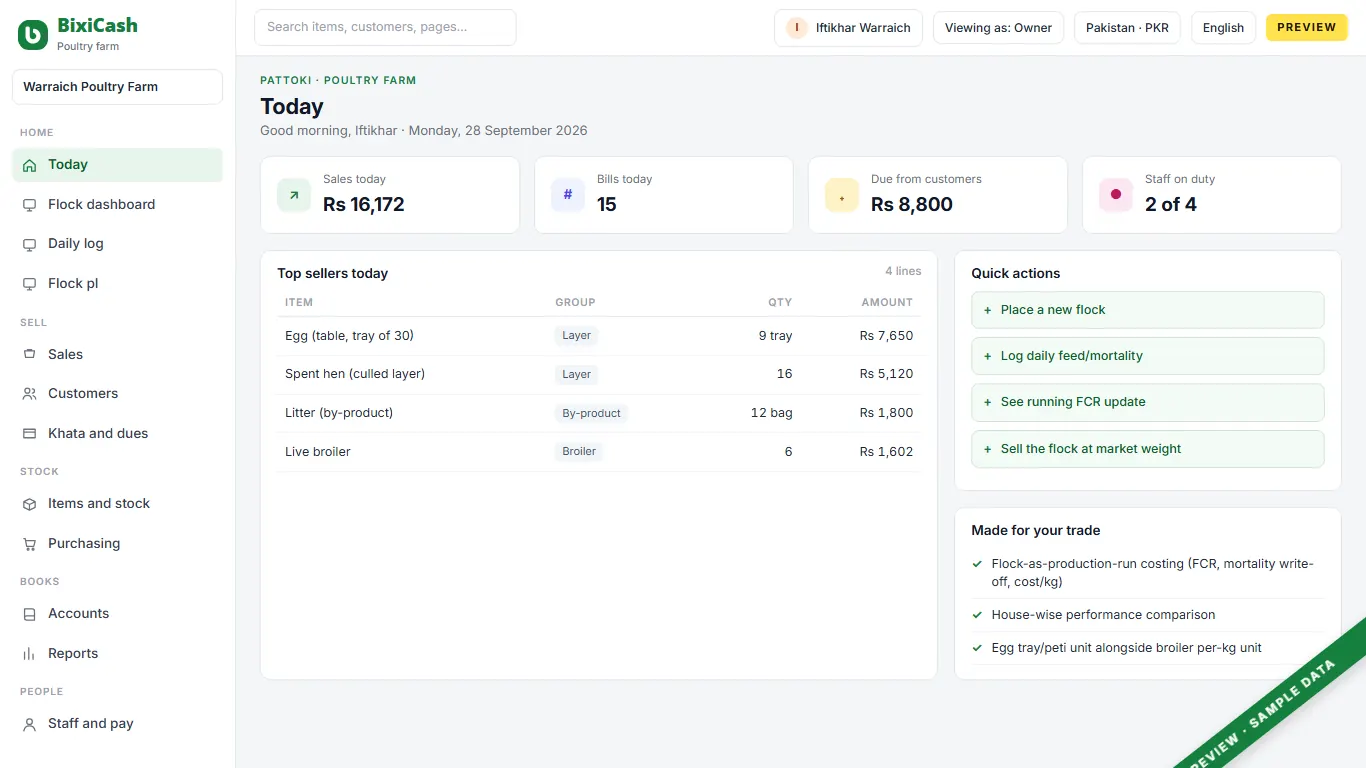
For an open-shed broiler or layer farm buying chicks from a hatchery and feed from a mill: every flock's chick, feed and medicine cost is meant to roll up into one cost per kilogram at sale to a live-bird trader or shop, next to the day's market rate.
A working day
Morning
Shed attendants feed and water the flock and record any mortality from the tablet in the shed.
Through the day
On the layer side, egg collection is logged by tray, kept apart from the broiler side's per-kilogram counting.
As the flock nears market age
The farm manager takes a weight sample and watches the running feed-conversion ratio (FCR).
At sale
Birds are sold by weight, at or near the day's announced market rate, to a live-bird trader or a poultry shop.
After sale
The owner checks feed, chick and medicine cost against sale revenue, and compares this flock or house against the last one.
What goes wrong today
Chick, feed and medicine cost scattered across five or six weeks are hard to add up into one figure before the bird is sold.
A dead bird is noted as a number, but its share of the feed and chick cost already spent rarely gets written off anywhere.
The broiler side sells by the kilogram and the layer side by the tray, and the two are easy to mix up in one set of books.
Two flocks, or two houses, are hard to compare side by side on FCR, mortality and cost per kilogram.
What it does
Parts marked Coming soon are on the way; founding shops get them first, at no extra charge.
Chick, feed and medicine cost accumulate against one flock, closing at sale into a true cost per kilogram.
A mortality entry is meant to write off that bird's share of the flock's accumulated cost, not just reduce a headcount.
Two flocks, or two houses, are meant to be compared side by side on FCR, mortality and cost per kilogram.
Nested pack counting, like a tray inside a peti, is shown in our demos; full support on every document, including purchases, is still being built.
Bills from the hatchery, feed mill and vet are tracked as open items until paid.
A live-bird trader or shop buying on short credit gets a running account with ageing.
A click-to-chat message can reach a buyer or the visiting vet; a person still presses send.
Who uses it
Owner
to see feed, chick and medicine cost against sale revenue as a real cost per kilogram, not an estimate
Farm manager
to place a flock, log daily feed and mortality, and see FCR update as it happens
Shed attendant
a fast way to record mortality and egg collection without touching the ledger
Accountant
to post feed bills, sale invoices and payroll against the right flock
Behind the counter
The screens for your trade sit on a full set of books. These parts come with it.
Double-entry books, statements, period close.
Orders, supplier bills and what you owe.
What you hold, where, and what it cost.
One staff register, attendance, pay runs.
The numbers an owner asks for each morning.
On the counter
Bought together with the software: one delivery, one bill, set up to work.
The price
Introductory price. Local taxes are added where they apply. A second shop costs the same as the first. Prices for countries without their own page, in USD, as of 28 Sep 2026.
The first 50 shops in each country get free setup and data import with a yearly plan, and today's price locked for two years.
Claim a placeThis trade does not have its own price line yet. The price shown is our retail line, and we confirm it when we quote.
Straight answers
Planned: a flock is meant to roll up chick, feed and medicine cost into FCR and cost per kilogram automatically. It is not built yet.
That is the design: a dead bird's share of accumulated feed and chick cost is meant to be written off, not just counted.
Nested pack counting, like a tray inside a peti, is shown in our demos, though full support on every document is still being built.
That is the plan for the flock dashboard; it has not been built yet.
No product-specific licence was found for a small farm at this scale; environment and effluent rules at larger scale still need confirming for your province.
Twenty minutes on a call. We show your day on the screen, with your words and your stock.