Morning
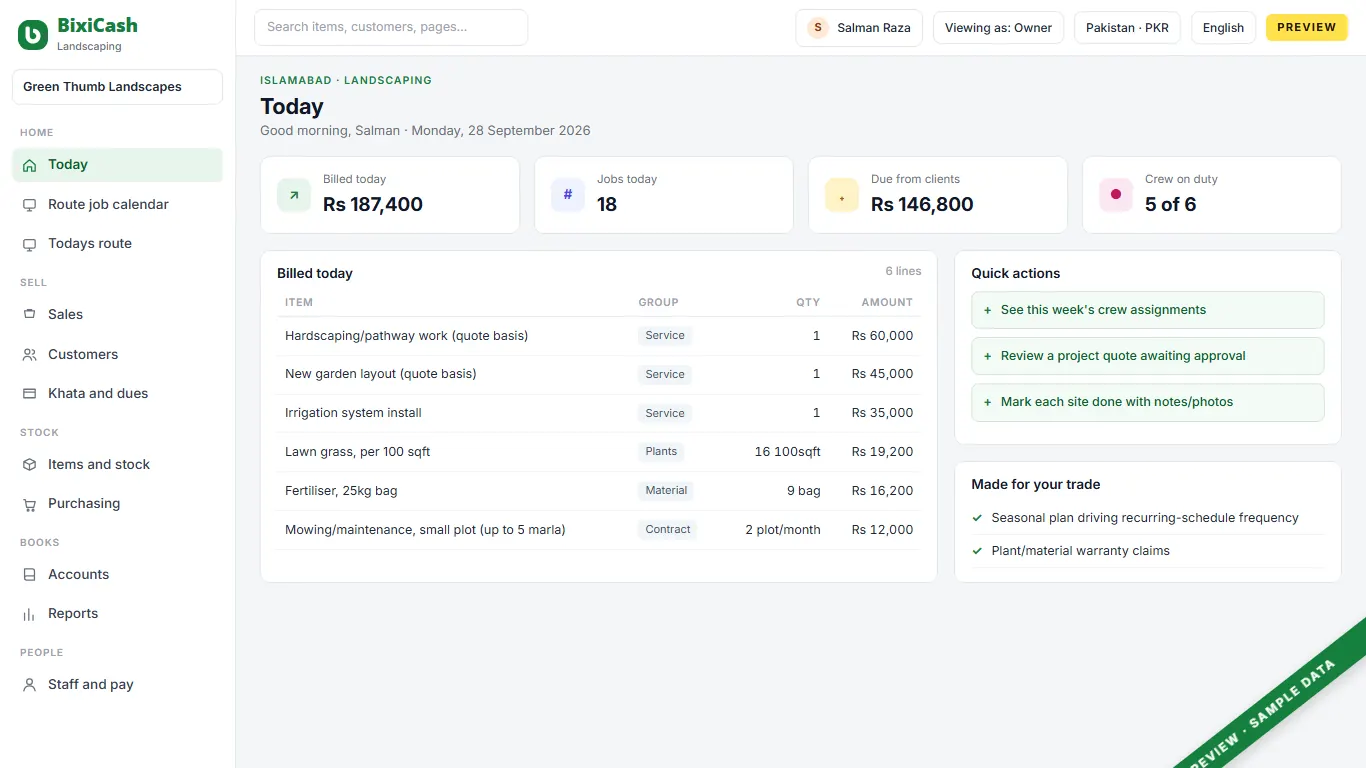
Crews take today's route
Recurring-contract stops and any scheduled project work sit on one route before the trucks leave.

Coming soon Construction, Property & Field Services
For a crew running mowing contracts and garden projects: one place to see today's route, let a seasonal plan set the right visit frequency, and bill a recurring contract every month without a spreadsheet.
A working day
Morning
Recurring-contract stops and any scheduled project work sit on one route before the trucks leave.
At each site
A note and a photo go against the site, so a dead plant or an irrigation fault isn't just remembered until someone asks.
Season change
A client's plan drives how often a site is visited, mowing weekly in monsoon and less often the rest of the year.
During a project
Once a client signs off a garden layout or hardscaping quote, it turns into a job with a deposit and a balance, not a separate piece of paper.
Month end
Every maintenance contract raises its own monthly invoice from the visit log.
What goes wrong today
A client going away for a season has no middle ground between full billing and losing the contract.
A dead plant inside its replacement-warranty window is hard to prove without a note from the original visit.
How many sites a crew actually finished today isn't visible until someone asks around.
A garden layout is quoted on paper and then re-entered as a job, so the two easily drift apart.
What it does
Parts marked Coming soon are on the way; founding shops get them first, at no extra charge.
Planned: a client's seasonal plan is meant to set how often a site is visited on its own, mowing weekly in monsoon and less often outside it, instead of a manual schedule change.
Planned: once a client signs off a garden-layout or hardscaping quote, it turns into a job with its own deposit and balance, carrying the same numbers through.
Planned: a recurring maintenance contract is meant to invoice itself every month from the visit log, instead of someone re-checking routes by hand.
A recurring client's invoices and ageing run on the same engine as any khata: what they owe, and since when.
Plant, shrub and fertiliser purchases post as vendor bills, the same accounts-payable engine as any other supplier.
Planned: how many sites each crew actually finished today, set against the route, without asking around.
A monthly invoice or an overdue balance pre-fills a WhatsApp message to the client; a person still presses send.
Who uses it
Owner / ops
sees this week's crew assignments and a project quote waiting on approval.
Crew lead
sees today's route and marks each site done with notes and photos.
Accounts
raises the monthly recurring invoices and tracks what each client owes.
Behind the counter
The screens for your trade sit on a full set of books. These parts come with it.
Double-entry books, statements, period close.
Cash, bank, cheques and reconciliation.
Orders, supplier bills and what you owe.
What you hold, where, and what it cost.
Quotations, orders, invoices, delivery notes.
One staff register, attendance, pay runs.
Machines and vehicles, and their wear.
The numbers an owner asks for each morning.
The price
Introductory price. Local taxes are added where they apply. A second shop costs the same as the first. Prices for countries without their own page, in USD, as of 28 Sep 2026.
The first 50 shops in each country get free setup and data import with a yearly plan, and today's price locked for two years.
Claim a placeThis trade does not have its own price line yet. The price shown is our retail line, and we confirm it when we quote.
Straight answers
Planned. Today the schedule is set and changed by hand; the seasonal-plan feature that drives it automatically is a build target.
Planned, carrying the same numbers from quote to job with a deposit and balance. It isn't built yet.
Planned. Recurring contract billing is a build target shared with other route-based trades; today an invoice is still raised by hand.
Planned as a crew-utilisation view; today that's tracked outside the product.
No. Plants aren't usually tracked by lot the way a regulated chemical or medicine is, so this trade uses simple, non-batched stock instead.
Twenty minutes on a call. We show your day on the screen, with your words and your stock.