A call comes in
The call is triaged
An emergency leak or drain problem is flagged red against a scheduled job.

Coming soon Construction, Property & Field Services
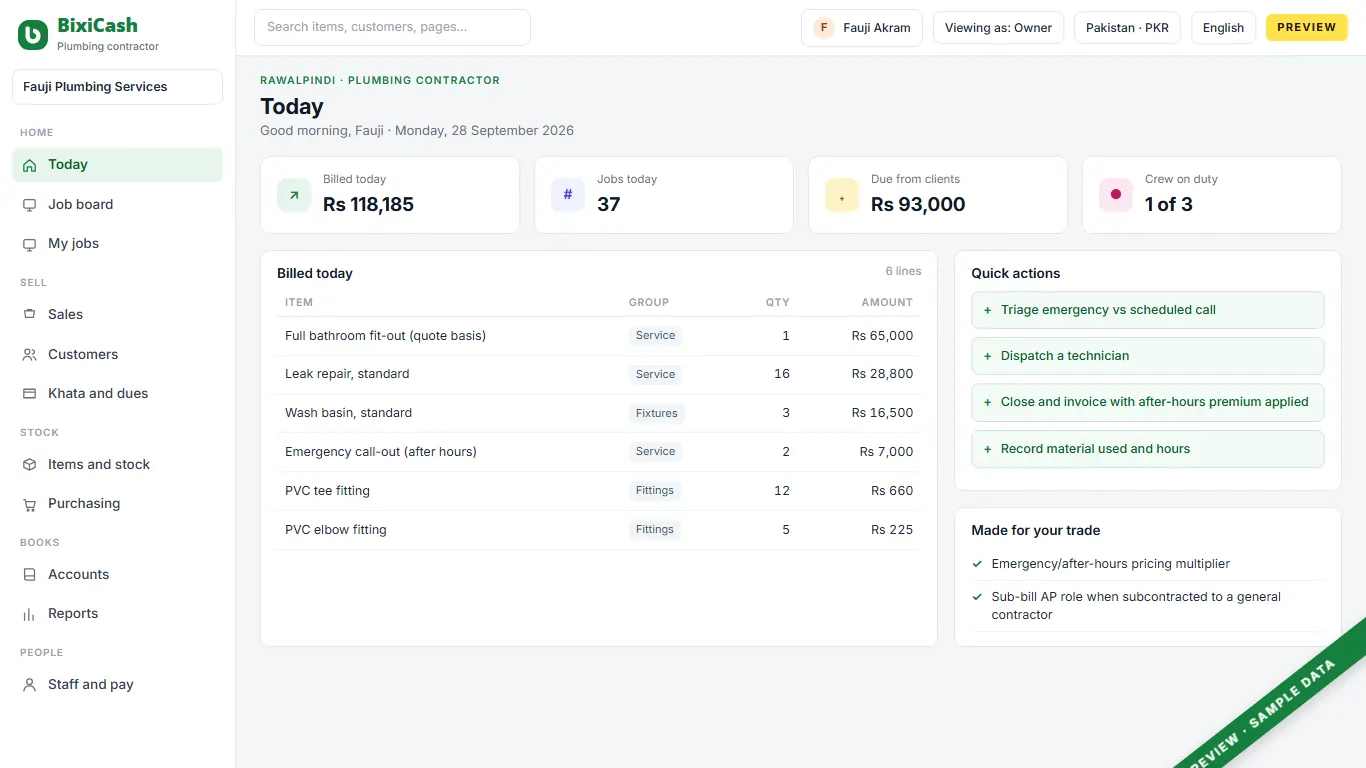
For a plumber triaging emergency and scheduled calls: dispatch a job, log parts and hours, and let the after-hours premium apply itself and show as its own line on the invoice, visible to the customer.
A working day
A call comes in
An emergency leak or drain problem is flagged red against a scheduled job.
On dispatch
The nearest technician is dispatched, with the after-hours flag carried on the job if it's outside normal hours.
On site
The technician records pipes, fittings and fixtures used, and the time taken, against the job.
On completion
An emergency job's after-hours multiplier is applied automatically and shown as its own line, not hidden in the price.
When working under a contractor
Fit-out work done as a subcontractor is billed to the general contractor as a sub-bill, with its own retention.
What goes wrong today
The technician forgets to add the emergency premium, or adds it inconsistently from job to job.
A job that turns into bigger repair work than quoted has no record of what changed and why the price moved.
Fit-out work billed as a subcontractor loses track of what retention is being held back until handover.
A leak that comes back has no link back to the original repair it's a callback on.
What it does
Parts marked Coming soon are on the way; founding shops get them first, at no extra charge.
Planned: an emergency job carries its after-hours multiplier automatically, shown as its own line on the invoice, not a hidden markup.
Planned: an emergency call is flagged red against the day's scheduled jobs, so it's never missed in the queue.
Planned: fit-out work billed to a general contractor posts as a sub-bill with its own retention held back, the same shape as a general contractor's own running bills.
Planned: material and hours logged on a job compute its real margin, next to the price it was quoted at.
Pipes, fittings and fixtures bought from a supplier are recorded as vendor bills, the same engine as any other accounts payable.
A regular residential or commercial client can run a balance on account, with the same ageing as any khata.
A finished invoice pre-fills a WhatsApp message to the customer; a person presses send.
Who uses it
Owner/dispatcher
triages emergency against scheduled calls, dispatches technicians, and closes jobs with the after-hours premium applied correctly.
Technician
receives the job, logs parts used and hours, and closes it with a note, without editing prices.
Office/accounts
invoices jobs, reorders parts, and raises sub-bills to general contractors for fit-out work.
Behind the counter
The screens for your trade sit on a full set of books. These parts come with it.
Double-entry books, statements, period close.
Cash, bank, cheques and reconciliation.
Orders, supplier bills and what you owe.
What you hold, where, and what it cost.
Quotations, orders, invoices, delivery notes.
One staff register, attendance, pay runs.
Machines and vehicles, and their wear.
The numbers an owner asks for each morning.
The price
Introductory price. Local taxes are added where they apply. A second shop costs the same as the first. Prices for countries without their own page, in USD, as of 28 Sep 2026.
The first 50 shops in each country get free setup and data import with a yearly plan, and today's price locked for two years.
Claim a placeThis trade does not have its own price line yet. The price shown is our retail line, and we confirm it when we quote.
Straight answers
Planned. Today there's no emergency-multiplier setting in the product.
The plan is for it to show as its own invoice line, not a hidden markup; this isn't built yet.
Planned: a sub-bill shaped like a general contractor's own running bills, with its own retention; not built yet.
Yes: khata on account, with ageing, is built and works today.
Planned. Today a callback would be logged as a fresh job, with no automatic link back.
Twenty minutes on a call. We show your day on the screen, with your words and your stock.