Enquiry
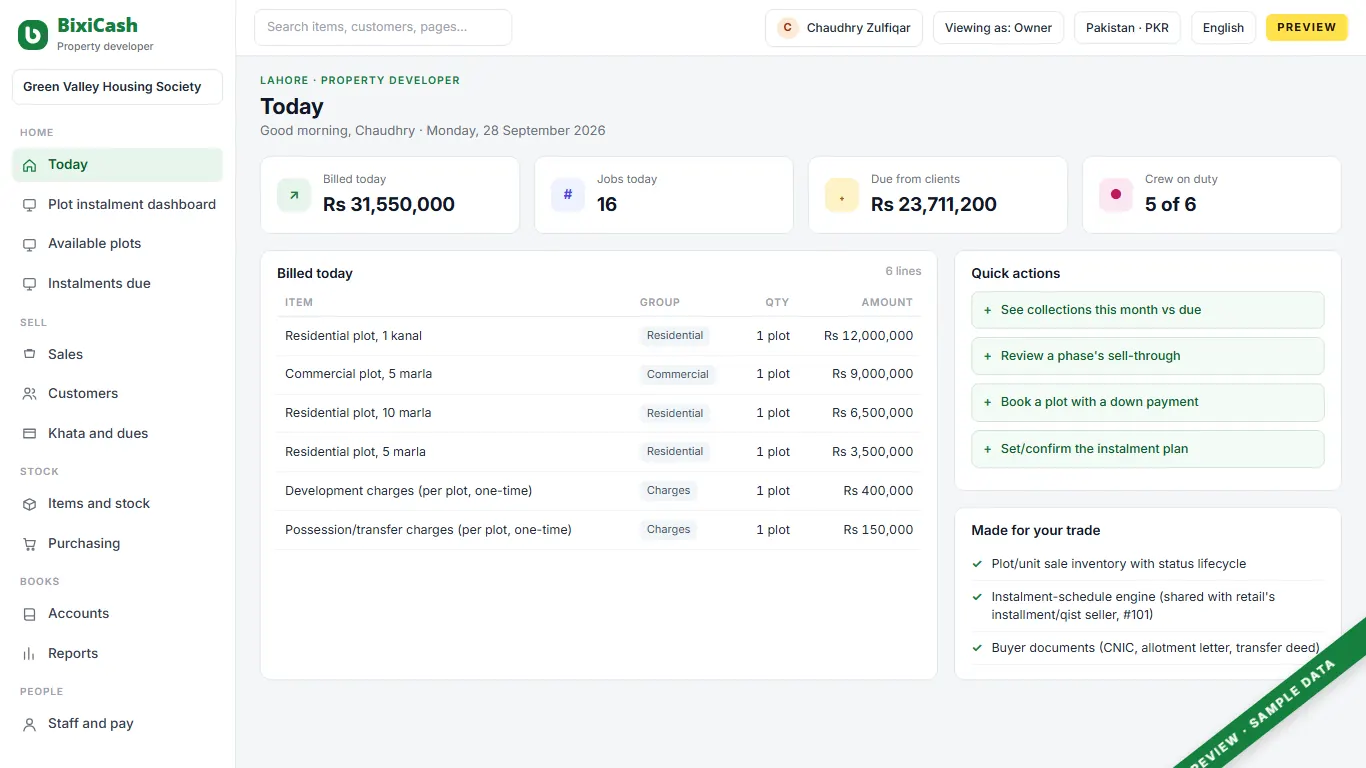
A plot is shown from the inventory
A buyer sees a plot's real status, available, booked, sold or cancelled, not a list that's gone stale.

Coming soon Construction, Property & Field Services
For a developer selling plots on instalments: one place to see the plot inventory by status, turn a booking into a multi-year instalment schedule, and track collections against what's actually due, not just invoiced.
A working day
Enquiry
A buyer sees a plot's real status, available, booked, sold or cancelled, not a list that's gone stale.
Booking
A down payment is taken, and a multi-year schedule of instalments generates itself from the plot price, term and frequency.
Monthly
A demand notice for this month's instalment reaches the buyer, reusing the same khata-reminder pattern as any other overdue balance.
Through the month
A payment is matched against the buyer's own schedule, and an overdue account is flagged by its due date, not just its invoice date.
Alongside
Roads, utilities and the boundary wall run as their own project, with a contractor's running bill and retention, inside the same books.
On default
A plot that's fallen too far behind is cancelled per the buyer agreement and goes back on the inventory board.
What goes wrong today
A down payment, a term and a frequency are worked into a payment plan on paper instead of generating themselves.
A buyer years into a plan can look current on an invoice-date report while actually behind on this month's instalment.
Cancelling and reselling a defaulted plot means untangling what was paid, what's forfeited and what's owed, by hand.
The development arm's own construction cost and the plot-sale ledger live as two separate records instead of one.
What it does
Parts marked Coming soon are on the way; founding shops get them first, at no extra charge.
Planned: a down payment, a term and a frequency are meant to generate the full multi-year instalment schedule on booking, the same engine a retail instalment seller needs too.
Planned: an overdue buyer is meant to be flagged by which instalment is actually due, not by the invoice date of the original sale.
Planned: a plot moves through available, booked, sold and cancelled-or-resold as one status, not a spreadsheet someone updates by hand.
Shown in our traders and pharmacy demos: a cheque tender with a post-dated cheque register; the product only posts cash or on-account today, so instalment cheques are a near-term build.
An instalment buyer's payments and balance run on the same engine as any khata, just carried over a much longer schedule.
Planned: roads, utilities and the boundary wall run as their own project, reusing a contractor's running-bill and retention shape, inside the same books as the plot sales.
An instalment due notice pre-fills a WhatsApp message to the buyer, reusing the same reminder pattern as any khata; a person still presses send.
Who uses it
Owner / sponsor
approves plot pricing and phase launches, and sees collections against what's due.
Sales agent
books a plot with a down payment and sets the instalment plan, seeing only their own bookings.
Accounts / collections clerk
raises instalment demands, records payments, flags overdue accounts and computes agent commission.
Site engineer
tracks the development arm's own project progress, roads, utilities, boundary wall, without pricing rights.
Behind the counter
The screens for your trade sit on a full set of books. These parts come with it.
Double-entry books, statements, period close.
Cash, bank, cheques and reconciliation.
Orders, supplier bills and what you owe.
What you hold, where, and what it cost.
Quotations, orders, invoices, delivery notes.
One staff register, attendance, pay runs.
Machines and vehicles, and their wear.
The numbers an owner asks for each morning.
More than one shop, one set of books.
The price
Introductory price. Local taxes are added where they apply. A second shop costs the same as the first. Prices for countries without their own page, in USD, as of 28 Sep 2026.
The first 50 shops in each country get free setup and data import with a yearly plan, and today's price locked for two years.
Claim a placeThis trade does not have its own price line yet. The price shown is our retail line, and we confirm it when we quote.
Straight answers
Planned. It's designed as one shared instalment-schedule engine, also used by a retail instalment seller; it isn't built yet.
Planned. Today ageing is invoice-date based; instalment-due-date ageing is a build target for this schedule shape.
Planned as part of the plot's own status lifecycle; today that's handled outside the product.
Shown in our traders and pharmacy demos as a cheque tender with a post-dated register; the product only posts cash or on-account today, so this is a near-term build for a developer.
We haven't confirmed how enforceable a buyer agreement's forfeiture clause is in practice; that's still an open question for us.
Twenty minutes on a call. We show your day on the screen, with your words and your stock.