Morning
Restock from the commissary
Stock moves from the commissary onto the van as a transfer, not a purchase, ready for tonight's pitch.

Coming soon Food, Hospitality & Events
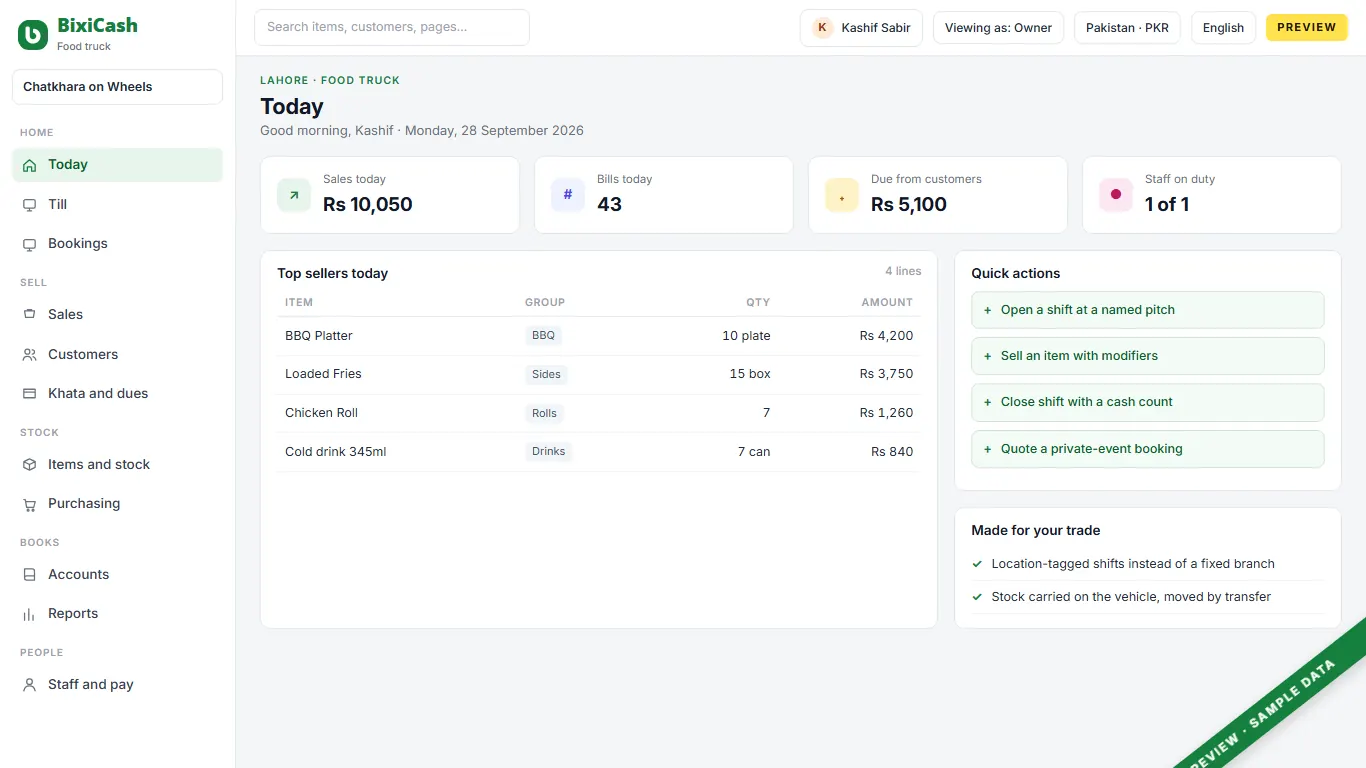
Open a shift against tonight's pitch instead of a fixed address, sell with the same till as any counter, and take a deposit on a wedding booking the same way a caterer would.
A working day
Morning
Stock moves from the commissary onto the van as a transfer, not a purchase, ready for tonight's pitch.
Drive to pitch
A shift is opened against a named pitch rather than a fixed branch, so the day's sales still report by location.
Evening trade
Items are sold with modifiers at the counter, cash and wallet payments taken as they come.
Close
Cash is counted at the pitch, and any unsold perishable stock is written off rather than silently carried over.
Private booking
A wedding or office lunch booking is quoted per head and a deposit is taken, tracked the same way a caterer tracks one.
What goes wrong today
A pitch with no signal has, in the past, meant a sale that simply could not be rung up at all.
Unsold perishable stock at the end of a rained-out night disappears without a record of what was lost.
A private-event deposit taken over the phone has no invoice or record tying it to the job.
A location that consistently underperforms looks the same in the numbers as a good one, because sales are never reported by pitch.
What it does
Parts marked Coming soon are on the way; founding shops get them first, at no extra charge.
A small relay hub will keep a shop selling through an outage; a van with no fixed connection at all is the clearest case for it.
Every sale at the pitch prints an itemised receipt from the same record used for the books.
A private-event deposit and its balance are tracked as an open account rather than a note in a phone.
A booking confirmation or reminder can be pre-filled into a WhatsApp message with one click.
A shift will open against a named pitch instead of a fixed branch, so sales, waste and fuel cost all report by location.
A compact stock list will move from the commissary to the van by transfer, not treated as a separate purchase each time.
Who uses it
Owner/operator
the till to work the same whether tonight's pitch has a signal or not
Helper/cook
to sell and prep at the same time without a complicated screen getting in the way
Owner (bookings)
a private event's quote and deposit tracked like any other job, not remembered by phone
Behind the counter
The screens for your trade sit on a full set of books. These parts come with it.
Double-entry books, statements, period close.
Orders, supplier bills and what you owe.
What you hold, where, and what it cost.
One staff register, attendance, pay runs.
Machines and vehicles, and their wear.
The numbers an owner asks for each morning.
On the counter
Bought together with the software: one delivery, one bill, set up to work.
The price
Introductory price. Local taxes are added where they apply. A second shop costs the same as the first. Prices for countries without their own page, in USD, as of 28 Sep 2026.
The first 50 shops in each country get free setup and data import with a yearly plan, and today's price locked for two years.
Claim a placeStraight answers
Not yet. A small relay hub that keeps a till selling through an outage is planned, and a van with no fixed connection is the clearest case for it.
Location-tagged shifts, so a sales report reads by pitch rather than by branch, are a planned build.
A deposit and its remaining balance can already be tracked as an open account, the same pattern used for any on-account customer.
Not yet. It will move as a stock transfer, not a purchase, since the commissary is usually the owner's own kitchen.
Yes, every sale prints an itemised receipt today.
Twenty minutes on a call. We show your day on the screen, with your words and your stock.