Morning
Time is logged
Developers and QA log time against tasks and tickets before the day's standup.

Coming soon Professional & Creative Services
For a software house billing export clients and local clients differently: log time against a project, watch its margin as you go, and keep the two revenue streams apart at tax time.
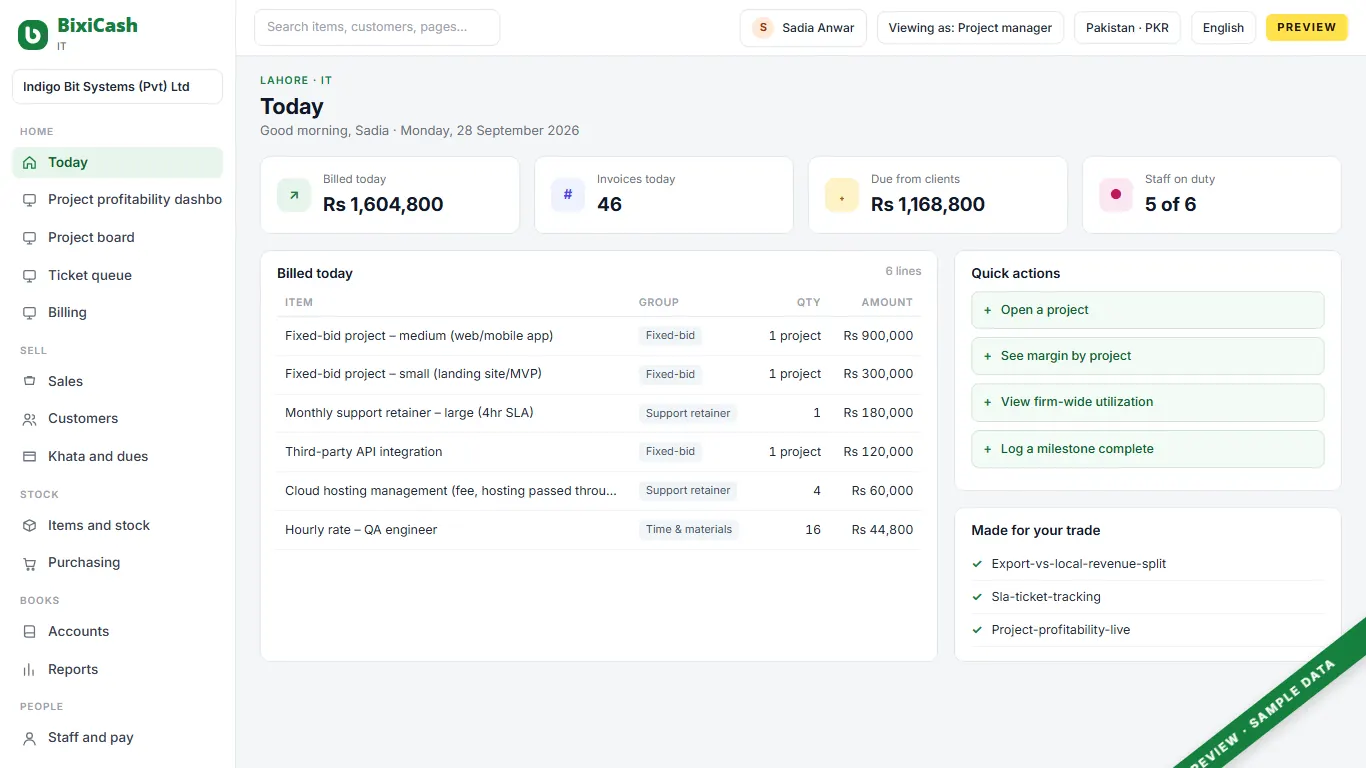
A working day
Morning
Developers and QA log time against tasks and tickets before the day's standup.
Through the day
The project manager checks actual cost against budget for every open project.
Ongoing
A support ticket is worked against its service-level agreement, not a general queue.
Month end
Signed-off timesheets become a milestone or time-and-materials invoice; retainer clients are billed on schedule.
Ongoing
What's landed from export clients is checked against the bank realisation the firm needs for its own compliance.
What goes wrong today
Actual cost against budget only becomes visible once the final invoice is being prepared.
Without a clear split at invoice time, an export sale risks the same tax treatment as a local one.
A support ticket runs past its service-level agreement and nobody sees it until the client complains.
Billable hours against available hours per developer is worked out rarely, not watched as it happens.
What it does
Parts marked Coming soon are on the way; founding shops get them first, at no extra charge.
A fixed-bid project's budgeted cost against actual cost from logged time will show before the final invoice, not after.
An export invoice and a local invoice will post to separate income accounts from the start, so the different tax treatment on each is never mixed up.
A support ticket will track time against its service-level agreement, so a breach shows on the dashboard, not only when the client complains.
Whichever way a client is billed, the invoice and its ageing run on the same core accounts-receivable engine.
Hosting, cloud and contractor or freelancer bills are recorded as vendor bills, the same engine as any other AP.
A billable-hours-against-available-hours report will show for each developer and for the firm, once time logging is built.
A project status or an invoice pre-fills a WhatsApp message to the client; a person presses send.
Who uses it
Founder / CEO
reviews project profitability and firm-wide utilization, not just the bank balance.
Project manager
assigns tasks, tracks milestones and approves timesheets, without changing billing rates.
Developer / QA
logs time against tasks and tickets, without seeing other projects' rates or margins.
Accounts / admin
raises invoices and keeps export revenue and local revenue clearly apart.
Behind the counter
The screens for your trade sit on a full set of books. These parts come with it.
Double-entry books, statements, period close.
Cash, bank, cheques and reconciliation.
Orders, supplier bills and what you owe.
Quotations, orders, invoices, delivery notes.
Tax on every line, by your country's rules.
One staff register, attendance, pay runs.
The numbers an owner asks for each morning.
More than one shop, one set of books.
The price
Introductory price. Local taxes are added where they apply. A second shop costs the same as the first. Prices for countries without their own page, in USD, as of 28 Sep 2026.
The first 50 shops in each country get free setup and data import with a yearly plan, and today's price locked for two years.
Claim a placeThis trade does not have its own price line yet. The price shown is our retail line, and we confirm it when we quote.
Straight answers
Not yet. Multi-currency is only a foundation today, so real USD invoicing and bank-realisation tracking is still being built.
That's the plan, so the different tax treatment is never guessed at invoice time. The project and billing feature behind it isn't built yet.
Planned, once logged time and cost are tied to a project. Today there's no project screen in the product.
Planned, alongside the same project and ticket work.
No. That's a bank-realisation check the firm would still do itself; it isn't part of the product today.
Twenty minutes on a call. We show your day on the screen, with your words and your stock.