Morning
A brief comes in
A campaign is opened against the client's brief before any task is assigned.

Coming soon Professional & Creative Services
For an agency billing a retainer, a campaign fee and the media or production spend it pays out first: one place to see what was paid, what's recharged, and whether the campaign is still inside budget.
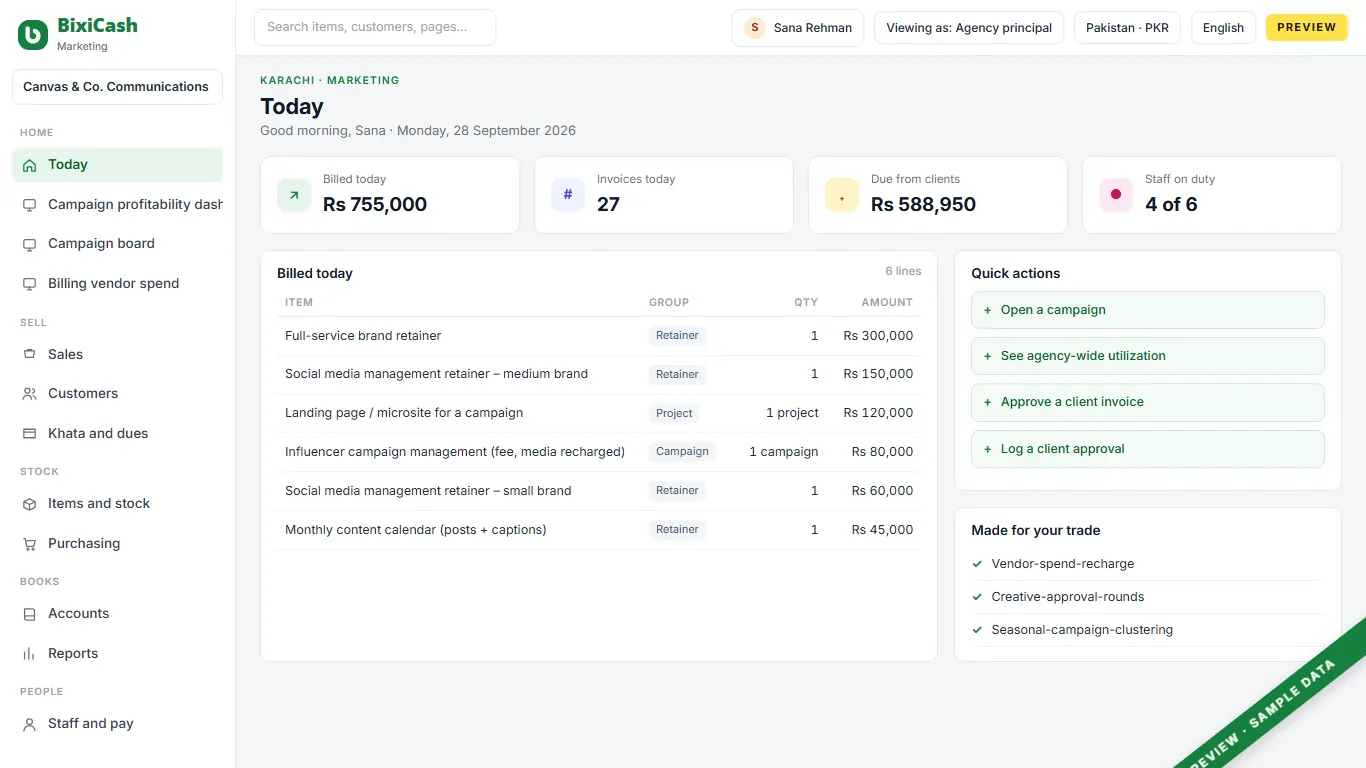
A working day
Morning
A campaign is opened against the client's brief before any task is assigned.
Through the day
Creative and production tasks are logged against the campaign, not a general to-do list.
As needed
Purchase orders go out for media, print or freelance work, tagged to the campaign.
Ongoing
Approval rounds are tracked against the original brief, not left to email threads.
Month end
Vendor spend is reconciled against what's recharged before the invoice goes out.
What goes wrong today
The agency pays a media house or printer first, creating a cash-flow gap until the client is billed.
Production spend against the campaign's budget only becomes clear once the job is finished.
Endless client revisions are hard to track against what was actually agreed at the start.
A cost arrives after billing and quietly eats into the campaign's margin.
What it does
Parts marked Coming soon are on the way; founding shops get them first, at no extra charge.
Planned: a vendor bill tagged as billable to a client flows onto the next client invoice at cost or an agreed markup, instead of being re-typed.
An approval flow like this is already shown in our demo elsewhere. Planned here so a revision round is tracked against what was actually briefed.
Planned: a campaign is a project with its own budget, staff and cost lines, the same shape as a law firm's matter or a studio's shoot.
Retainer invoices and campaign invoices run on the same accounts-receivable engine, with ageing by client.
A high line-count of small vendor bills, media houses, printers, freelancers, tracked the same way as any other AP.
Planned: a billable-versus-available-hours view for the agency, once time logging against a campaign is built.
A creative round or an invoice pre-fills a WhatsApp message; a person presses send.
Who uses it
Agency principal
sees campaign profitability and agency-wide utilization, and signs off client invoices.
Account manager
manages the brief, timelines and client approvals, without changing vendor payment terms.
Creative / producer
logs time against campaigns and tracks asset versions, without seeing client-side rates.
Finance / admin
runs retainer invoicing and reconciles vendor spend against what's recharged.
Behind the counter
The screens for your trade sit on a full set of books. These parts come with it.
Double-entry books, statements, period close.
Orders, supplier bills and what you owe.
Quotations, orders, invoices, delivery notes.
One staff register, attendance, pay runs.
Machines and vehicles, and their wear.
The numbers an owner asks for each morning.
The price
Introductory price. Local taxes are added where they apply. A second shop costs the same as the first. Prices for countries without their own page, in USD, as of 28 Sep 2026.
The first 50 shops in each country get free setup and data import with a yearly plan, and today's price locked for two years.
Claim a placeThis trade does not have its own price line yet. The price shown is our retail line, and we confirm it when we quote.
Straight answers
That's the plan. Today it would still need to be re-entered by hand; the billable-cost link isn't built yet.
Planned, as part of the same project and campaign design the whole firm needs; not built today.
Planned, once time logging against a campaign exists.
Both patterns are real; the demo's first cut is expected to show the agency paying and recharging, since that's the harder case to prove.
Not confirmed either way; we haven't verified whether a legacy advertisement-specific tax still applies in any province.
Twenty minutes on a call. We show your day on the screen, with your words and your stock.