Morning
The cause list is checked
Every open matter's next hearing shows on today's diary before anyone leaves for court.

Coming soon Professional & Creative Services
For a chamber running matters, hearings and client-trust money: one place to see a matter's next hearing, its billed balance, and what is still the client's, not the firm's.
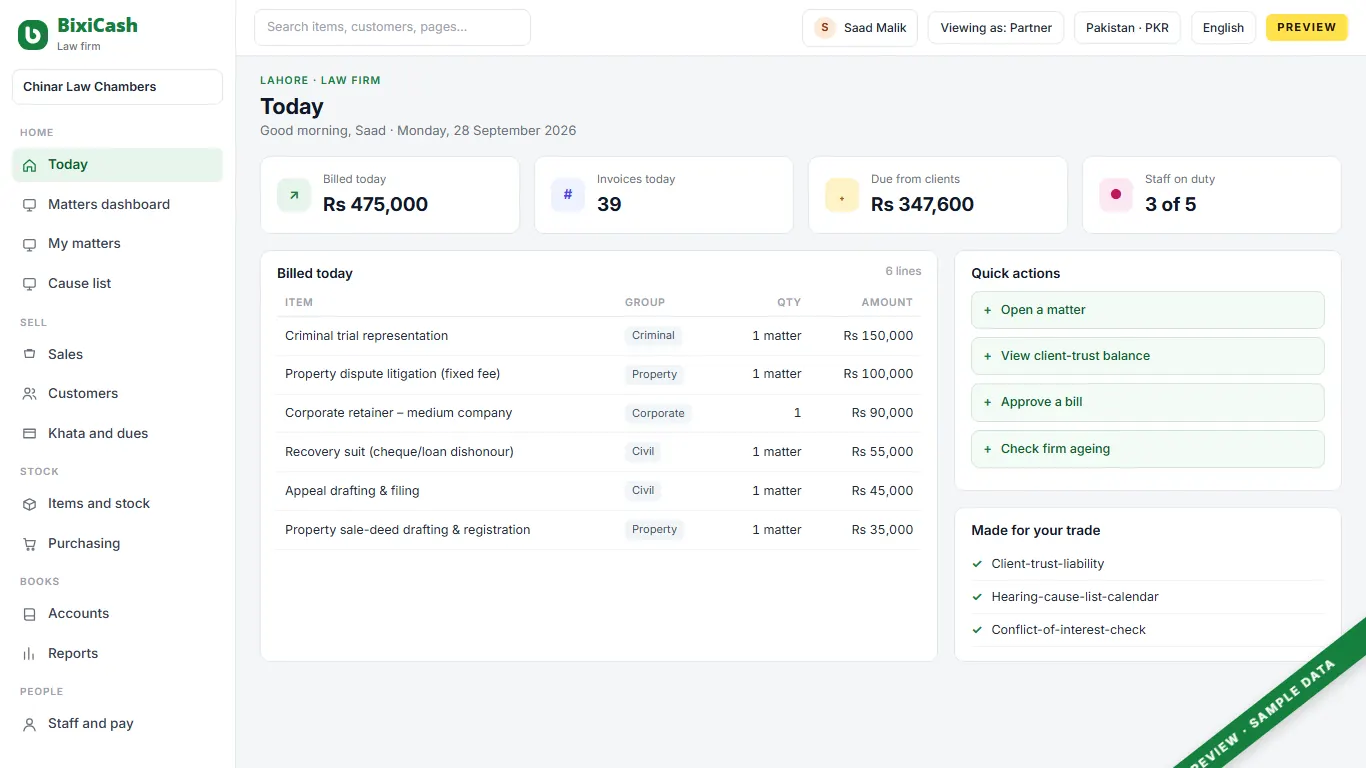
A working day
Morning
Every open matter's next hearing shows on today's diary before anyone leaves for court.
Intake
A conflict check, a vakalatnama, and an advance fee taken as the client's money, not the firm's.
After a hearing
The result and the next date are recorded straight after court, not from memory the next day.
As work is done
Court fees and process-server costs paid on the client's behalf are tagged to the matter as they happen.
Month end
A milestone reached, or a retainer client's monthly bill, draws down only the earned part of the advance.
What goes wrong today
Money taken to hold a matter is at risk of being treated as income before the matching work is actually billed.
Tomorrow's cause list lives in a diary or in someone's memory, not pulled automatically from every open matter.
A court fee or a process-server payment is made on the client's behalf and quietly never makes it onto the bill.
A client's own advance and the firm's actually-earned fee show up as one number instead of two.
What it does
Parts marked Coming soon are on the way; founding shops get them first, at no extra charge.
Planned: an advance fee posts as a liability owed to the client, never as income, until the matching work is actually billed.
Planned: every open matter's next hearing date builds tomorrow's cause list automatically; an adjournment rolls the date forward on its own.
Planned: a new matter checks against existing clients before it's opened, so a conflict is caught before an advance fee is taken.
Client balances and ageing use the same engine as any khata, but only count what's actually been billed, never the client's own trust money.
Court fees, process-server and expert-witness costs are recorded as vendor bills, so what's recoverable from the client is never lost.
An approval flow like this is already shown in our demo elsewhere. Planned here for case files, drafts and versions moving through review.
A hearing date or a bill pre-fills a WhatsApp message to the client; a person presses send.
Who uses it
Partner / advocate
sees every matter's client-trust balance and signs off a bill before it goes out.
Associate
drafts, researches, and logs time and hearing outcomes, without finalising a client bill.
Clerk (munshi)
files documents, tracks the cause list, and pays court fees, without seeing fee arrangements.
Office manager / accountant
keeps the client-trust ledger, runs billing, and tracks disbursements for recharge.
Behind the counter
The screens for your trade sit on a full set of books. These parts come with it.
Double-entry books, statements, period close.
Cash, bank, cheques and reconciliation.
Orders, supplier bills and what you owe.
Quotations, orders, invoices, delivery notes.
One staff register, attendance, pay runs.
The numbers an owner asks for each morning.
The price
Introductory price. Local taxes are added where they apply. A second shop costs the same as the first. Prices for countries without their own page, in USD, as of 28 Sep 2026.
The first 50 shops in each country get free setup and data import with a yearly plan, and today's price locked for two years.
Claim a placeThis trade does not have its own price line yet. The price shown is our retail line, and we confirm it when we quote.
Straight answers
No, by design. It's planned to post as a liability until the matching work is billed. This isn't built yet.
Planned. Today there is no hearing-diary screen in the product.
That depends on the role permissions set for a clerk; fee arrangements are meant to stay visible only to the lawyer and accountant.
Yes, as vendor bills tagged to the matter, using the same accounts-payable engine as any other bill.
We haven't confirmed a formal requirement either way; today this is treated as good practice to build for, not a compliance rule we can certify.
Twenty minutes on a call. We show your day on the screen, with your words and your stock.