Opening
The drinks till opens
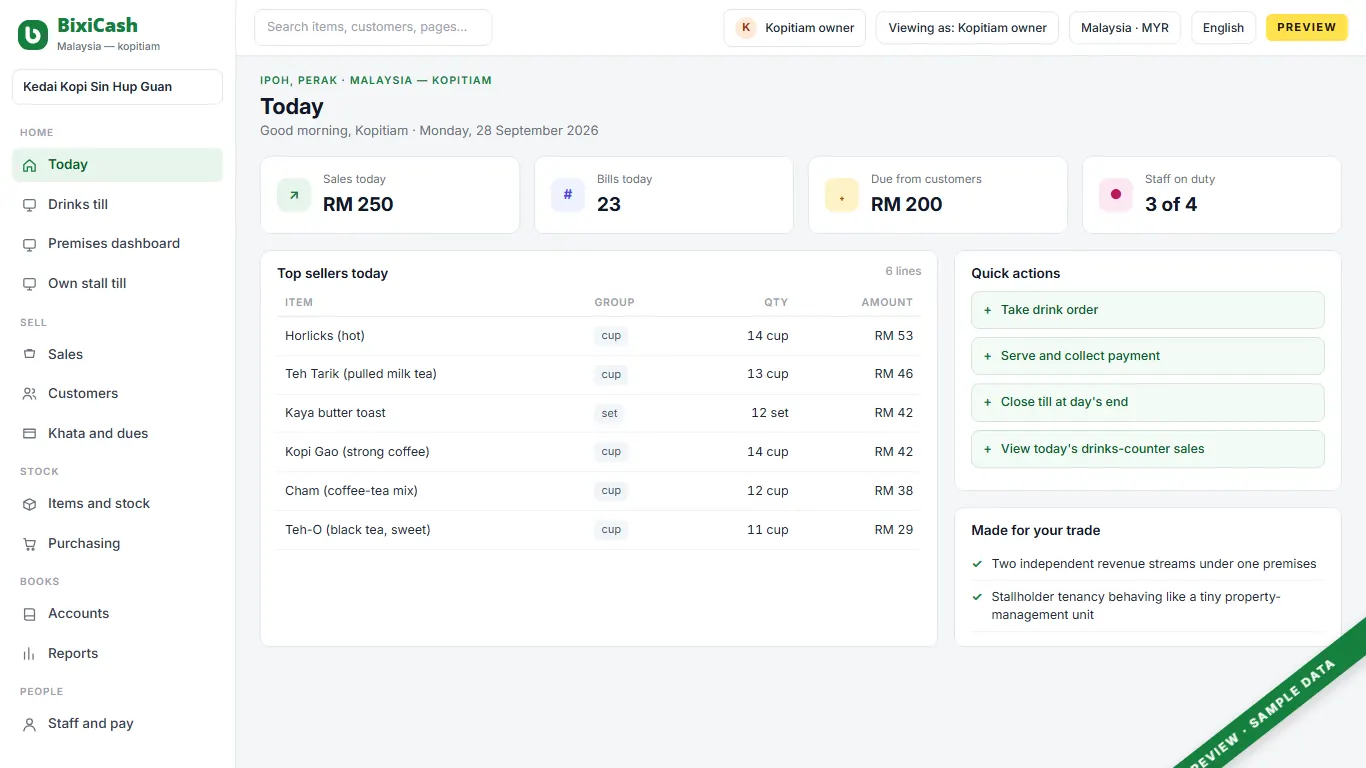
The counter operator opens the drinks till for the day's walk-in trade.

Coming soon Local businesses by country
For a Malaysian kopitiam where the owner runs the drinks counter and independent stallholders rent space for their own food stalls, keeping two sets of books, drinks sales and stall rent, under one premises.
A working day
Opening
The counter operator opens the drinks till for the day's walk-in trade.
Through the day
Each stallholder opens their own till and runs their own food sales, entirely separate from the drinks counter.
Evening
The drinks till is reconciled on its own, separate from any stallholder's sales.
Monthly
The owner collects stall rent from each stallholder and reviews any arrears.
Monthly
The owner reviews the drinks counter's own profit and loss, and the premises' combined income, side by side.
What goes wrong today
The drinks counter's sales and the stall rent collected are two separate paper records with no connection between them.
A stall vacancy loses the old stallholder's rent history when it's re-let.
A shared-utility recharge is worked out by hand and apportioned across stallholders.
There's no one number for what the whole premises actually earns: drinks plus rent together.
What it does
Parts marked Coming soon are on the way; founding shops get them first, at no extra charge.
Our till is already used for a straightforward counter sale; running the drinks counter and a stallholder's own till side by side, each seeing only their own sales, is the next step for this trade.
Planned: a stallholder tenancy that behaves like a small property-management unit — a monthly rent, an arrears list, a vacancy that can be re-let without losing history.
Planned: a shared utility cost apportioned automatically across active stallholders.
The tax engine lets drinks income and rental income carry different tax codes, without a country's rule hard-coded.
A WhatsApp button pre-fills a rent-due reminder for a stallholder; a person still presses send.
Stock is tracked by location across the product, for an owner running more than one kopitiam premises.
Planned: the whole premises' income, drinks plus rent, as one owner-level number, alongside each stream broken out.
Who uses it
Counter operator
To take a drink order, serve it and collect payment quickly.
Kopitiam owner
The drinks counter's own accounts and the stall rent due and collected, side by side.
Stallholder (tenant)
Their own till and their own day's sales, never anyone else's.
Behind the counter
The screens for your trade sit on a full set of books. These parts come with it.
Double-entry books, statements, period close.
Cash, bank, cheques and reconciliation.
Orders, supplier bills and what you owe.
What you hold, where, and what it cost.
Quotations, orders, invoices, delivery notes.
Tax on every line, by your country's rules.
One staff register, attendance, pay runs.
The numbers an owner asks for each morning.
More than one shop, one set of books.
On the counter
Bought together with the software: one delivery, one bill, set up to work.
The price
Introductory price. Local taxes are added where they apply. A second shop costs the same as the first. Prices for countries without their own page, in USD, as of 28 Sep 2026.
The first 50 shops in each country get free setup and data import with a yearly plan, and today's price locked for two years.
Claim a placeStraight answers
Planned: two tills, drinks and stall, each seeing only its own sales. Today this is a design, not a shipped screen.
Planned: a rent-due list per stallholder, separate from the drinks counter's own sales.
The tax engine lets each income stream carry its own tax code; a specific SST rate would need to be entered by hand, not something calculated for you today.
Planned: a stall record that keeps its rent history even after the tenant changes.
Planned: drinks and rent shown side by side and combined into one owner-level total.
Twenty minutes on a call. We show your day on the screen, with your words and your stock.