Morning
Cutting starts
The cutting master cuts today's planned styles against the order's fabric allowance.

Coming soon Local businesses by country
For a small garment factory that cuts and sews to a lead exporter's spec at a negotiated CM rate per dozen, tracking line output, defects and fabric use against each order's real cost.
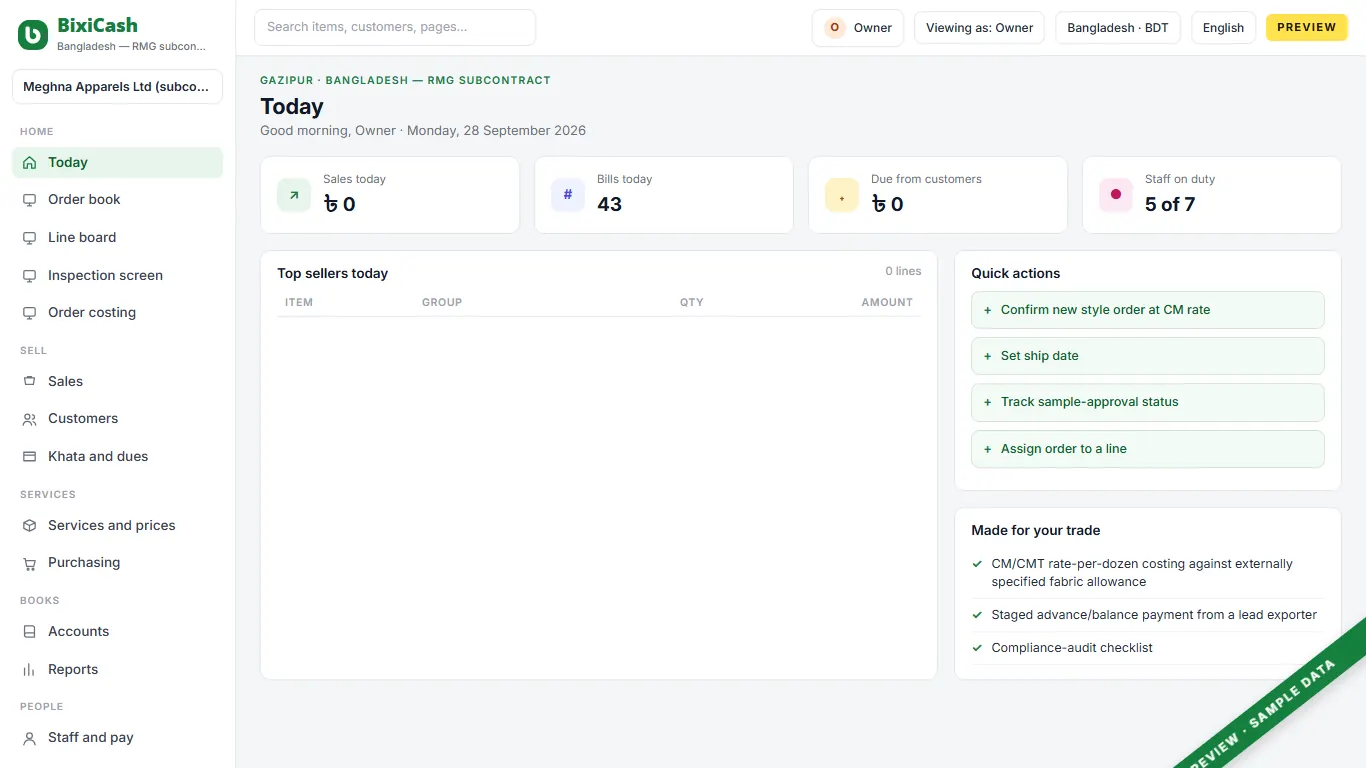
A working day
Morning
The cutting master cuts today's planned styles against the order's fabric allowance.
Through the shift
The line supervisor assigns bundles to a line and logs output against target, flagging any line falling behind.
Continuously
Quality-in-charge inspects in-line and end-of-line, holding defective pieces for rework.
Afternoon
A finished, passed lot is signed off as shipment-ready and packed.
Weekly
The accountant reviews CM revenue earned against labour and fabric cost for every order in progress, and records a staged payment received.
What goes wrong today
A CM rate that looked profitable on paper is only proven right or wrong by hand, at month-end.
A defect or rework event gets logged on paper and loses track of which bundle it belongs to.
Fabric consumption against the order's planned allowance is reconciled late, after a shortfall has already cost money.
A staged payment — advance now, balance on shipment — is chased and matched to the wrong order.
What it does
Parts marked Coming soon are on the way; founding shops get them first, at no extra charge.
Planned: a style/order entered with its CM rate, quantity and ship date, immediately showing a target margin.
Planned: daily line output rolling up automatically into percent-of-order-complete and days-to-ship-date at the current pace.
Planned: a defect or rework event logged against the bundle it belongs to, not a general note.
Each pay period already posts as one balanced accounting entry; a full pay run for piece-rate operators alongside monthly staff is still being built.
Attendance is shown in our school and restaurant demos; it isn't in the product yet, and piece-rate pay depends on it here more than almost anywhere else.
The tax engine lets you set a rate or exemption per company without a country hard-coded, for wherever an export-linked tax rule applies.
Stock is tracked by location in the product, for a company running more than one production unit.
Who uses it
Merchandiser
To confirm a style order's CM rate, quantity and ship date, and track sample approval.
Production/line supervisor
Today's output against target, by line, without waiting for a paper tally.
Quality-in-charge
A defect logged against the right bundle, not lost in a general note.
Accountant/owner
To see, order by order, whether the CM rate is actually being eaten by overtime, rework or a fabric shortfall.
Behind the counter
The screens for your trade sit on a full set of books. These parts come with it.
Double-entry books, statements, period close.
Orders, supplier bills and what you owe.
What you hold, where, and what it cost.
Quotations, orders, invoices, delivery notes.
Tax on every line, by your country's rules.
One staff register, attendance, pay runs.
Machines and vehicles, and their wear.
The numbers an owner asks for each morning.
More than one shop, one set of books.
On the counter
Bought together with the software: one delivery, one bill, set up to work.
The price
Introductory price. Local taxes are added where they apply. A second shop costs the same as the first. Prices for countries without their own page, in USD, as of 28 Sep 2026.
The first 50 shops in each country get free setup and data import with a yearly plan, and today's price locked for two years.
Claim a placeThis trade does not have its own price line yet. The price shown is our retail line, and we confirm it when we quote.
Straight answers
Planned: an order-costing view showing CM revenue earned against labour and fabric cost as the order runs, not only after month-end.
Planned: a full pay run for piece-rate operators with a guaranteed minimum. Today each pay period posts as one balanced entry; the pay run itself is still being built.
Planned: daily line output rolling up into a days-to-ship-date figure at the current pace.
Shown in our school and restaurant demos, not yet this trade's own. Attendance matters more here than almost anywhere else, since piece-rate pay depends on it.
Planned: a receivable schedule per order for an advance now, balance on shipment, and any quality-inspection holdback.
Twenty minutes on a call. We show your day on the screen, with your words and your stock.