Lunch and evening
Orders are rung up
Counter and phone orders are rung up, each at its correct VAT rate.

Coming soon Local businesses by country
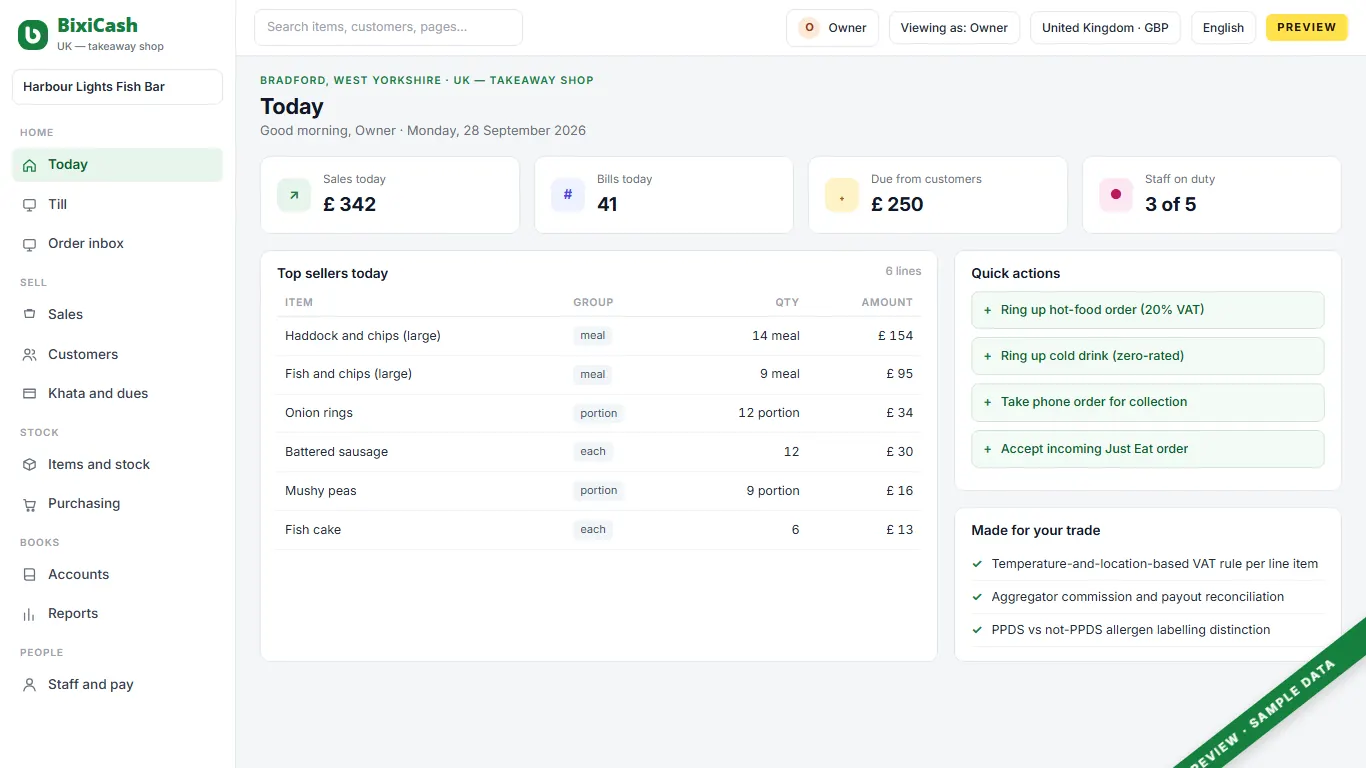
For a British chippy, curry house or kebab shop, applying the right VAT to a hot or cold item automatically, and bringing counter and delivery-aggregator orders into one order screen.
A working day
Lunch and evening
Counter and phone orders are rung up, each at its correct VAT rate.
Continuously
The delivery-order handler accepts incoming aggregator orders and confirms a prep time.
Through service
The fryer/cook works from a kitchen ticket for each order, counter or aggregator.
Closing
The till is reconciled, split between counter cash/card and aggregator settlement due.
Weekly
The aggregator payout is reconciled against the orders actually taken, and the VAT return's hot/cold/eat-in split is reviewed.
What goes wrong today
The hot-versus-cold VAT rule trips up manual bookkeeping every quarter.
An aggregator payout is trusted on faith, without checking it against the orders actually taken.
A cancelled aggregator order, after prep has already started, is a cost no one tracks.
Counter and aggregator orders live in two different places, at a busy pass.
What it does
Parts marked Coming soon are on the way; founding shops get them first, at no extra charge.
Planned: a till that applies standard-rated VAT to hot food and eat-in automatically, and zero-rates most cold takeaway food, line by line.
Planned: an aggregator order accepted, prepped and handed off inside the same screen as a counter order.
Planned: a weekly aggregator payout checked automatically against the orders taken, flagging any shortfall.
The tax engine defines codes and rates per company with nothing hard-coded; a UK VAT rule would be set up as a rate today, not applied for you automatically yet.
Planned for later: Making Tax Digital record-keeping for VAT. Not built yet.
Each pay period already posts as one balanced accounting entry; a full pay run for hourly, rota-driven staff is still being built.
Who uses it
Counter/till operator
The right VAT applied without thinking about it, order after order.
Delivery-order handler
An aggregator order and a counter order on the same screen.
Fryer/cook
A kitchen ticket, not a shouted order, at a busy fryer.
Owner/manager
The counter-versus-aggregator sales split and the weekly payout reconciled.
Behind the counter
The screens for your trade sit on a full set of books. These parts come with it.
Double-entry books, statements, period close.
Cash, bank, cheques and reconciliation.
Orders, supplier bills and what you owe.
What you hold, where, and what it cost.
Tax on every line, by your country's rules.
One staff register, attendance, pay runs.
The numbers an owner asks for each morning.
On the counter
Bought together with the software: one delivery, one bill, set up to work.
The price
Introductory price. Local taxes are added where they apply. A second shop costs the same as the first. Prices for countries without their own page, in USD, as of 28 Sep 2026.
The first 50 shops in each country get free setup and data import with a yearly plan, and today's price locked for two years.
Claim a placeStraight answers
Planned: a per-item VAT rule based on hot/cold and eat-in/takeaway. Today VAT codes are set up by hand, not applied by a built-in food-temperature rule.
Planned: an aggregator order inbox next to counter orders on one screen. It hasn't shipped yet.
Planned: reconciling a weekly payout against the orders taken, to flag a shortfall.
Not yet. It's planned; today VAT record-keeping would need your own MTD bridging software, not something built in.
That depends on the item: cooked-to-order food handed over unpackaged is usually outside PPDS labelling rules; a pre-packed item would need its own label. We don't decide this for a specific menu item; that stays your own food-safety judgement to make.
Twenty minutes on a call. We show your day on the screen, with your words and your stock.