Morning
Molding begins
Patheras mold bricks for the day; the munshi records each worker's count against their piece-rate ledger.

Coming soon Manufacturing & Process
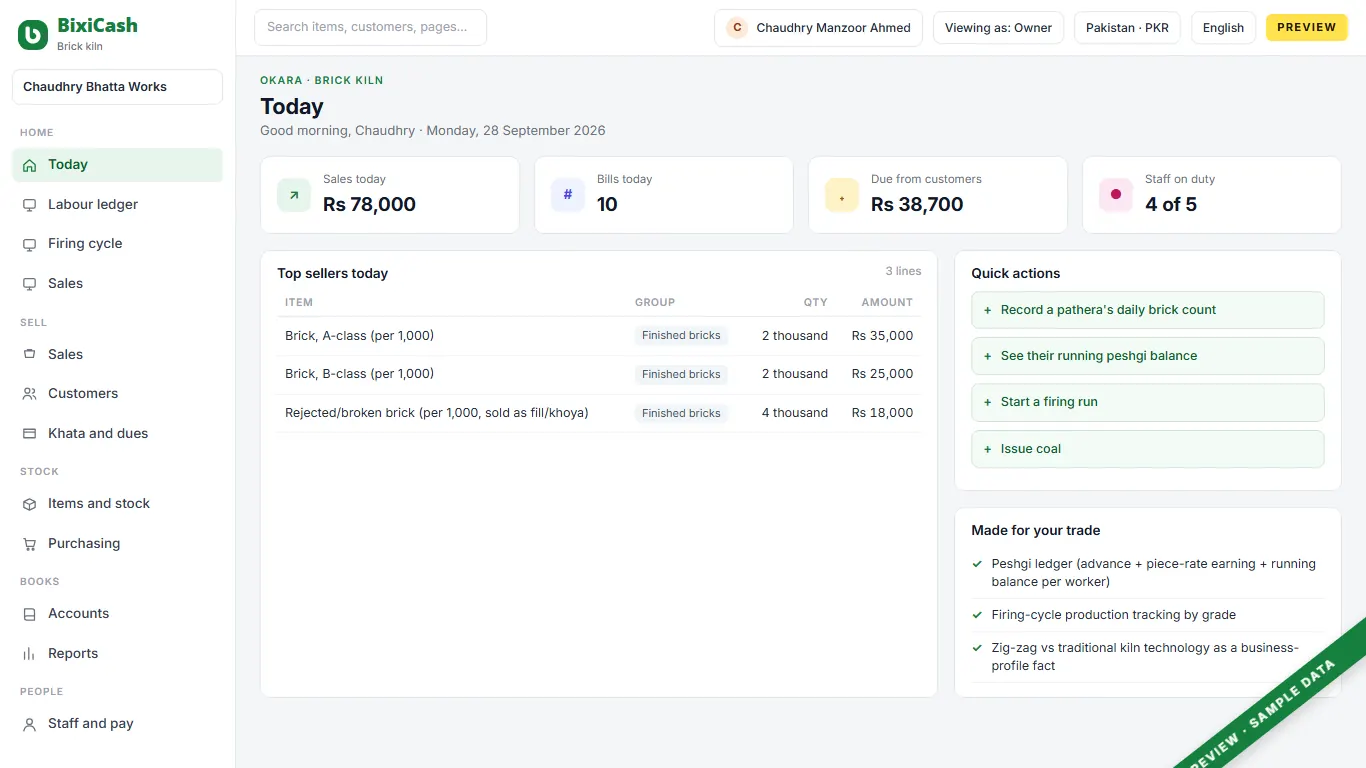
See every pathera's piece-rate earnings and peshgi balance in one place, and track a firing cycle from coal in to graded bricks out.
A working day
Morning
Patheras mold bricks for the day; the munshi records each worker's count against their piece-rate ledger.
Through the week
Molded bricks dry in the sun, weather allowing, then are stacked into the kiln.
Firing cycle
The fireman starts a firing cycle, issuing coal and tracking it over several days.
After cooling
Fired bricks are unstacked and graded A-class, B-class or reject.
Any day
A contractor or dealer collects bricks by grade, against an advance or a short khata.
Week end
The owner reviews every pathera's outstanding advance against their piece-rate earnings.
What goes wrong today
An advance given to a pathera and recovered from their piece-rate earnings is often tracked in an opaque, paper-based way.
Paying by the 1,000 bricks molded, then netting off an advance, is easy to get wrong without a running ledger.
Coal issued against bricks fired, and the grade mix that comes out, isn't usually tracked cycle by cycle.
Monsoon months bring molding and firing to a near-halt, and a calendar rarely reflects that.
What it does
Parts marked Coming soon are on the way; founding shops get them first, at no extra charge.
Planned: every pathera's advance, piece-rate earning and running balance in one auditable place, reusing the existing staff-advance and loan record.
Planned: coal issued and bricks fired, by grade, as one process-costed batch.
A contractor or dealer buys on account or against an advance; open invoices and ageing sit behind every balance.
Raise a purchase order for coal and receive it into stock, the same flow as any other supplier.
Planned: pay by the 1,000 bricks molded, net of any peshgi recovery, on top of the existing monthly payroll for staff.
Every advance, recovery and brick sale is a full double-entry journal entry, never a silent edit of a paper register.
Who uses it
Munshi (labour clerk)
To record each pathera's daily brick count and see their running peshgi balance.
Fireman / kiln in-charge
To start a firing cycle, issue coal, and record output by grade.
Dealer / sales officer
To take a builder or dealer's order and dispatch bricks by grade.
Owner
To see every peshgi balance outstanding and the cost of the last firing cycle.
Behind the counter
The screens for your trade sit on a full set of books. These parts come with it.
Double-entry books, statements, period close.
Cash, bank, cheques and reconciliation.
Orders, supplier bills and what you owe.
What you hold, where, and what it cost.
Quotations, orders, invoices, delivery notes.
One staff register, attendance, pay runs.
The numbers an owner asks for each morning.
On the counter
Bought together with the software: one delivery, one bill, set up to work.
The price
Introductory price. Local taxes are added where they apply. A second shop costs the same as the first. Prices for countries without their own page, in USD, as of 28 Sep 2026.
The first 50 shops in each country get free setup and data import with a yearly plan, and today's price locked for two years.
Claim a placeThis trade does not have its own price line yet. The price shown is our retail line, and we confirm it when we quote.
Straight answers
That's planned: an advance, a piece-rate earning and a running balance per worker, never silently written off.
Planned: pay by the 1,000 bricks molded, reusing the existing staff-advance and loan record rather than a new ledger type.
That's planned too: coal issued against bricks fired, by grade, as one costed batch.
Yes. A contractor or dealer's running balance is an ordinary khata, with open invoices, receipts and ageing behind it.
Planned: a small on-site relay hub is meant to keep selling through an internet outage; a kiln's own office is usually a single wired PC, so this matters less here than at a counter business.
Same aisle
Twenty minutes on a call. We show your day on the screen, with your words and your stock.