Morning
Batch scheduled
Production starts a batch against a formulation, issuing API and excipients with their own batch and expiry.

Coming soon Manufacturing & Process
Start a batch, watch raw materials with their own batch and expiry get consumed, and keep it blocked from sale until QC actually releases it.
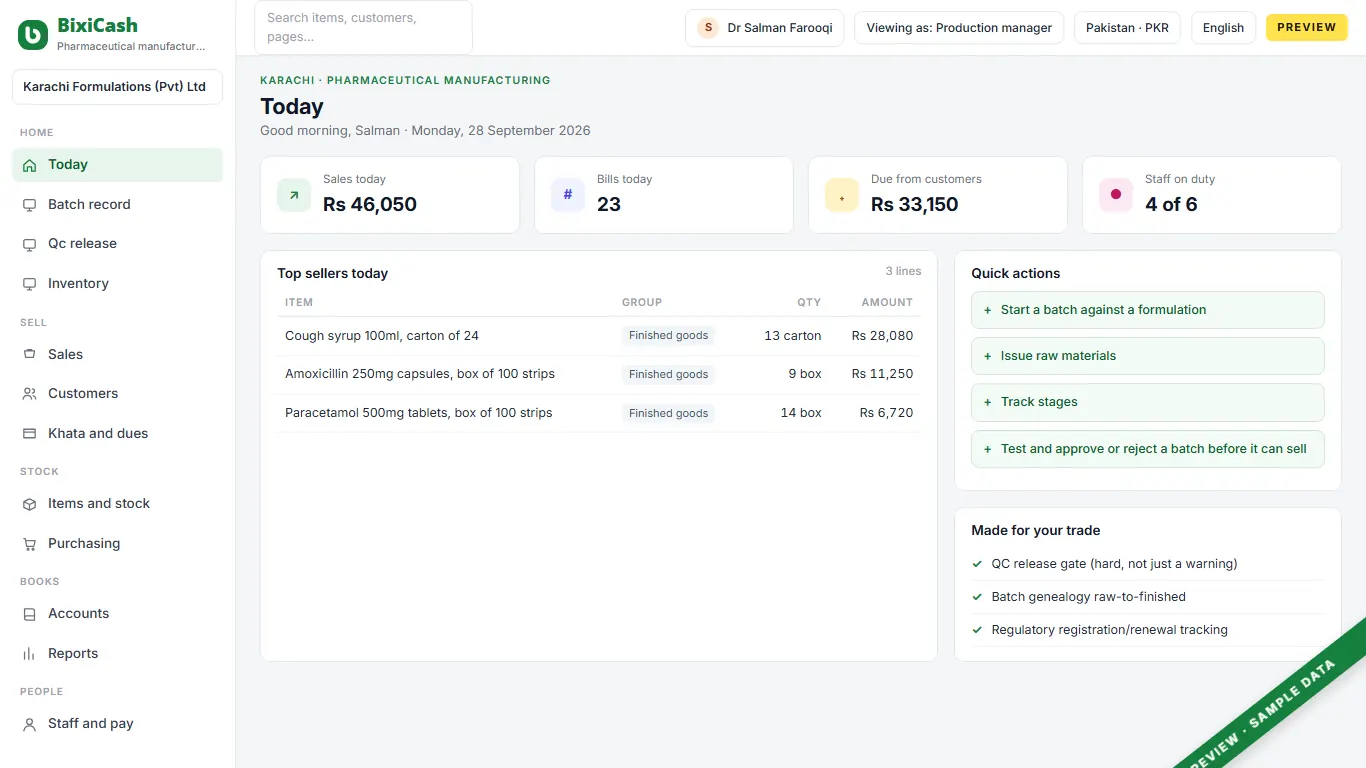
A working day
Morning
Production starts a batch against a formulation, issuing API and excipients with their own batch and expiry.
Midday
The batch moves through production, with in-process checks along the way.
Afternoon
Finished product is blistered, bottled or cartoned, ready for QC.
Late afternoon
QC tests the batch and releases it, or rejects and quarantines it. Nothing sells before this step.
Evening
Released stock is invoiced to a distributor on khata, or against a tender for an institutional buyer.
What goes wrong today
Without a hard gate, a batch can be sold before QC has actually signed it off.
Knowing which raw-material batches went into a specific finished batch is often guesswork.
A rejected batch needs to show as a written-off cost, not vanish from the books.
Product registration and renewal dates are easy to lose track of by hand.
What it does
Parts marked Coming soon are on the way; founding shops get them first, at no extra charge.
Our pharmacy, traders and retail demos pick the earliest-expiring batch automatically and block expired stock; the product has no batch/expiry engine yet, so this is a build target.
Distributors can buy against a running khata account; the accounts track open invoices, receipts and ageing behind the balance.
An API or excipient purchase order flows through to goods receipt and then a supplier bill.
Planned: a batch cannot post to sellable stock until QC explicitly approves it, a hard gate, not just a warning.
Planned: trace which raw-material batches went into a specific finished batch.
Planned: track a product's registration and renewal dates against a calendar.
Every receipt carries an FBR-style invoice number and QR code. The live FBR connection is coming soon.
Who uses it
Production manager
to schedule batches and oversee the manufacturing floor
QC / QA officer
to test and approve or reject a batch, and cannot release their own production run
Store keeper
API, excipient and finished-batch stock with expiry
Sales / distribution officer
distributor orders and ageing, without production cost detail
Behind the counter
The screens for your trade sit on a full set of books. These parts come with it.
Double-entry books, statements, period close.
Orders, supplier bills and what you owe.
What you hold, where, and what it cost.
Tax on every line, by your country's rules.
Machines and vehicles, and their wear.
On the counter
Bought together with the software: one delivery, one bill, set up to work.
The price
Introductory price. Local taxes are added where they apply. A second shop costs the same as the first. Prices for countries without their own page, in USD, as of 28 Sep 2026.
The first 50 shops in each country get free setup and data import with a yearly plan, and today's price locked for two years.
Claim a placeThis trade does not have its own price line yet. The price shown is our retail line, and we confirm it when we quote.
Straight answers
Planned as a hard gate: a batch cannot post to sellable stock until QC explicitly approves it.
Planned: batch genealogy from raw material to finished batch.
Shown in our pharmacy, traders and retail demos: the earliest-expiring batch is picked automatically and expired stock is blocked; the product has no batch/expiry engine yet, so this is a build target.
Planned. We have not independently verified DRAP's exact batch-record field list, so today's plan covers the shape of a batch record, not a guaranteed compliance checklist.
Planned: it posts to a write-off expense with a reason, instead of disappearing.
Same aisle
Twenty minutes on a call. We show your day on the screen, with your words and your stock.