Morning
Bulk lot selected
The owner picks a bulk lot and decides today's pack-out plan across tins and pouches.

Coming soon Manufacturing & Process
Take one bulk lot, split it into smaller packs, and see the cost, the waste and the use-by date carried through correctly.
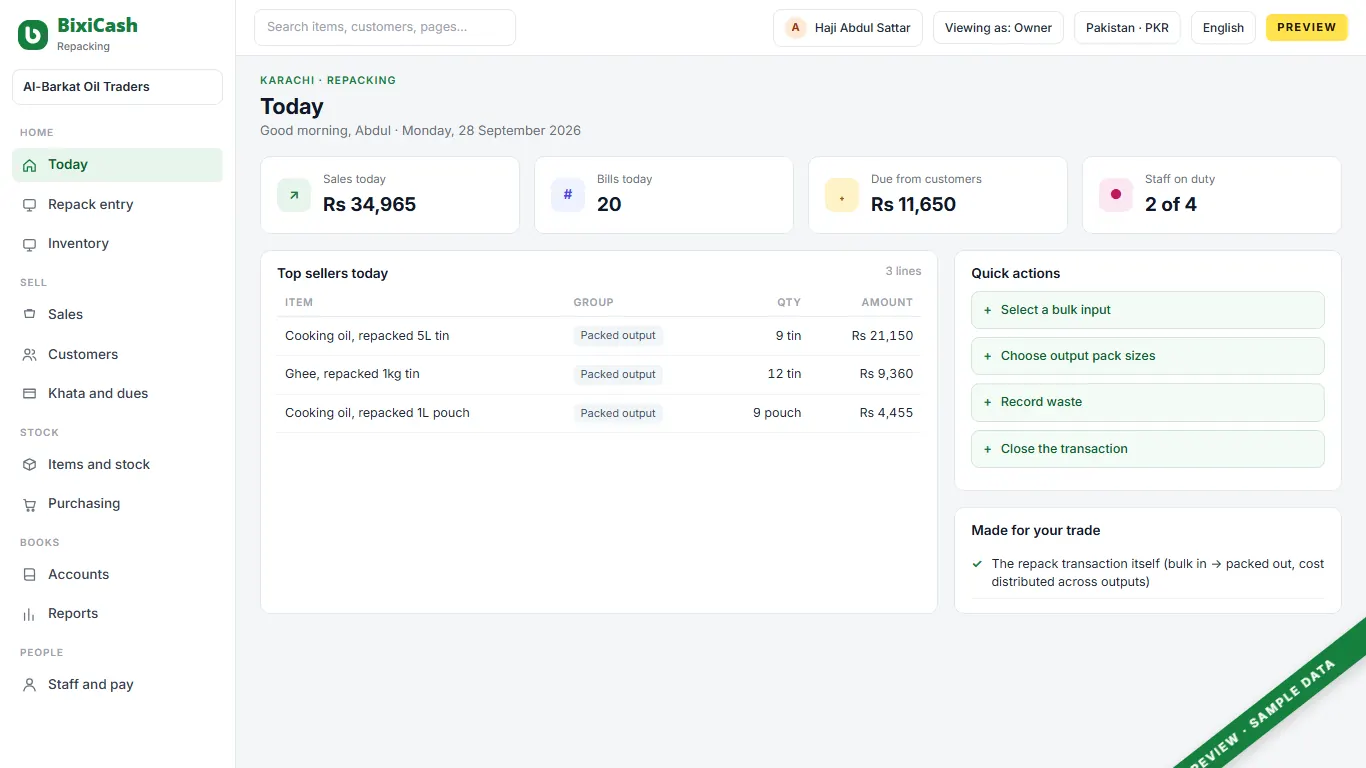
A working day
Morning
The owner picks a bulk lot and decides today's pack-out plan across tins and pouches.
Midday
The supervisor consumes the bulk input and packaging, and creates the smaller-pack outputs in one transaction, recording any spillage separately.
Afternoon
Packed output enters stock by SKU and size, with a pack date and use-by date where relevant.
Evening
The repacked units sell through the ordinary till or khata channel, with no special handling needed.
What goes wrong today
Dividing one bulk lot into different pack sizes makes it hard to know what each output really cost.
A repacking loss should show up as its own figure, not sit quietly inside the packed unit's cost.
A pack date or use-by date on the bulk lot needs to carry onto every smaller pack made from it.
Bulk input and packed-output stock are often tracked in two different registers instead of one.
What it does
Parts marked Coming soon are on the way; founding shops get them first, at no extra charge.
Buyers can purchase repacked stock against a running khata account; the accounts track open invoices, receipts and ageing behind the balance.
A bulk-input purchase order flows through to goods receipt and then a supplier bill.
Our demos sell in nested packs with a price per level; the product today handles one pack level per sale line, with no pack support yet on purchases or stock documents.
Our pharmacy, traders and retail demos pick the earliest-expiring batch automatically and block expired stock; the product has no batch and expiry tracking yet, so this is a build target.
Planned: one transaction consumes the bulk input and packaging and creates the packed outputs, with cost spread across them by volume, not split evenly.
Our demos show FBR-style invoice numbers and QR codes on a bill. The live FBR connection is coming soon.
Who uses it
Owner / trader
repack margin: input cost plus packaging and labour against sale value
Repack supervisor
to run the transformation and record input, output and waste
Store keeper
bulk stock and packed-output stock side by side
Behind the counter
The screens for your trade sit on a full set of books. These parts come with it.
Double-entry books, statements, period close.
Orders, supplier bills and what you owe.
What you hold, where, and what it cost.
Tax on every line, by your country's rules.
On the counter
Bought together with the software: one delivery, one bill, set up to work.
The price
Introductory price. Local taxes are added where they apply. A second shop costs the same as the first. Prices for countries without their own page, in USD, as of 28 Sep 2026.
The first 50 shops in each country get free setup and data import with a yearly plan, and today's price locked for two years.
Claim a placeThis trade does not have its own price line yet. The price shown is our retail line, and we confirm it when we quote.
Straight answers
Planned: one repack transaction creating a mix of output pack sizes from a single bulk input.
Planned: allocated by volume or weight, not split evenly across the outputs.
Planned: recorded as its own line, never absorbed into the packed cost.
Planned: the pack date and use-by date carry onto each output.
Shown in our demos: nested pack levels sell with one price per level, the same pack-level pricing a repacked pouch or tin would use.
Same aisle
Twenty minutes on a call. We show your day on the screen, with your words and your stock.