Any time, day or night in summer
A freezing cycle starts
Water and salt go into the tanks for a freezing cycle that runs for hours, not minutes.

Coming soon Manufacturing & Process
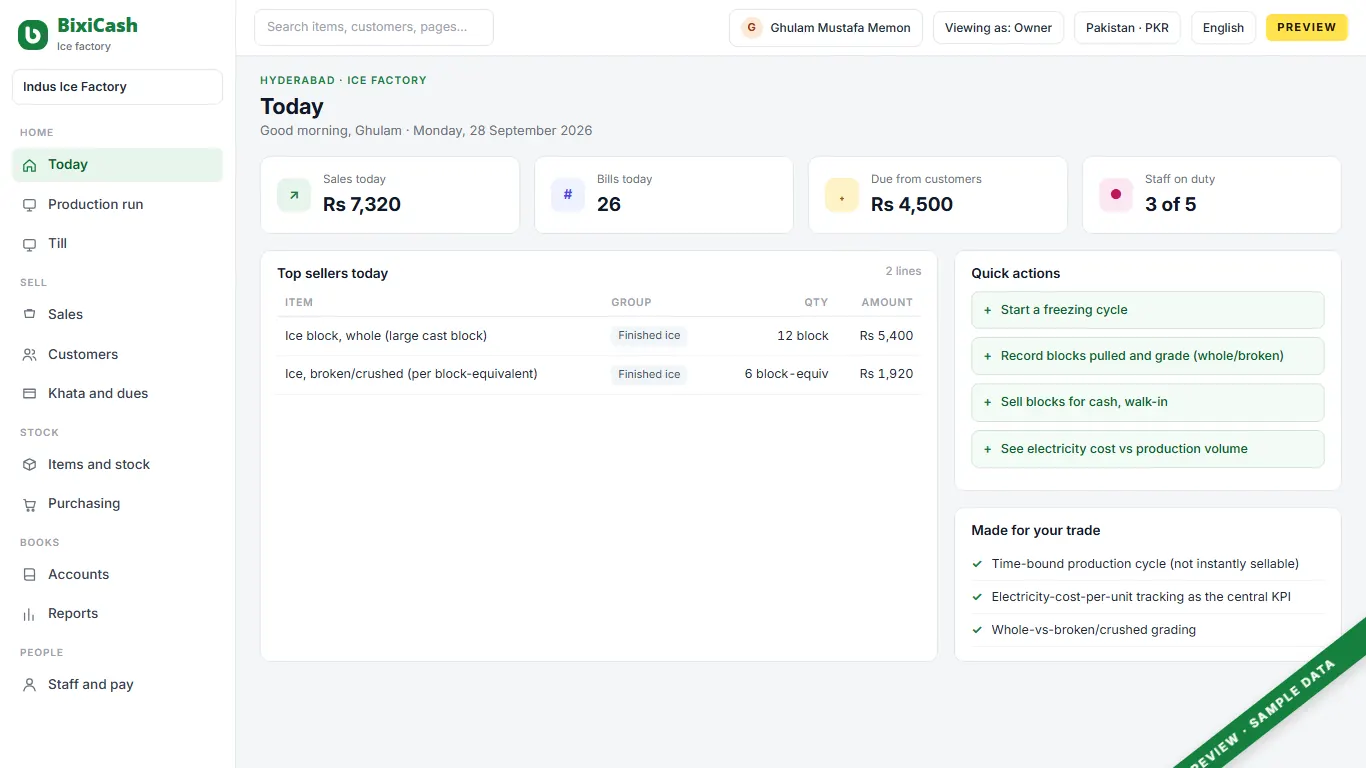
Track a freezing cycle from water in to graded ice out, and see electricity cost against how much you actually made.
A working day
Any time, day or night in summer
Water and salt go into the tanks for a freezing cycle that runs for hours, not minutes.
After the cycle
Blocks are pulled from the tanks and graded whole or broken; a cracked block still sells, at its own price.
All day
A walk-in buyer from the fish or produce market pays cash for a block or a broken quantity.
Month end
The owner compares the electricity bill against how many blocks the plant actually produced.
Season to season
Cycles run round the clock in summer and taper off through winter.
What goes wrong today
Electricity dominates this business's cost, but it's rarely compared against how much ice was actually produced.
Ice takes hours to freeze; treating it like an instant retail transaction hides how much is really in progress.
A block that cracks on de-molding still has value broken or crushed, but it's easy to write off instead of selling it at its own price.
Demand swings hard between an intense summer and a quiet winter, and planning capacity around that is mostly guesswork.
What it does
Parts marked Coming soon are on the way; founding shops get them first, at no extra charge.
A cycle in progress will become its own stock state, hours long, not an instant sale.
A cost-per-block figure will show, so a summer peak's efficiency and a winter month's are both visible.
A cracked block will sell at its own price, on its own stock line, instead of being written off.
Every sale prints a real receipt from the same accounting record, not a separate receipt table.
Every sale is a full double-entry journal entry, so an overwhelmingly cash business still has real, checkable books.
A cold-chain or export buyer can still be given a short account with open invoices and ageing, alongside the daily cash till.
Who uses it
Plant operator
To start a freezing cycle and record blocks pulled, whole or broken.
Sales / counter
To sell blocks for cash to a walk-in buyer, quickly.
Owner
To see electricity cost against production volume, and the whole-versus-broken sale mix.
Behind the counter
The screens for your trade sit on a full set of books. These parts come with it.
Double-entry books, statements, period close.
Cash, bank, cheques and reconciliation.
What you hold, where, and what it cost.
The numbers an owner asks for each morning.
On the counter
Bought together with the software: one delivery, one bill, set up to work.
The price
Introductory price. Local taxes are added where they apply. A second shop costs the same as the first. Prices for countries without their own page, in USD, as of 28 Sep 2026.
The first 50 shops in each country get free setup and data import with a yearly plan, and today's price locked for two years.
Claim a placeThis trade does not have its own price line yet. The price shown is our retail line, and we confirm it when we quote.
Straight answers
Not yet. It's planned: electricity cost compared against production volume, so a cost-per-block figure is visible.
Not yet. Whole and broken ice will be separate, sellable stock lines, each at its own price.
No, it's planned as its own stock state, since a cycle runs for hours before there's anything to sell.
Yes. A commercial account can be given its own open invoices and ageing, alongside a cash till for everyone else.
Not yet. A small on-site relay hub will keep a till selling through an internet outage, useful here, since this is a fast, walk-in, cash counter.
Same aisle
Twenty minutes on a call. We show your day on the screen, with your words and your stock.