Morning
A batch is mixed
Cement, sand and aggregate are issued against a recipe and mixed into blocks or pavers.

Coming soon Manufacturing & Process
Follow a batch of blocks or pavers from the mixer through curing to a depot, then out to a dealer on credit with a commission.
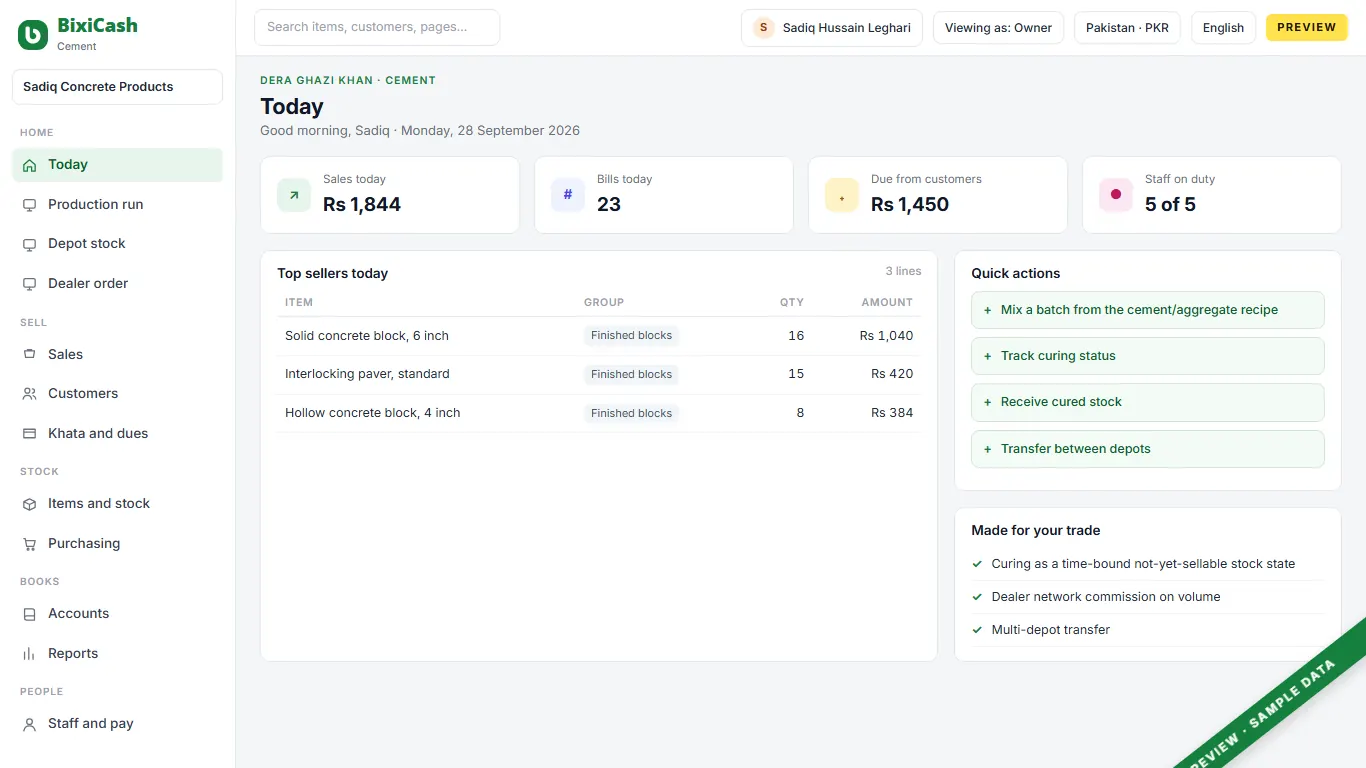
A working day
Morning
Cement, sand and aggregate are issued against a recipe and mixed into blocks or pavers.
Through the week
The batch sits in curing for several days, real stock, but not yet sellable.
Once cured
Cured stock moves from the plant to a depot, ready to sell.
Any day
A dealer places an order against their running khata balance and their agreed commission.
End of day
The owner looks at stock across every depot and which dealer balances are ageing.
What goes wrong today
A freshly mixed batch needs days to cure; without a clear stock state, it's easy to lose track of what is and isn't ready to sell.
Knowing what's actually sitting at each depot, and moving stock between them, is hard to keep straight by hand.
A dealer's commission on their running volume is usually calculated separately from the invoice it's tied to.
Cement prices shift, but a batch's costed recipe doesn't always keep up.
What it does
Parts marked Coming soon are on the way; founding shops get them first, at no extra charge.
Planned: a batch sits in a curing state that isn't sellable until it clears, so nothing ships before it's ready.
Planned: cement, sand and aggregate are issued against a recipe, and a batch's cost builds up from what actually went into it.
Stock is tracked by depot in the product; moving cured blocks from the plant to a depot is the same stock-transfer the product already does.
A dealer buys on account; open invoices, receipts and ageing sit behind every khata balance.
Raise a purchase order for cement or aggregate and receive it into stock, the same flow as any other supplier.
Planned: a dealer's commission is meant to calculate itself at the point of sale, against their agreed rate.
Who uses it
Production supervisor
To mix a batch from the recipe and see which batches are still curing.
Depot in-charge
To receive cured stock, move it between depots, and dispatch to a dealer.
Dealer / sales officer
To take a dealer's order and see their running commission.
Owner
To see stock across every depot and which dealer balances need chasing.
Behind the counter
The screens for your trade sit on a full set of books. These parts come with it.
Double-entry books, statements, period close.
Orders, supplier bills and what you owe.
What you hold, where, and what it cost.
Quotations, orders, invoices, delivery notes.
More than one shop, one set of books.
The numbers an owner asks for each morning.
On the counter
Bought together with the software: one delivery, one bill, set up to work.
The price
Introductory price. Local taxes are added where they apply. A second shop costs the same as the first. Prices for countries without their own page, in USD, as of 28 Sep 2026.
The first 50 shops in each country get free setup and data import with a yearly plan, and today's price locked for two years.
Claim a placeThis trade does not have its own price line yet. The price shown is our retail line, and we confirm it when we quote.
Straight answers
Planned: curing is meant to be its own stock state, not sellable until the cure period clears.
Yes. Stock is tracked by depot in the product; a single combined view across every depot is still being wired into our demos.
Not modelled yet. This research is built around a small concrete-block or paver plant; a large clinker-cement manufacturer would need its own study.
Not yet. It's planned: commission calculated automatically at the point of sale, against the dealer's agreed rate.
Planned: a small on-site relay hub is meant to keep a till selling through an internet outage; a block plant's own sales are mostly dealer orders from a back-office PC, so this matters less here than at a counter business.
Same aisle
Twenty minutes on a call. We show your day on the screen, with your words and your stock.