Morning
Style or order booked
A style pack or local order comes in. The merchandiser builds its bill of materials across the size-colour ratio and costs it.

Coming soon Manufacturing & Process
Cost a style's bill of materials across a size-colour ratio, track fabric use against the plan, and pay the stitching line correctly.
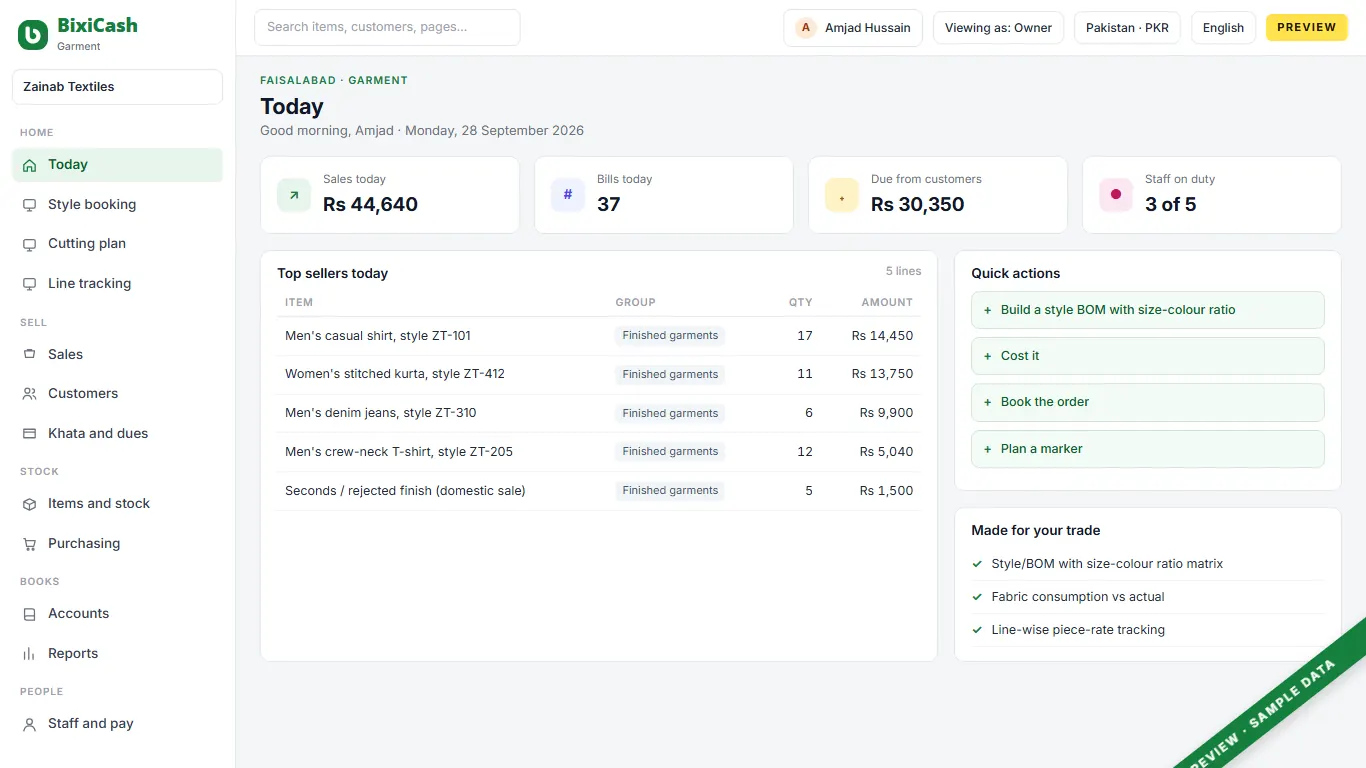
A working day
Morning
A style pack or local order comes in. The merchandiser builds its bill of materials across the size-colour ratio and costs it.
Midday
The cutting master plans a marker, issues fabric, and checks consumption against the plan.
Afternoon
The line stitches the order, with piece-rate output logged as it happens.
Late afternoon
QC inspects and packs the order by its size-colour ratio; a rejected piece is reworked or sold as seconds.
Evening
The order is invoiced on khata, or packed for export against a letter of credit.
What goes wrong today
Scaling a style across sizes and colours by hand makes the ratio easy to get wrong.
What the cutting table actually consumes rarely gets compared to what the marker planned.
Line workers' piece-rate earnings are often worked out on paper, separately from the books.
Export buyer audit documents are rarely kept alongside the order itself.
What it does
Parts marked Coming soon are on the way; founding shops get them first, at no extra charge.
Domestic buyers can order against a running khata account. The product tracks open invoices, receipts and ageing behind the balance.
A fabric or trims purchase order flows through to goods receipt and then a supplier bill.
A style's fabric and trims will scale automatically across a size-colour ratio, before the order is booked.
Actual fabric use will track against the cutting plan, the order's real margin driver.
The product already posts a pay period as one real, balanced accounting entry. A full pay run with piece-rate payslips is still being built.
A buyer's compliance and shipment documents will attach directly to the export order.
Every receipt carries an FBR-style invoice number and QR code. The live FBR connection is coming soon.
Who uses it
Owner / merchandiser
order margin, actual vs planned fabric use, and ageing
Cutting master
to plan a marker, issue fabric and see consumption vs plan
Line supervisor
to log line output by style and see piece-rate earnings build up
QC / finishing
to inspect and pack by size-colour ratio
Behind the counter
The screens for your trade sit on a full set of books. These parts come with it.
Double-entry books, statements, period close.
Orders, supplier bills and what you owe.
What you hold, where, and what it cost.
Tax on every line, by your country's rules.
One staff register, attendance, pay runs.
Machines and vehicles, and their wear.
On the counter
Bought together with the software: one delivery, one bill, set up to work.
The price
Introductory price. Local taxes are added where they apply. A second shop costs the same as the first. Prices for countries without their own page, in USD, as of 28 Sep 2026.
The first 50 shops in each country get free setup and data import with a yearly plan, and today's price locked for two years.
Claim a placeThis trade does not have its own price line yet. The price shown is our retail line, and we confirm it when we quote.
Straight answers
Not yet. Fabric and trims will scale to the ratio before the order is booked.
Not yet. Consumption vs the cutting plan will be visible per order.
The product already posts a pay period as one real, balanced accounting entry. Piece-rate payslips and a full pay run are still being built.
Not yet. The plan is for it to be reworked or sold as seconds, and never counted as export output.
Export sales are typically zero-rated; we are still confirming the documentation the tax engine should ask for before that is built in.
Same aisle
Twenty minutes on a call. We show your day on the screen, with your words and your stock.