Morning
Paddy arrives
A truck of paddy is weighed and graded at intake, and the load is recorded against the grower or the arhti who supplied it.

Coming soon Manufacturing & Process
Weigh and grade paddy at intake, then see what one milling run produces: head rice, broken rice, bran and husk, each on its own stock line. Keep a wholesaler's khata and an export buyer's account side by side.
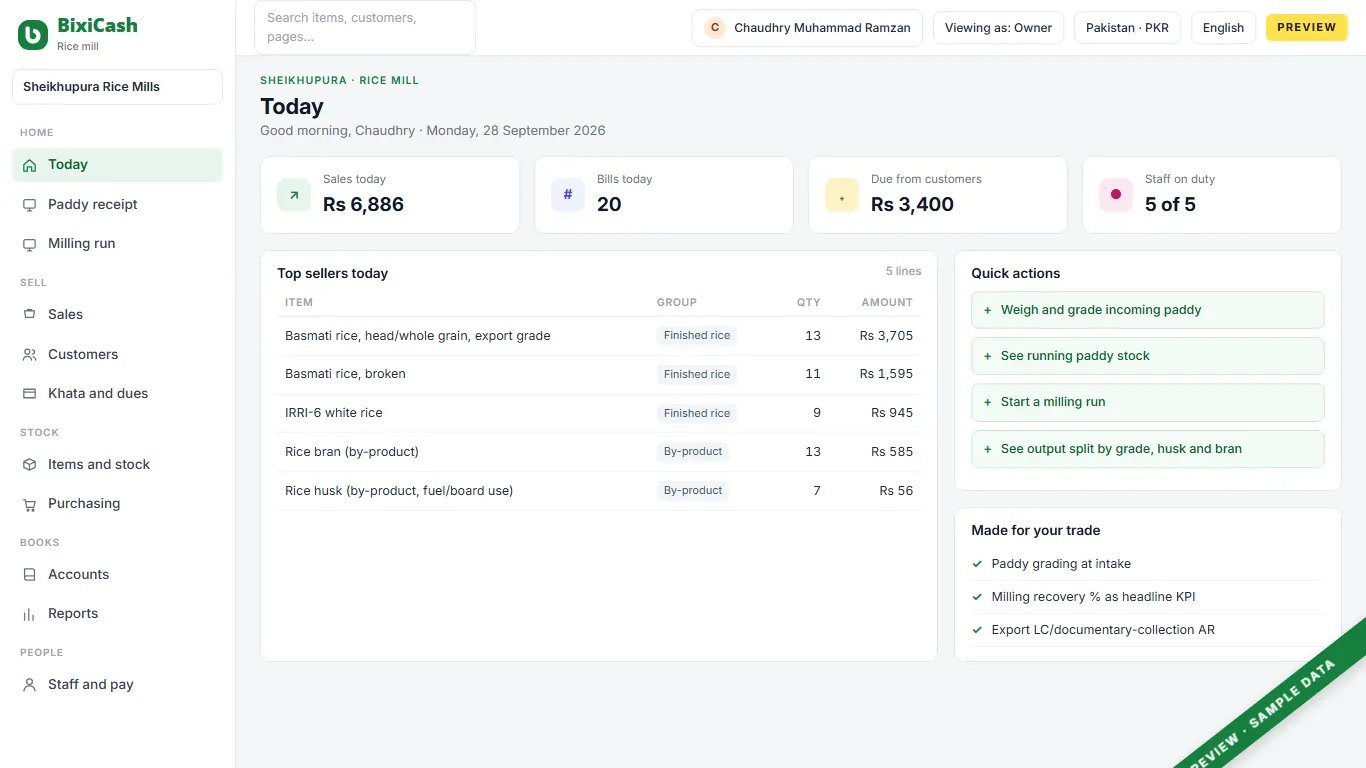
A working day
Morning
A truck of paddy is weighed and graded at intake, and the load is recorded against the grower or the arhti who supplied it.
Mid-morning
Paddy goes into the mill; head rice, broken rice, bran and husk come out, each landing on its own stock line.
Afternoon
The QC officer grades the milled rice before it is packed for a wholesaler or an export container.
Afternoon
Bags go out to a domestic wholesaler on khata or into a container for an export buyer on an LC.
End of day
The owner looks at how much rice this run recovered from the paddy that went in, against the usual range for this variety.
What goes wrong today
Working out how much rice a run recovered from its paddy usually means a manual calculation after the fact.
By-products are real, saleable stock, but they are easy to sell without a proper stock record behind them.
A domestic wholesaler on khata and an export buyer on an LC need to be tracked side by side, not in separate systems.
Most of the year's paddy is bought in a few months, often against an advance to the grower or arhti.
What it does
Parts marked Coming soon are on the way; founding shops get them first, at no extra charge.
Planned: paddy issued to a run comes back out as head rice, broken rice, bran and husk, each costed and put into its own stock line.
Planned: the milling recovery percentage is shown for every run and trended over time.
Planned: when one paddy input becomes several saleable outputs, their shared cost is split by relative sale value.
Sell to a domestic wholesaler on account; open invoices, receipts and ageing sit behind every khata balance.
Raise a purchase order for a paddy lot and receive it into stock, the same flow as any other supplier.
Shown in our demo: one price for a bag, another for loose weight.
A standard-rated wholesale sale and a zero-rated export sale come off the same rate table, with no country hard-coded.
Who uses it
Owner
To see this run's recovery percentage and the export order book at a glance.
Procurement / weighbridge officer
To weigh and grade incoming paddy quickly, without a paper register.
Mill operator
To start a milling run and record output by grade, including bran and husk.
Export / accounts officer
To invoice a wholesaler on khata or an export buyer against an LC, and keep both ageing.
Behind the counter
The screens for your trade sit on a full set of books. These parts come with it.
Double-entry books, statements, period close.
Orders, supplier bills and what you owe.
What you hold, where, and what it cost.
Quotations, orders, invoices, delivery notes.
Tax on every line, by your country's rules.
One staff register, attendance, pay runs.
The numbers an owner asks for each morning.
On the counter
Bought together with the software: one delivery, one bill, set up to work.
The price
Introductory price. Local taxes are added where they apply. A second shop costs the same as the first. Prices for countries without their own page, in USD, as of 28 Sep 2026.
The first 50 shops in each country get free setup and data import with a yearly plan, and today's price locked for two years.
Claim a placeThis trade does not have its own price line yet. The price shown is our retail line, and we confirm it when we quote.
Straight answers
Not yet. It is planned: a milling run will show the recovery percentage as soon as it closes, and trend it over time.
That is the plan: a milling run is designed to post rice, bran and husk each into its own stock line, so nothing is sold off the books.
Yes. Both sides use the same accounts-receivable engine; a wholesaler's khata and an export invoice against an LC are both open items, tracked and aged the same way.
Planned: a small on-site relay hub is meant to keep a till selling through an internet outage; a rice mill's own back office is mostly a single wired PC, so this matters less here than at a counter business.
Not fully. The plan is to split the shared cost by relative sale value, with a simpler physical-yield split as a fallback, but this has not been confirmed against real mill practice yet.
Same aisle
Twenty minutes on a call. We show your day on the screen, with your words and your stock.