Morning
A customer brings a brief
A customer describes or sketches the piece they want, a wardrobe, a bed, a dining set, with rough dimensions.

Coming soon Manufacturing & Process
Turn a customer's dimensions into a cut-list and a quote, take a deposit, then track the job through cutting, assembly and finishing to delivery.
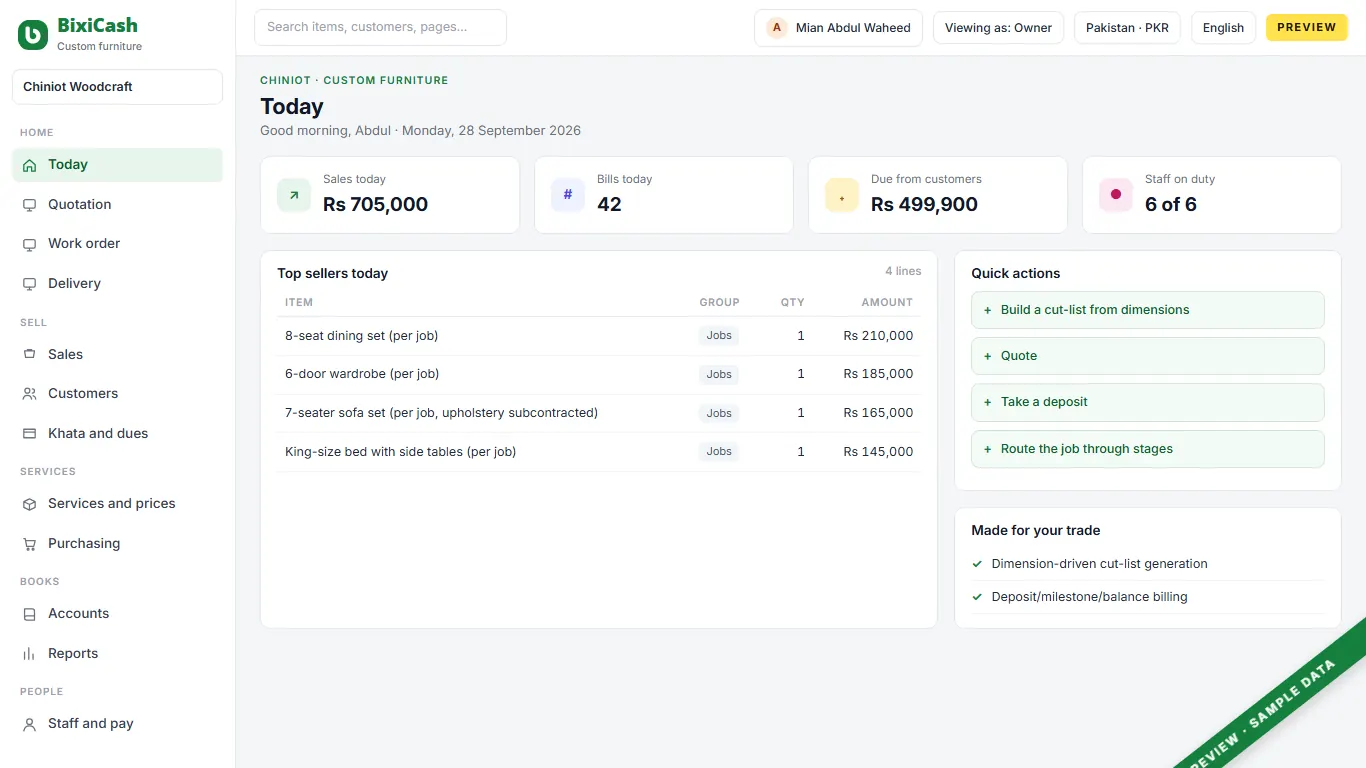
A working day
Morning
A customer describes or sketches the piece they want, a wardrobe, a bed, a dining set, with rough dimensions.
Morning
The owner works out a cut-list from the dimensions, quotes the job, and takes a deposit before cutting starts.
Through the week
The piece is routed through cutting, assembly and finishing, with a carpenter logging progress at each stage.
Delivery day
The installer delivers and fits the piece on site, then collects the balance payment.
End of job
The owner compares what the job actually cost in timber, hardware and labour against what it was quoted at.
What goes wrong today
Timber, hardware and labour for a custom piece are rarely compared against the original quote until the job is already delivered.
A custom job usually needs a deposit up front and a balance on delivery, tracked by hand against the same order.
When a customer changes a dimension or a finish mid-job, the original quote is easy to lose track of.
Timber prices shift, but a quoted job doesn't automatically reflect what timber actually cost by the time it's cut.
What it does
Parts marked Coming soon are on the way; founding shops get them first, at no extra charge.
Enter a piece's dimensions, and the timber and board sizes a job needs will generate before it's quoted.
Material and labour will track as a job moves through cutting, assembly and finishing, so the final cost can be compared to the quote.
A job's deposit and its balance on delivery are both recorded against the same order, alongside any B2B customer's khata.
Raise a purchase order for timber or hardware and receive it into stock, the same flow as any other supplier.
A click-to-chat button pre-fills a delivery update or a balance-due reminder; a person presses send.
A mid-job change will keep the original quote's trail, instead of overwriting it.
Who uses it
Owner / designer
To quote a job accurately from a customer's dimensions and see its real margin once it ships.
Workshop supervisor
To route a job through cutting, assembly and finishing without losing track of it.
Installer
To confirm delivery and collect the balance payment on site.
Accountant
To track each job's deposit and balance, and any supplier bill for timber or hardware.
Behind the counter
The screens for your trade sit on a full set of books. These parts come with it.
Double-entry books, statements, period close.
Orders, supplier bills and what you owe.
What you hold, where, and what it cost.
Quotations, orders, invoices, delivery notes.
One staff register, attendance, pay runs.
Machines and vehicles, and their wear.
The numbers an owner asks for each morning.
On the counter
Bought together with the software: one delivery, one bill, set up to work.
The price
Introductory price. Local taxes are added where they apply. A second shop costs the same as the first. Prices for countries without their own page, in USD, as of 28 Sep 2026.
The first 50 shops in each country get free setup and data import with a yearly plan, and today's price locked for two years.
Claim a placeThis trade does not have its own price line yet. The price shown is our retail line, and we confirm it when we quote.
Straight answers
Not yet. It's planned: enter length, width and height and get the timber and board sizes the job needs.
Yes. A deposit and a balance are both recorded against the same order, the same advance-payment record the product already keeps for other sales.
That's planned: comparing a job's real material and labour cost to what it was quoted is on the roadmap, not built yet.
Yes, a WhatsApp click-to-chat button pre-fills the message; someone on your team still presses send.
Not yet. A small on-site relay hub will keep selling through an internet outage; most of a workshop's own work is a single back-office PC, so this matters less here than at a counter business.
Same aisle
Twenty minutes on a call. We show your day on the screen, with your words and your stock.