Morning
A buyer's spec comes in
A buyer gives a box size, ply and print. Sales runs the box-size calculator to work out the sheet size and board needed, then quotes it.

Coming soon Manufacturing & Process
Quote a buyer's box spec, run it through the corrugator, and see the finished carton's real cost, waste and dealer credit in one place.
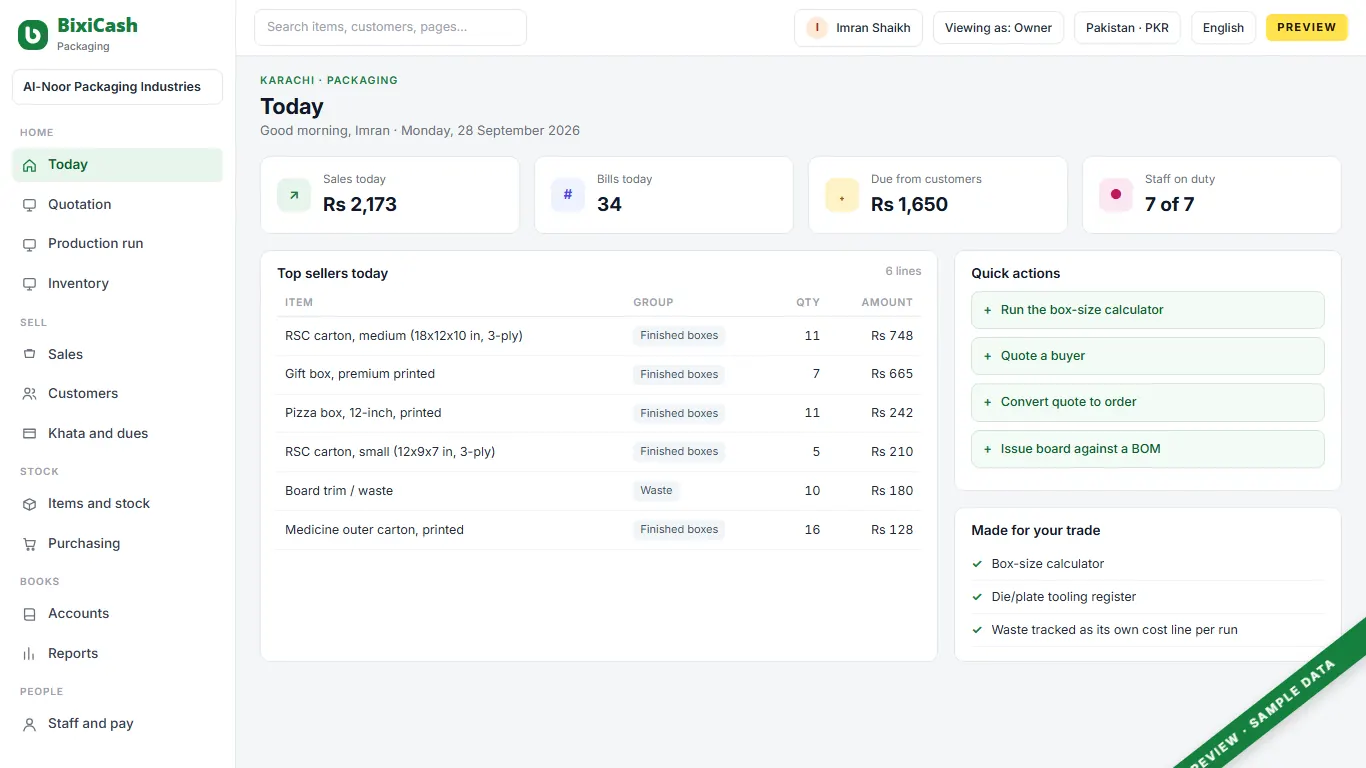
A working day
Morning
A buyer gives a box size, ply and print. Sales runs the box-size calculator to work out the sheet size and board needed, then quotes it.
Late morning
The buyer confirms, and the order moves to the production planner as a running order or a one-off job.
Midday
The planner issues board to the corrugator and die-cutter. The operator runs the job and records the output and the waste.
Afternoon
Finished cartons come into stock counted by the piece or by the bundle, with the run's waste shown as its own figure, never folded into the cost.
Evening
Boxes go out on a delivery note and an invoice against the buyer's running khata account.
What goes wrong today
Board trims and rejects can run 5 to 10% of what goes in, and it is easy for that to vanish into the box's cost instead of showing up on its own.
A die or plate is a real asset with real wear, but it rarely gets tracked as one.
Buyers work on 30 to 60 day running orders, and ageing is easy to lose track of by hand.
Working out a sheet size from a box's dimensions by hand is slow and easy to get wrong.
What it does
Parts marked Coming soon are on the way; founding shops get them first, at no extra charge.
Buyers can order against a running khata account; the accounts track open invoices, receipts and ageing behind the balance.
A board or paper purchase order flows through to goods receipt and then a supplier bill.
Our traders demo already turns a quotation into a confirmed order and then an invoice; the same chain applies to a buyer's running box order.
Planned: enter a box's length, width, height and ply, and get back the sheet size and board quantity a die-maker would accept, before the order is confirmed.
Planned: issue board against a bill of materials, close the run, and post finished boxes into stock at their built-up cost, with waste shown as its own line, never folded in.
Planned: track a die or print plate as its own asset, and spread its cost over the runs it prints.
Every receipt carries an FBR-style invoice number and QR code. The live FBR connection is coming soon.
Who uses it
Owner / GM
conversion margin, board yield and waste, and which dealers are overdue
Sales / order desk
a fast, accurate sheet size before quoting a buyer
Production planner
to issue board against a job and see wastage as it happens, not at month-end
Store keeper
board, die and plate stock that matches what is really on the floor
Behind the counter
The screens for your trade sit on a full set of books. These parts come with it.
Double-entry books, statements, period close.
Orders, supplier bills and what you owe.
What you hold, where, and what it cost.
Quotations, orders, invoices, delivery notes.
Tax on every line, by your country's rules.
Machines and vehicles, and their wear.
On the counter
Bought together with the software: one delivery, one bill, set up to work.
The price
Introductory price. Local taxes are added where they apply. A second shop costs the same as the first. Prices for countries without their own page, in USD, as of 28 Sep 2026.
The first 50 shops in each country get free setup and data import with a yearly plan, and today's price locked for two years.
Claim a placeThis trade does not have its own price line yet. The price shown is our retail line, and we confirm it when we quote.
Straight answers
Planned: a die/plate register with a cost that spreads across the runs it prints.
Planned: waste is recorded as its own line on every production run, never folded into the box's cost.
Yes: khata credit and ageing is already core to the product; the box-size calculator and the production run around it are still being built.
Not yet. It is planned; today it is a design, not a working screen.
That is still an open question we are checking; today the tax engine applies standard sales tax to what you sell, and we will confirm the scrap-sale treatment before launch.
Same aisle
Twenty minutes on a call. We show your day on the screen, with your words and your stock.