Morning
Check the recipe cost
The formulator checks a feed type's current cost per bag against today's raw-material prices.

Coming soon Manufacturing & Process
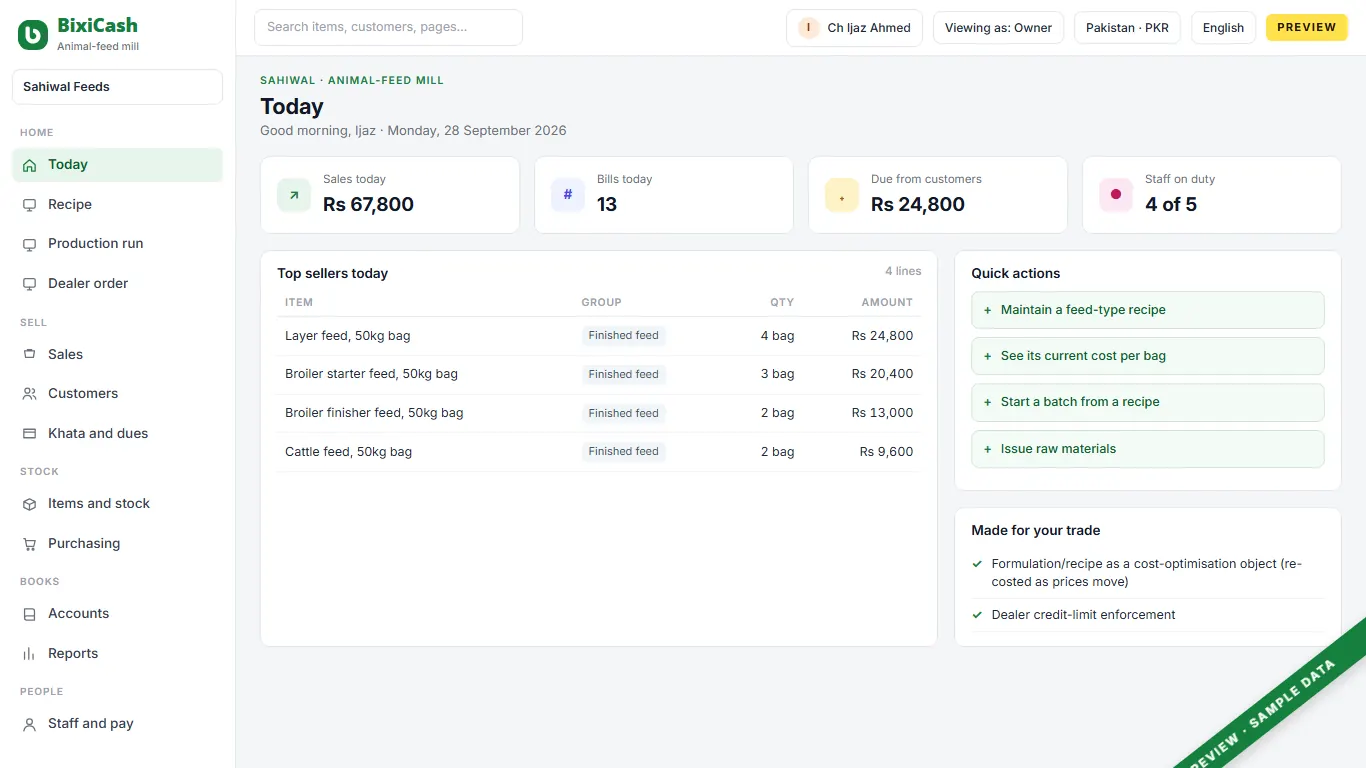
See a feed recipe's cost per bag update as a raw-material price changes, then run a batch from that recipe and dispatch it to a dealer on credit.
A working day
Morning
The formulator checks a feed type's current cost per bag against today's raw-material prices.
Morning
Maize, soybean meal, bran and premix are issued at the recipe's proportions, mixed, and bagged.
Any time
A dealer's order is checked against their credit limit before it's dispatched.
Weekly
Maize, soybean meal and premix are bought in, some of it import-linked.
Month end
The owner reviews cost per bag by feed type and which dealers are close to their credit limit.
What goes wrong today
Raw-material prices move, especially an imported one like soybean meal, but a recipe's costed price doesn't always keep up.
Without a check at the point of order, a dealer can keep buying past what they're meant to owe.
Knowing what a bag of a given feed type actually costs to make, right now, usually means a spreadsheet.
What it does
Parts marked Coming soon are on the way; founding shops get them first, at no extra charge.
A feed recipe's cost per bag will recalculate as a raw-material price changes, so a formulator sees the effect before running a batch.
Raw materials will issue to a production batch at the proportions the recipe sets, and bagged output will post in at the computed cost.
A dealer's order is checked against their credit limit before it's dispatched, the same check the till already uses at the counter.
Raise a purchase order for maize, soybean meal or premix and receive it into stock, the same flow as any other supplier.
Shown in our demo: one price per bag, the standard pack this trade sells in.
The tax engine works from a rate table entered per tenant, with no country or rate hard-coded.
Who uses it
Nutritionist / formulator
To maintain a feed recipe and see its current cost per bag.
Production supervisor
To start a batch from a recipe, issue raw materials, and bag the output.
Dealer / sales officer
To take a dealer's order within their credit limit.
Owner
To see cost per bag by feed type and how dealer credit is being used.
Behind the counter
The screens for your trade sit on a full set of books. These parts come with it.
Double-entry books, statements, period close.
Orders, supplier bills and what you owe.
What you hold, where, and what it cost.
Quotations, orders, invoices, delivery notes.
Tax on every line, by your country's rules.
The numbers an owner asks for each morning.
On the counter
Bought together with the software: one delivery, one bill, set up to work.
The price
Introductory price. Local taxes are added where they apply. A second shop costs the same as the first. Prices for countries without their own page, in USD, as of 28 Sep 2026.
The first 50 shops in each country get free setup and data import with a yearly plan, and today's price locked for two years.
Claim a placeThis trade does not have its own price line yet. The price shown is our retail line, and we confirm it when we quote.
Straight answers
Not yet. It's planned: a recipe's cost per bag will update as a raw-material price moves.
Not yet. The plan is to apply the same credit check the till already uses at a counter to a dealer's order.
No, a feed batch has a single output, the bagged feed, so there is no by-product split to model here.
Planned, alongside the recipe re-costing work above.
Not yet. A small on-site relay hub will keep selling through an internet outage; a feed mill's own office is usually a single wired PC, so this matters less here than at a counter business.
Same aisle
Twenty minutes on a call. We show your day on the screen, with your words and your stock.